Key Takeaways: We rank in answer engines by placing direct answers first, written in simple language that AI systems can quote without editing. We rely on structured content, question-based headings, and schema markup to improve AI parsing and retrieval accuracy. We strengthen visibility by building topical authority, freshness signals, and trusted citations across connected content clusters.
Ranking in answer engines starts with giving AI a clean, direct answer it can trust and reuse without extra work. Instead of just chasing clicks, we structure every page so large language models can quickly find clear answers, understand context, and see why our content is credible. That means simple wording, tight formatting, and signals that match how answer engines actually retrieve information today. We use this same method every day inside GeekyExpert workflows, testing what AI systems pick up and what they ignore, so keep reading to see the exact process and how you can apply it.
Answer Engine Optimization focuses on structuring content so AI systems extract and cite clear answers rather than ranking pages, prioritizing concise formats and strong entity clarity across topics, which reflects how answer engine optimization shifts visibility from links to reusable answers.
Answer Engine Optimization shifts our focus from links to answers. Instead of optimizing only for blue links, we optimize for AI systems that summarize information directly. These systems pull short, confident answers from reliable sources.
Industry data from 2024 shows that over 40% of informational searches now trigger AI generated answers. This shift aligns with the rise of systems connected to ChatGPT style retrieval models and similar technologies.
At GeekyExpert, we design content to be reused as standalone explanations. Each section answers one question clearly. Each answer stands on its own without needing surrounding context.
This paragraph prepares readers for the practical elements listed below by explaining why structured answers matter for AI retrieval accuracy today.
AEO focuses on answers instead of clicks
Clear structure helps AI reuse content safely
Entity clarity improves citation confidence
How should content be structured to rank in answer engines?
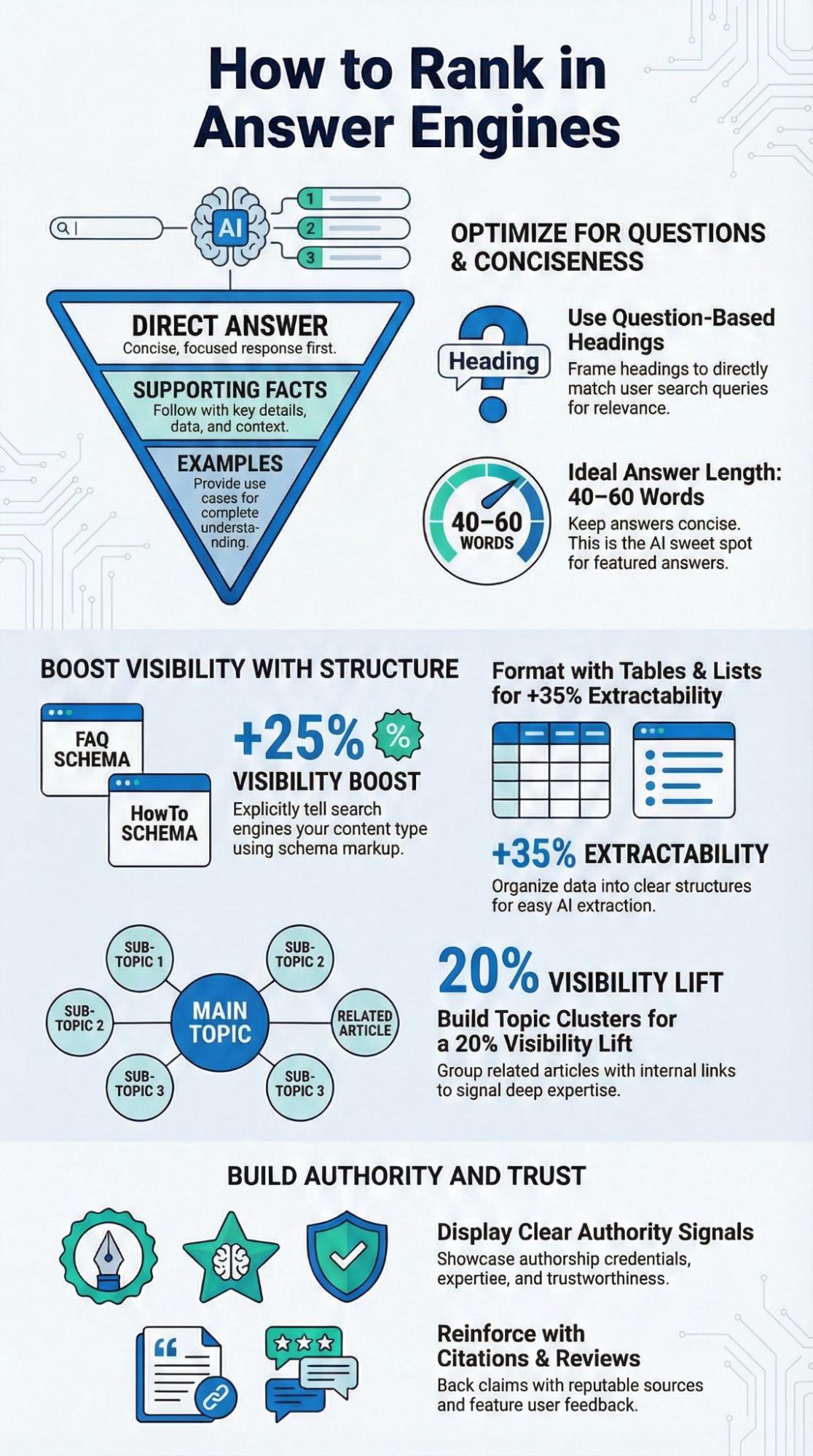
We structure content using an inverted pyramid: the direct answer comes first, then supporting facts, then examples and context at the end. This makes it easy for AI systems to lift a clean answer from the top of the page without needing to scan the whole article.
This approach aligns with guidance from HubSpot, which emphasizes answer-first writing for AI visibility. As they explain:
"Lead with natural language, Write headings and subheadings that match how people (and engines) look for information: questions, definitions, comparisons, and instructions. Answer directly, Put your core answer in the first 40–60 words before adding detail." — HubSpot [1]
Answer engines often focus on the first 100 words, so the key explanation, not a teaser, needs to live there. Platforms similar to Perplexity reward pages that deliver a full, self-contained answer early, even if the rest of the content is skipped.
To keep this consistent, every major section follows the same pattern: a clear one-paragraph answer, followed by simple explanations, then optional examples or edge cases that do not change the core meaning.
Practical pattern to follow
Place the answer in the first paragraph
Expand with facts and simple explanations
Add examples without changing the core meaning
Why do question-based headings improve answer engine visibility?
Laptop at night showing content optimization work demonstrating how to rank in answer engines for AI-powered search results
Question-based headings improve answer engine visibility because they mirror the exact way users phrase natural language queries, making it easier for AI systems to map prompts to precise answers with higher confidence.
This method matches passage-level optimization guidance from Search Engine Land, which highlights how individual sections are evaluated by AI systems:
"Treat every H2/H3 as a self-contained answer that can be ripped out of context. Include the full claim, the qualifiers, and the proof in that one passage. Avoid forcing the reader (or model) to scroll around the page to rebuild the logic." — Search Engine Land [2]
AI systems are trained heavily on question–answer patterns, so aligning headings with how people actually ask questions improves matching quality. Voice and conversational searches now account for a large share of queries, often using 5W1H formats.
To support this, we write each heading as a full question and attach just one core answer to it. This reduces ambiguity in retrieval, keeps each block of content focused, and makes it easier for AI to quote or reuse the response as-is.
How question-based headings help
Questions mirror real search prompts
One question equals one clear answer
Simple wording improves reuse
How long should direct answers be for AI citation?
Infographic guide on how to rank in answer engines with structure, schema markup, topic clusters, and authority signals
Direct answers perform best for AI citation when they stay between 40 and 60 words, long enough to be complete but short enough to be quoted without trimming, which reflects an AEO optimization strategy built around extractable, self-contained answers. At this length, language models can lift the answer as a single unit and reuse it accurately in generated responses.
Very short answers often lack context and force AI systems to add their own framing, which can change the meaning. Very long answers get cut, mixed, or summarized, which increases the chance of distortion. Research guidance from teams connected to OpenAI has pointed to compact, focused explanations as the most reliable for consistent citation.
To keep answers stable, we edit each one so it can stand alone. If an answer is copied into another system or interface, it should still be clear, correct, and self-contained without needing the rest of the page.
Editing rules for answer length
Keep answers under one short paragraph
Remove filler words and repetition
Focus on one idea only
How do answer engines differ from traditional search engines?
Printed documents on desk displaying structured content strategies for how to rank in answer engines with clear formatting
Answer engines generate summarized responses instead of ranking links, rewarding clarity and structure over backlink volume and traditional ranking signals, a pattern closely aligned with generative engine optimization, where inclusion matters more than position. Traditional search engines list pages. Answer engines respond with synthesized text.
In 2024, AI overview style answers expanded globally, reaching over 100 countries according to public rollout updates tied to Google AI Overviews. This confirms that generated answers are no longer experimental.
We adjust by removing unnecessary introductions and placing facts first. The goal is to help AI systems select our content as a trusted source for a specific question. The comparison below clarifies how these systems evaluate content differently in practice.
Element
Traditional Search
Answer Engines
Output
Ranked links
Generated answers
Priority
Authority and links
Clarity and structure
Content use
Full page
Extracted segments
This paragraph introduces the list by summarizing how these differences influence daily content decisions we make.
Traditional search rewards exploration
Answer engines reward precision
Structure replaces link dominance
What role does schema markup play in ranking for answer engines?
Schema markup helps answer engines understand what your content is about by clearly labeling intent, structure, and relationships, so AI systems can spot definitions, questions, and step-by-step instructions with higher confidence.
Video: Schema and answer engines
Credits: Neil Patel
In practice, schema works like a machine-readable guide layered on top of your page. The Schema.org vocabulary provides shared types for entities, actions, and sections, and it can be implemented in formats like JSON-LD, RDFa, or Microdata.
According to Schema.org, tens of millions of domains now use this markup, and major platforms such as Google, Microsoft, and others use it to power rich, structured experiences.
For answer-focused pages, we lean on FAQPage and HowTo schema when the content is built around questions and procedures. This keeps what users see and what machines read aligned, which reduces ambiguity during parsing and increases the odds that AI systems select the right block of content for citation or rich results.
How schema markup supports answer engines
FAQ schema labels questions clearly
HowTo schema defines steps precisely
Consistency improves extraction accuracy
How to Rank in Answer Engines: Conclusion and Next Steps
How to Rank in Answer Engines: Conclusion and Next Steps
The key is discipline. Clear answers, simple language, and a repeatable structure the AI can trust. You build content around direct responses, strong schema, and consistent authority signals. That gives answer engines fewer reasons to guess and every reason to cite you. It's a practical system.
This isn't just theory. It's the exact approach a platform like GeekyExpert applies. Their system is built to ship question-based content and direct-answer pages at scale, engineered specifically for AI extraction. If you want a practical model to implement this, that's the methodology.
How does answer engine optimization help content rank in answer engines?
Answer engine optimization helps content rank by making answers easy to extract and understand. It focuses on natural language queries, question-based content, and clear upfront answers. When content demonstrates topical authority, strong entity relationships, and clear experience and expertise signals, answer engines can confidently surface it as zero-click answers or direct response results.
What content structure improves AI search ranking for conversational search?
Conversational search performs best with a clear, predictable structure. The inverted pyramid structure places the direct answer first, followed by supporting details. Using bullet point lists, numbered steps, and comparison tables improves readability. Long-tail questions and 5W1H queries align content with real user intent and improve eligibility for featured snippets.
How do schema markup and structured data support answer engine visibility?
Schema markup helps answer engines understand exactly what a page is about. FAQ schema, HowTo schema, and Q&A structured data label questions and answers clearly. This reduces interpretation errors. When combined with proper indexation, clean internal linking, and crawlable page architecture, structured data increases visibility in direct answer boxes.
Why is topical authority important for ranking in answer engines?
Topical authority shows that a site covers a subject thoroughly and accurately. It is built through topic clusters, content silos, and strong internal linking. Supporting content with expert quotes, original research, and first-party data strengthens experience and expertise signals. Answer engines rely on this depth to choose reliable sources.
How do freshness and user intent affect zero-click answer performance?
Zero-click answers favor content that is both current and intent-matched. Regular content updates signal freshness and relevance. Clear alignment with user intent ensures the answer directly solves the query. When content delivers accurate information immediately, without unnecessary detail, answer engines are more likely to surface it directly.
About Geeky Expert
Geeky Expert is a leading provider of research and insights, dedicated to helping businesses make informed decisions through comprehensive analysis.