
Best AI Agent Platforms for Business (2026)
What is the best AI agent platform for business in 2026?
Microsoft Copilot Studio is the best overall AI agent platform for business in 2026 (GeekyExpert score: 9.4/10). It combines consumption-based pricing at $200/month for 25,000 credits, deep Microsoft 365 integration, and enterprise-grade governance with the broadest ecosystem reach for organizations already invested in the Microsoft stack. For CRM-driven teams, Salesforce Agentforce (9.2/10) leads with native customer data unification and omnichannel agent deployment.
Best for your situation
- ›Best for CRM & Sales Teams: Salesforce Agentforce — native customer data unification with omnichannel deployment
- ›Best for Multi-Cloud AI: Google Vertex AI Agent Builder — 200+ foundation models with pay-as-you-go infrastructure
- ›Best for Developers: CrewAI — Python-native multi-agent orchestration with role-based agent design
- ›Best for No-Code Teams: Relevance AI — visual multi-agent builder with unlimited agents on every plan
AI AGENT PLATFORM PRICING COMPARISON (2026)
| Platform | Pricing Model | Key Capability | Best For |
|---|---|---|---|
| Microsoft Copilot Studio | $200/mo (25K credits) or $0.01/credit via Azure | Microsoft 365 native agents + Copilot integration | Microsoft-centric enterprises |
| Salesforce Agentforce | $2/conversation or Flex Credits ($500/100K) | CRM-native agents with omnichannel deployment | Sales & service teams |
| Google Vertex AI Agent Builder | Pay-as-you-go ($0.0864/vCPU-hr + model costs) | 200+ models, Agent Engine, ADK, Agent Studio | Multi-cloud AI infrastructure |
| CrewAI | Free (50 exec/mo), Pro $25/mo, Enterprise custom | Python multi-agent framework with role-based design | Developer teams |
| LangGraph / LangChain | OSS free; LangSmith Plus $39/seat/mo | Graph-based stateful agent orchestration | Custom agent architectures |
| ServiceNow AI Agents | $10K+/yr (quote-based), $50–$100+/user/mo add-ons | ITSM-native agents with workflow fabric | IT service management |
| Relevance AI | Free (200 actions/mo), Team $349/mo, Enterprise custom | No-code multi-agent workforce orchestration | No-code multi-agent teams |
AI AGENT MARKET STATISTICS (2026)
| Metric | Figure | Source |
|---|---|---|
| Global AI agents market (2026) | $10.9 billion | Grand View Research, 2026 |
| Projected market size (2030) | $52.62 billion | MarketsandMarkets, 2026 |
| CAGR (2026–2030) | 46.3% | MarketsandMarkets, 2026 |
| YoY market growth (2025 → 2026) | 43% | Grand View Research, 2026 |
| Enterprises with production AI agents | 80% (at least one) | Gartner CIO Survey, 2026 |
| Organizations deployed AI agents | 17% (60%+ plan within 2 years) | Gartner, 2026 |
| Apps embedding AI agents (Q1 2026) | 80% (up from 33% in 2024) | Gartner, 2026 |
| Enterprise spending growth (YoY) | 3x increase in one year | Industry analysis, 2026 |
AI AGENT PLATFORM DECISION FRAMEWORK
| Your Situation | Best Fit | |
|---|---|---|
| Microsoft 365 enterprise, need agents in Teams/Outlook/SharePoint | → | Microsoft Copilot Studio |
| Salesforce CRM stack, customer-facing agents | → | Salesforce Agentforce |
| Multi-cloud, need access to 200+ foundation models | → | Google Vertex AI Agent Builder |
| Python dev team, rapid multi-agent prototyping | → | CrewAI |
| Complex stateful agents, full graph control | → | LangGraph (LangChain) |
| IT service desk automation, enterprise ITSM | → | ServiceNow AI Agents |
| No-code team, want multi-agent workforce without engineering | → | Relevance AI |
The AI Agent Platform Landscape in 2026
The AI agent platform market has undergone a structural transformation between 2024 and 2026. What began as experimental chatbot frameworks has matured into a $10.9 billion industry projected to reach $52.62 billion by 2030, growing at a compound annual rate of 46.3% according to MarketsandMarkets. The 2026 Gartner CIO and Technology Executive Survey found that 80% of enterprise applications shipped or updated in Q1 2026 now embed at least one AI agent, up from 33% in 2024. Enterprise spending on AI agent infrastructure tripled in a single year, making agentic AI the most aggressive adoption curve among all emerging technologies measured in the survey.
The competitive landscape has stratified into three distinct tiers. The first tier comprises hyperscaler-native platforms — Microsoft Copilot Studio, Salesforce Agentforce, and Google Vertex AI Agent Builder — that leverage existing enterprise ecosystem lock-in to embed AI agents directly into the tools businesses already use. The second tier consists of developer-first frameworks like CrewAI and LangGraph/LangChain that prioritize flexibility and customization for engineering teams building bespoke agent architectures. The third tier includes specialized platforms like ServiceNow AI Agents for ITSM and Relevance AI for no-code multi-agent orchestration, each dominating their respective niches. For a broader view of AI-powered business tools, see our Best AI Tools for B2B Marketing (2026) report.
The most important differentiator in 2026 is not feature count — it is governance. According to Gartner, fewer than one in four companies is successfully scaling agentic systems, and a large share of AI agent projects are expected to be canceled before 2028. The platforms that win are those that make it easy to prove an agent is behaving correctly at scale: observability, audit trails, human-in-the-loop guardrails, and role-based access controls. GeekyExpert evaluated all seven platforms in this report against these governance criteria alongside traditional metrics like integration depth, pricing transparency, and ease of deployment. For related coverage on business automation, refer to our Best AI Agents for Business Automation (2026) research.
EVALUATION METHODOLOGY
| Criterion | Weight | What We Measured |
|---|---|---|
| Agent Capabilities | 25% | Multi-step reasoning, tool use, memory, multi-agent orchestration, autonomy level |
| Enterprise Governance | 20% | Observability, audit trails, RBAC, SSO, compliance certifications (SOC 2, GDPR) |
| Integration Ecosystem | 20% | Native connectors, API extensibility, ecosystem breadth, data source access |
| Pricing & Scalability | 15% | Cost transparency, consumption predictability, scaling economics, free tier |
| Ease of Deployment | 10% | Time to first agent, no-code vs. code-required, documentation quality |
| Community & Ecosystem | 10% | Template libraries, open-source activity, third-party extensions, partner network |
"The AI agent platform market in 2026 is defined by ecosystem gravity, not feature parity. Every major vendor has multi-step reasoning, tool use, and memory. What separates winners from also-rans is governance depth and how naturally agents integrate into the workflows your team already runs. Pick the platform that matches your existing stack, not the one with the longest feature list."
— GeekyExpert Research Analyst
Featured AI & Business Technology
Microsoft Copilot Studio -- Best for Enterprise Microsoft Ecosystems
MICROSOFT COPILOT STUDIO — VERIFIED CAPABILITIES
| Capability | Detail |
|---|---|
| Pricing | $200/mo for 25K credits or $0.01/credit via Azure PAYG |
| Copilot Business | $18/user/mo (promo through June 2026), $21 standard |
| Copilot Enterprise | $30/user/mo with advanced security and compliance |
| Credit pooling | Tenant-level pooling (not per-seat), licensed users exempt |
| Agent Builder | No-code visual builder + in-context builder within M365 Copilot |
| Multi-channel | Teams, web, mobile, Dynamics 365, custom channels |
| Governance | SSO, RBAC, DLP policies, audit logging, Entra ID integration |
| Free trial | Yes — build and test agents for free before purchasing credits |
Honest Limitation
Best For
Salesforce Agentforce -- Best for CRM-Driven Sales and Service
SALESFORCE AGENTFORCE — VERIFIED CAPABILITIES
| Capability | Detail |
|---|---|
| Pricing model | $2/conversation or Flex Credits at $500/100K credits |
| Free tier | Salesforce Foundations: Agent Builder, 200K Flex Credits, 1,000 conversations |
| Channels (GA) | Web, SMS, WhatsApp, Messenger, Apple Messages, LINE, email, voice |
| Agent Builder | Low-code builder with topics, instructions, actions, and guardrails |
| Prompt Builder | Template-driven prompt engineering with grounding in CRM data |
| Data Cloud integration | 250K Data Cloud credits included with Foundations |
| Voice support | GA since Oct 2025 with Amazon Connect, Five9, Genesys, NiCE, Vonage |
| Usage tracking | Digital Wallet with threshold alerts and usage trend analytics |
Honest Limitation
Agentforce is only available to Salesforce customers on Enterprise Edition or higher. Organizations not already on Salesforce cannot adopt Agentforce without first purchasing and implementing the Salesforce platform, which represents a significant cost and timeline commitment. The $2-per-conversation pricing can scale rapidly for high-volume use cases -- a service team handling 100,000 conversations per month faces a $200,000 monthly Agentforce bill before other Salesforce licensing costs. Agent customization beyond the low-code builder requires Salesforce development expertise (Apex, Flows, Lightning Web Components), which is a specialized skill set with a limited talent pool.
Best For
Google Vertex AI Agent Builder -- Best for Multi-Cloud AI Infrastructure
GOOGLE VERTEX AI AGENT BUILDER — VERIFIED CAPABILITIES
| Capability | Detail |
|---|---|
| Pricing model | Pay-as-you-go across four meters (compute, memory, sessions, search) |
| Agent Engine runtime | $0.0864/vCPU-hour + $0.0090/GB-hour memory |
| Session/Memory events | $0.25 per 1,000 events (since Jan 28, 2026) |
| Vertex AI Search | $1.50–$6.00 per 1,000 queries |
| Foundation models | 200+ models: Gemini 3 Pro, Flash, Claude on Vertex, Model Garden |
| Agent Studio | Visual agent creation from prompts ("vibe coding" agents) |
| Free tier | Express Mode: up to 10 agent engines, 90 days, no billing required |
| Free trial credit | $300 Google Cloud credit valid for 90 days |
Honest Limitation
The four-meter pricing model is genuinely complex. A single user query can trigger charges across compute, memory, session events, and search queries, plus model-specific per-token costs. Without cloud cost management expertise, organizations can face unexpected bills. The platform also requires Google Cloud Platform (GCP) commitment -- it is not available outside of Google's infrastructure. For organizations on AWS or Azure, adopting Vertex AI means adding a third cloud provider or migrating workloads. Agent Studio's "vibe coding" approach is convenient for prototyping but may produce agents that require significant refinement for production reliability.
Best For
CrewAI -- Best for Developer-First Multi-Agent Systems
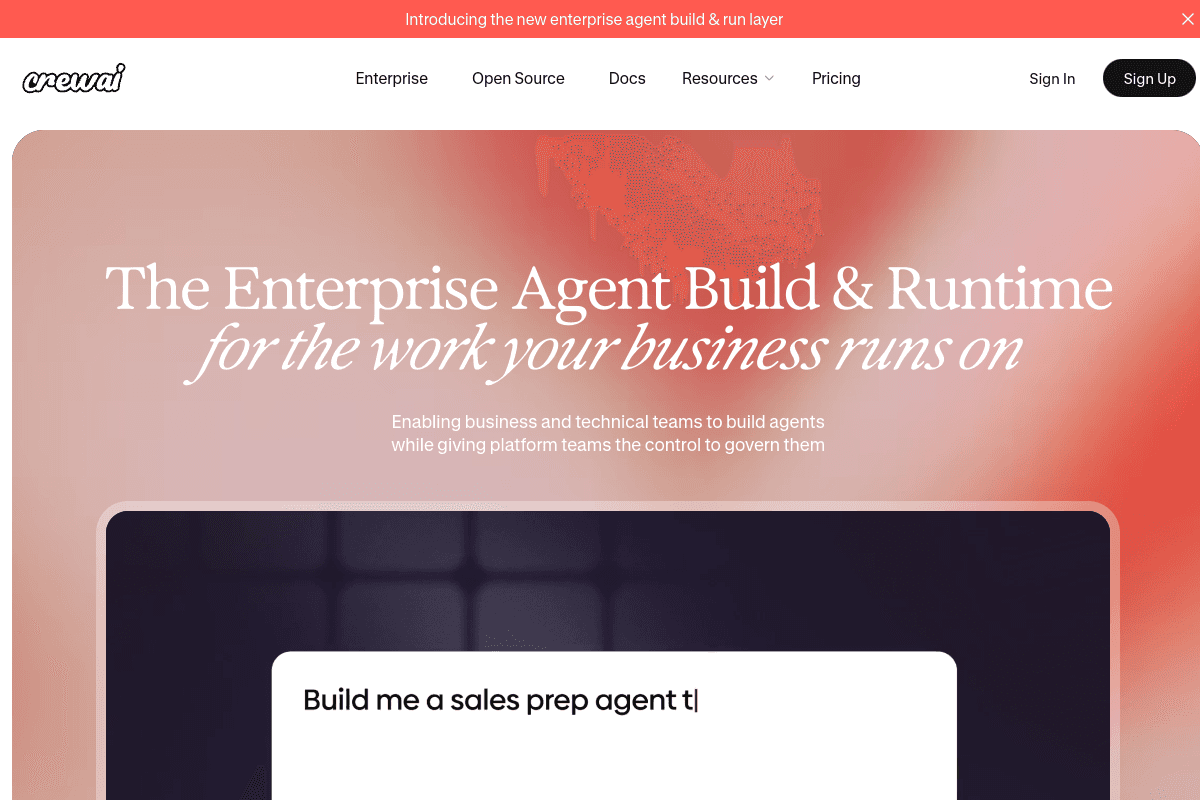
CREWAI — VERIFIED CAPABILITIES
| Capability | Detail |
|---|---|
| Free plan | 50 workflow executions/mo, visual editor, AI training tools |
| Professional plan | $25/mo with 100 executions, $0.50/extra, GitHub integration |
| Enterprise plan | Up to 30,000 executions, unlimited seats, private infra, on-site support |
| Agent architecture | Role-based agents with goals, backstories, and tool assignments |
| Orchestration modes | Sequential, hierarchical, and parallel task execution |
| LLM support | OpenAI, Anthropic Claude, Google Gemini, Ollama, Mistral, and more |
| All plans include | Unlimited deployments, workflow chat, usage dashboards |
| Enterprise features | SSO, RBAC, dedicated cloud infrastructure, on-site support |
Honest Limitation
CrewAI does not cover your LLM API costs -- the platform fee buys you the orchestration framework and execution infrastructure, but you pay OpenAI, Anthropic, Google, or your model provider separately for token usage. For multi-agent crews running complex tasks, LLM costs can be substantial and unpredictable because CrewAI's agent-to-agent delegation generates significant token volume. The framework is also less suitable for production systems that require precise control over agent state transitions -- for those use cases, LangGraph's explicit state graph model provides more architectural control. There is no pay-as-you-go option; costs are tied to tiered plans.
Best For
LangGraph (LangChain) -- Best for Custom Agent Architectures
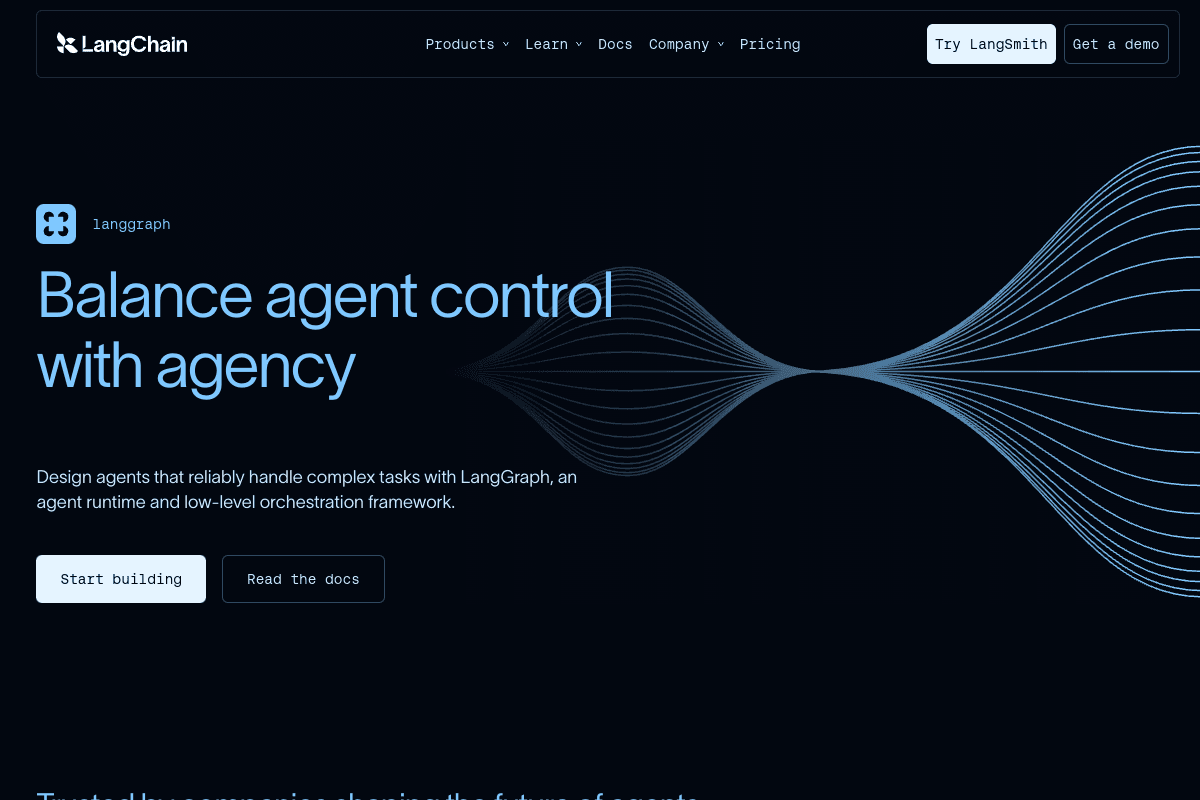
LANGGRAPH / LANGCHAIN — VERIFIED CAPABILITIES
| Capability | Detail |
|---|---|
| Framework license | MIT open-source — free to use, modify, and distribute |
| LangSmith Developer | Free for 1 seat |
| LangSmith Plus | $39/seat/mo, 10K base traces, 1 free small serverless deployment |
| Trace overages | $2.50/1K (14-day retention) or $5.00/1K (400-day retention) |
| Agent architecture | Graph-based state machine with explicit nodes, edges, conditionals |
| State persistence | Built-in checkpointing for long-running agents and state recovery |
| Human-in-the-loop | Native support for approval gates, interrupts, and manual overrides |
| Production deployment | LangGraph Cloud ($200–$500/mo compute) or self-hosted |
Honest Limitation
LangGraph's power comes with complexity. The graph-based state machine model requires developers to think about agent behavior at a lower abstraction level than CrewAI or Relevance AI. Building a multi-agent system in LangGraph means defining state schemas, creating nodes for each processing step, wiring edges with conditional routing, and managing state persistence. For teams that want to prototype quickly, this overhead can slow initial development. The framework also requires a strong Python engineering team -- LangGraph is not accessible to non-developers. Production deployments with high concurrency can incur substantial compute costs ($200-500/month+) on top of LangSmith subscriptions and LLM API bills.
Best For
ServiceNow AI Agents -- Best for IT Service Management
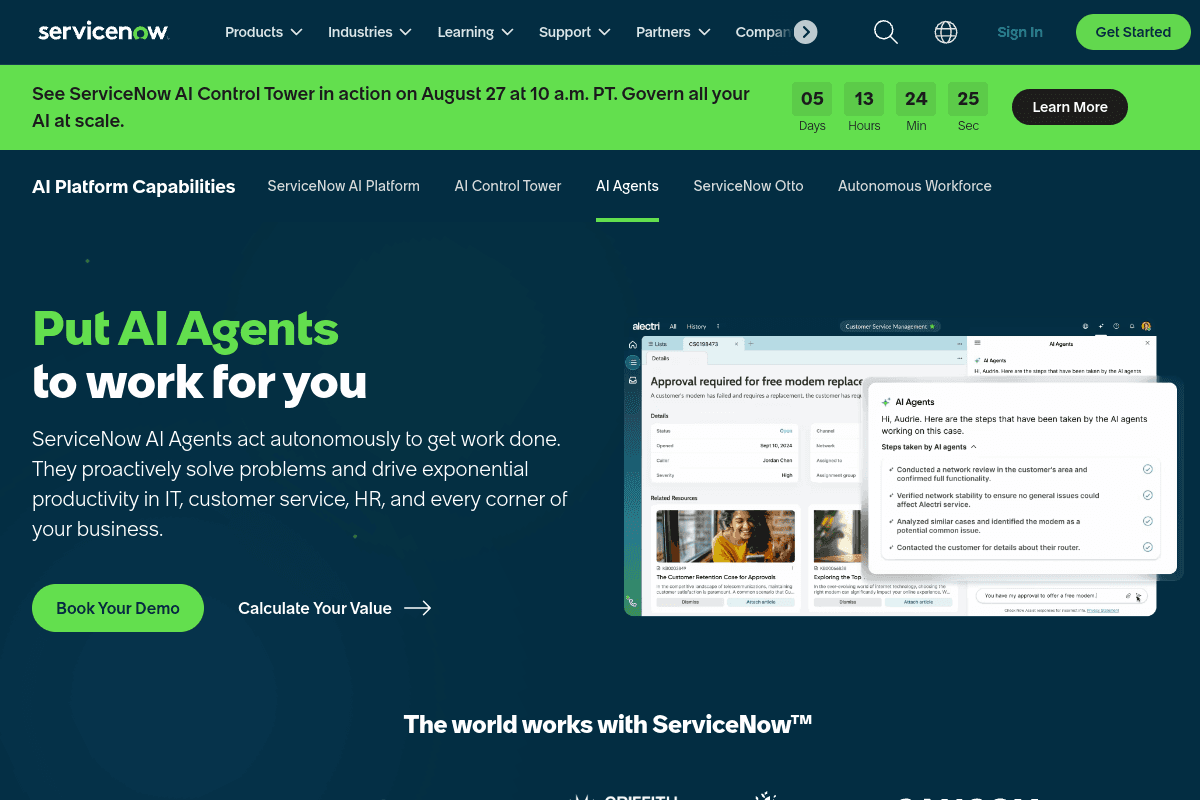
SERVICENOW AI AGENTS — VERIFIED CAPABILITIES
| Capability | Detail |
|---|---|
| Pricing | Starts at $10,000+/yr (quote-based), $50–$100+/user/mo for AI add-ons |
| Foundation tier | Generative AI: summarization, insights, data extraction |
| Advanced tier | Deterministic + AI agent-executed workflows for specific tasks |
| Prime tier | Full role replacement (e.g., L1 service desk) |
| Core AI components | Now Assist, Moveworks, Workflow Data Fabric, Context Engine, AI Control Tower |
| Multi-agent orchestration | Coordinated agent teams across ITSM, HR, CSM, and custom workflows |
| Governance | AI Control Tower for observability, guardrails, compliance, and audit |
| Deployment model | Cloud-hosted (ServiceNow instance), partner-assisted implementation |
Honest Limitation
ServiceNow AI Agents has the highest cost barrier in this ranking. Starting at $10,000+ annually with AI add-ons at $50-$100+ per user per month, and large enterprise deployments typically costing $100,000 to $500,000+, it is prohibitively expensive for SMBs and mid-market organizations. ServiceNow almost always requires a certified implementation partner (Deloitte, Accenture, KPMG, etc.) to configure and deploy, adding significant professional services costs. The platform is also tightly coupled to the ServiceNow ecosystem -- organizations not already running ServiceNow ITSM cannot adopt ServiceNow AI Agents without a full platform implementation first. The new three-tier pricing structure (Foundation, Advanced, Prime) launched in April 2026 is still being understood by the market, and pricing transparency remains a challenge.
Best For
Relevance AI -- Best for No-Code Multi-Agent Orchestration
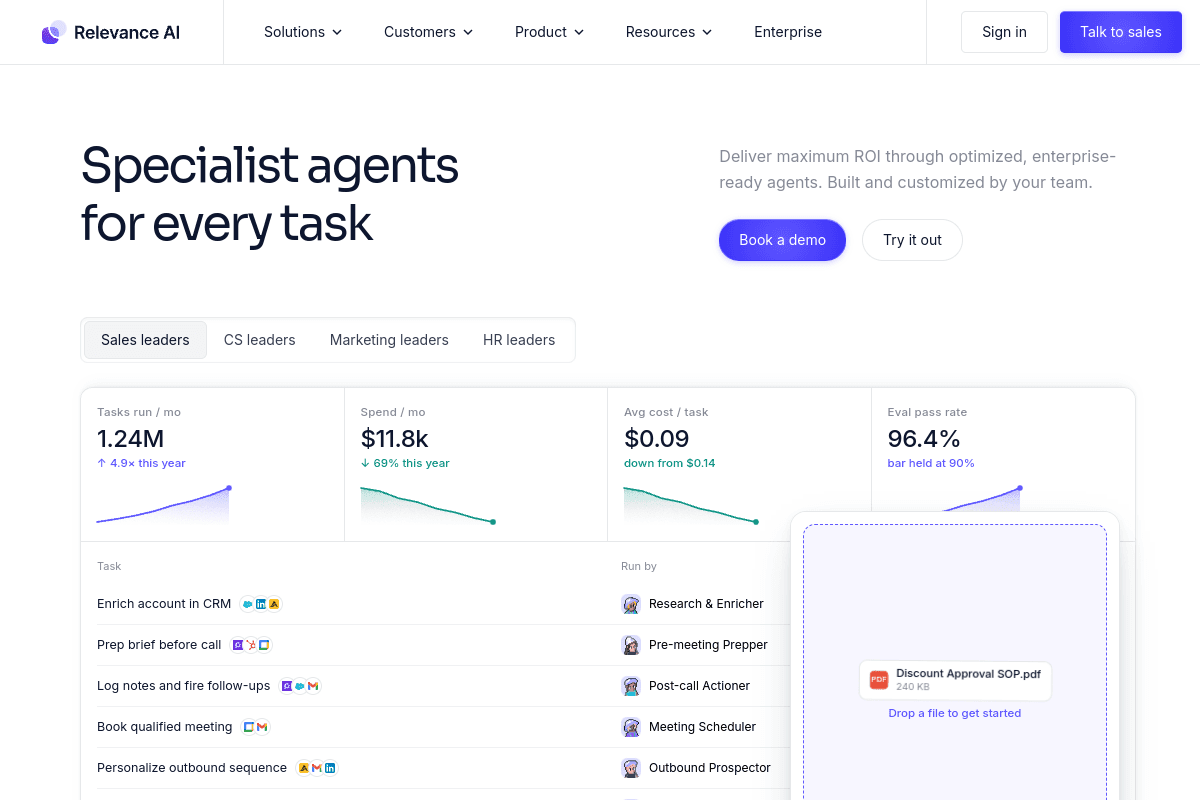
RELEVANCE AI — VERIFIED CAPABILITIES
| Capability | Detail |
|---|---|
| Free plan | 200 Actions/mo, 1,000 Vendor Credits (one-time), unlimited agents |
| Pro plan | $19/mo (billed annually) |
| Team plan | $349/mo ($234/mo annual), 7,000 Actions, $70 Vendor Credits, A/B testing |
| Billing model | Two meters: Actions (task runs) + Vendor Credits (LLM compute) |
| Multi-agent workforce | Specialized agents collaborating through orchestration layer |
| Tool library | 3,000+ pre-built tools agents can select and use autonomously |
| BYOK support | Paid plans allow bringing your own API keys to bypass Vendor Credits |
| Enterprise clients | Canva, Autodesk, Franke, and mid-market SaaS companies |
Honest Limitation
Relevance AI is cloud-only with no self-hosting option, which limits its fit for organizations with strict data sovereignty requirements. The dual-meter billing (Actions + Vendor Credits) can be confusing for users who are accustomed to flat-rate SaaS pricing, and total costs depend on both workflow volume and which LLM models agents use. The Team plan at $349/month is substantially more expensive than CrewAI's $25/month Professional plan for organizations that have development resources available. The platform's community and ecosystem are smaller than those of LangChain, CrewAI, or the hyperscaler platforms, which means fewer templates, tutorials, and third-party extensions.
Best For
Frequently Asked Questions
What is the best AI agent platform for business in 2026?
Microsoft Copilot Studio is the best overall AI agent platform for business in 2026 according to GeekyExpert research, scoring 9.4 out of 10. It offers consumption-based pricing at $200 per month for 25,000 credits, deep native integration with Microsoft 365 (Teams, Outlook, SharePoint, Dynamics 365), and enterprise-grade governance including SSO, RBAC, DLP policies, and audit logging.
For organizations on Microsoft 365 Copilot, internal agent interactions by licensed users do not consume credits. Salesforce Agentforce (9.2/10) is the top alternative for CRM-driven sales and service teams, with native customer data unification and omnichannel deployment at $2 per conversation. Google Vertex AI Agent Builder (9.0/10) offers the most model-flexible infrastructure with access to 200+ foundation models. The right choice depends on your existing technology ecosystem.
How much do AI agent platforms cost in 2026?
AI agent platform pricing in 2026 varies from free open-source frameworks to enterprise solutions costing over $100,000 per year. LangGraph is free and MIT-licensed for self-hosted deployments, with LangSmith observability starting at $39 per seat per month. CrewAI offers a free tier with 50 executions per month and a Professional plan at $25 per month. Microsoft Copilot Studio costs $200 per month for 25,000 credits or $0.01 per credit via Azure pay-as-you-go.
Salesforce Agentforce charges $2 per conversation, with a free Salesforce Foundations tier including 1,000 conversations. Google Vertex AI Agent Builder uses granular pay-as-you-go pricing starting at $0.0864 per vCPU-hour plus model costs. Relevance AI provides a free plan with 200 actions per month, with Team plans at $349 per month. ServiceNow AI Agents starts at $10,000 annually with enterprise deployments ranging from $100,000 to $500,000.
All platforms except LangGraph and CrewAI's open-source framework charge separately for underlying LLM API costs.
What is the difference between an AI agent platform and a chatbot?
An AI agent platform enables autonomous, multi-step reasoning systems that can plan complex tasks, use external tools and APIs, maintain memory across interactions, make decisions based on context, and execute business processes with minimal human oversight. A chatbot is a conversational interface that typically follows scripted decision trees or generates single-turn responses to direct questions.
The key distinction is agency: AI agents decompose complex goals into subtasks, decide which tools to use, handle exceptions dynamically, collaborate with other agents, and take action on behalf of users. Chatbots respond to messages. In 2026, the market has shifted decisively toward agentic architectures -- 80% of enterprise applications now embed at least one AI agent, up from 33% in 2024.
Platforms like Microsoft Copilot Studio, Salesforce Agentforce, and CrewAI represent this evolution from reactive chatbots to proactive autonomous agents that execute workflows end to end.
Which AI agent platform is best for developers in 2026?
For developer teams, CrewAI and LangGraph are the two leading AI agent platforms in 2026, serving complementary needs. CrewAI excels at rapid multi-agent prototyping with its Python-native role-based agent design pattern, allowing developers to define agents with specific roles, goals, and backstories that collaborate on complex tasks. It is the fastest path from concept to working multi-agent system.
LangGraph offers deeper architectural control through its graph-based state machine approach, where every decision point, tool call, and conditional branch is modeled as an explicit node and edge. This makes agent behavior fully observable, testable, and deterministic, which is essential for regulated industries and production systems requiring auditability. Both frameworks are open-source.
CrewAI is better for speed-to-deployment and prototyping (free tier with 50 executions per month, Pro at $25 per month). LangGraph is better for complex, stateful production architectures requiring precise control over agent decision flows (framework is free, LangSmith monitoring costs $39 per seat per month).
How big is the AI agents market in 2026 and how fast is it growing?
The global AI agents market reached $10.9 billion in 2026, up from $7.6 billion in 2025, representing a 43% year-over-year increase according to Grand View Research. MarketsandMarkets projects the market will grow to $52.62 billion by 2030 at a compound annual growth rate (CAGR) of 46.3%. BCC Research provides a slightly more conservative estimate of $48.3 billion by 2030 at a 43.3% CAGR, while Grand View Research projects $182.9 billion by 2033 at a 49.6% CAGR.
According to the 2026 Gartner CIO and Technology Executive Survey, 80% of enterprise applications shipped or updated in Q1 2026 now embed at least one AI agent, up from 33% in 2024. Enterprise spending on AI agent infrastructure tripled in a single year. However, Gartner also notes an adoption gap: only 17% of organizations have fully deployed AI agents, though over 60% expect to do so within two years, representing the most aggressive adoption curve among all emerging technologies in the survey.
About Geeky Expert
Geeky Expert is a leading provider of research and insights, dedicated to helping businesses make informed decisions through comprehensive analysis.