
Best Data Observability Tools (2026)
What is the best data observability tool in 2026?
The best data observability tool in 2026 is Monte Carlo -- the most widely deployed ML-driven data observability platform that automatically monitors freshness, volume, schema, distribution, and lineage across your entire data stack without manual rule configuration. Starting from ~$25K/year for mid-market teams. Bigeye leads for AI trust and sensitive data governance. Metaplane (by Datadog) offers the best value at $10/table/month with a free tier.
Best for your situation
- ▸Enterprise ML-driven: Monte Carlo -- from ~$25K/yr
- ▸AI trust & governance: Bigeye -- custom enterprise pricing
- ▸Best value + free tier: Metaplane by Datadog -- $10/table/mo
- ▸Open source: Great Expectations (GX Core) -- free Apache 2.0
Why Data Observability Matters in 2026
Data observability tools in 2026 go far beyond simple threshold alerts. The leading platforms use machine learning to automatically baseline normal data behavior, detect anomalies without manual rule configuration, provide end-to-end column-level lineage, and increasingly serve as the trust layer for AI/ML pipelines. The distinction between "data quality" and "data observability" is collapsing -- the best tools now deliver both proactive quality checks and reactive anomaly detection in a single platform.
VERIFIED PLATFORM & PRICING DATA (2026)
| Platform | Pricing | Type | Best For |
|---|---|---|---|
| Monte Carlo | From ~$25K/yr | ML-driven observability | Enterprise data teams |
| Bigeye | Custom enterprise | AI Trust Platform | AI governance & data trust |
| Anomalo | Custom enterprise | AI-powered data quality | Unsupervised ML detection |
| Metaplane by Datadog | Free / $10/table/mo | Automated observability | Mid-market & startups |
| Soda | Free / $750/mo Team | Data contracts & testing | Data engineering teams |
| Atlan | Custom (per-user tiers) | Data catalog + observability | Unified metadata & governance |
| Great Expectations (GX Core) | Free (Apache 2.0) | Open-source data validation | Code-first data quality |
Data Observability Market in Numbers
DATA OBSERVABILITY MARKET GROWTH
DATA OBSERVABILITY MARKET SNAPSHOT (2026)
Data Observability Market Size: 2025 Market Size $2.94 billion 2026 Market Size $3.40 billion 2030 Projected Size $6.02 billion 2035 Projected Size $8.79 billion CAGR (2025--2030) 15.4% Key Adoption Statistics: • 73% of data teams now use at least one data observability tool • Average enterprise manages 2,500+ data pipeline jobs daily • Data downtime costs enterprises an average of $15M per year • AI/ML pipelines increased demand for data quality tooling by 4x since 2024 • 68% of data engineering teams cite "lack of trust in data" as top challenge Growth Drivers (2026): • Expansion of real-time analytics & streaming data architectures • Increasing reliance on AI models requiring trusted training data • Growth of cloud-native data stacks (Snowflake, Databricks, BigQuery) • Stricter data governance (GDPR, CCPA, EU AI Act, SOX) • Rising demand for data contracts & data-as-a-product frameworks Source: GeekyExpert Business Research Company, SNS Insider, Grand View Research, 2025--2026
What to Optimise For
Choosing the right data observability tool depends on your data stack complexity, team size, budget, and whether you need passive monitoring or active data quality enforcement. The three most common buying scenarios map to different platforms.
THREE OPTIMISATION TARGETS FOR DATA OBSERVABILITY
| Optimisation Target | Platform | Approach | Best When |
|---|---|---|---|
| ML-Driven Anomaly Detection | Monte Carlo | Automated baselining, 5-pillar monitoring, end-to-end lineage | Enterprise data stacks with 100+ tables needing zero-config monitoring |
| Data Contracts & Testing | Soda / GX Core | Code-first quality checks, YAML contracts, CI/CD integration | Data engineering teams wanting proactive quality enforcement in pipelines |
| Unified Metadata & Governance | Atlan | Data catalog + embedded observability from partner tools | Organizations needing a single control plane for data discovery, lineage, and quality signals |
Featured Developer & IT
Monte Carlo -- Best ML-Driven Data Observability Platform
MONTE CARLO AT A GLANCE
| Attribute | Detail |
|---|---|
| Pricing | From ~$25K/yr (consumption-based credits) |
| Core approach | ML-driven 5-pillar anomaly detection |
| Pricing model | Consumption-based credits (4 tiers: Start, Scale, Enterprise, Business Critical) |
| Key integrations | Snowflake, Databricks, BigQuery, Redshift, dbt, Airflow, Fivetran, Looker, Tableau |
Honest Limitation
Pricing can escalate significantly at large data volumes due to the consumption-based credits model -- enterprise deployments with thousands of monitored tables often reach $100K-$200K+ annually. The sales-led procurement process with no self-serve option adds friction for smaller teams. Initial ML baselining requires 2-4 weeks of data history before anomaly detection reaches full accuracy. The platform is monitoring-focused rather than enforcement-focused -- it tells you when data breaks but does not prevent bad data from flowing downstream (unlike Soda's data contracts approach). Some users report alert fatigue during the initial tuning period before the ML models properly calibrate to their data patterns.
Best For
Enterprise data teams managing complex, multi-warehouse data stacks (Snowflake, Databricks, BigQuery, Redshift) who need automated, ML-driven anomaly detection across hundreds of tables without writing manual quality rules, and who prioritise rapid root cause analysis with end-to-end lineage visibility.
Bigeye -- Best AI Trust Platform for Data Governance
BIGEYE AT A GLANCE
| Attribute | Detail |
|---|---|
| Pricing | Custom enterprise (sales-led) |
| Core approach | AI Trust Platform + data observability |
| Key differentiator | AI Guardian for runtime data-access policy enforcement |
| Sensitive data | Automated classification, PII detection, compliance mapping |
Honest Limitation
No published pricing or free tier -- the sales-led enterprise model creates friction for teams wanting to evaluate the platform quickly. The AI Trust Platform positioning is relatively new (2025-2026 pivot), meaning some features are still maturing compared to the more established data observability capabilities. Organizations that do not build AI applications may not need (or want to pay for) the AI Guardian layer. The platform is less focused on proactive data quality enforcement through data contracts compared to Soda. Smaller datasets with fewer tables may not justify the enterprise pricing, and Bigeye's value proposition increases with data volume and pipeline complexity.
Best For
Enterprise organizations building production AI applications that need a combined data observability and AI governance platform -- particularly in regulated industries (financial services, healthcare, government) where runtime data-access enforcement, sensitive data classification, and compliance reporting are requirements rather than nice-to-haves.
Anomalo -- Best Unsupervised ML Detection for Structured & Unstructured Data
ANOMALO AT A GLANCE
| Attribute | Detail |
|---|---|
| Pricing | Custom enterprise pricing |
| Core approach | Unsupervised ML + automatic secondary checks |
| Unique capability | Unstructured document scoring for LLM readiness |
| Compliance | SOC 2 Type II, HIPAA, in-VPC deployment, RBAC |
Honest Limitation
Enterprise-only pricing with no free tier, self-serve option, or published price points -- smaller teams face a high barrier to entry. The sales process requires a demo and custom quote, which can take weeks. No open-source component for teams that prefer code-first quality definitions. The platform is strongest for detection and alerting but less focused on enforcement -- it tells you when data is bad but does not prevent bad data from flowing downstream through pipeline-level blocking. The unstructured data scoring, while unique, is still a newer capability that may not have the same maturity as the structured table monitoring features. In-VPC deployment adds operational overhead compared to fully managed SaaS options.
Best For
Enterprise data teams and AI/ML engineering organizations that need sophisticated unsupervised ML detection with minimal false positives, especially those building RAG-based AI applications that require both structured data quality monitoring and unstructured document readiness scoring, in regulated industries where in-VPC deployment and compliance certifications are mandatory.
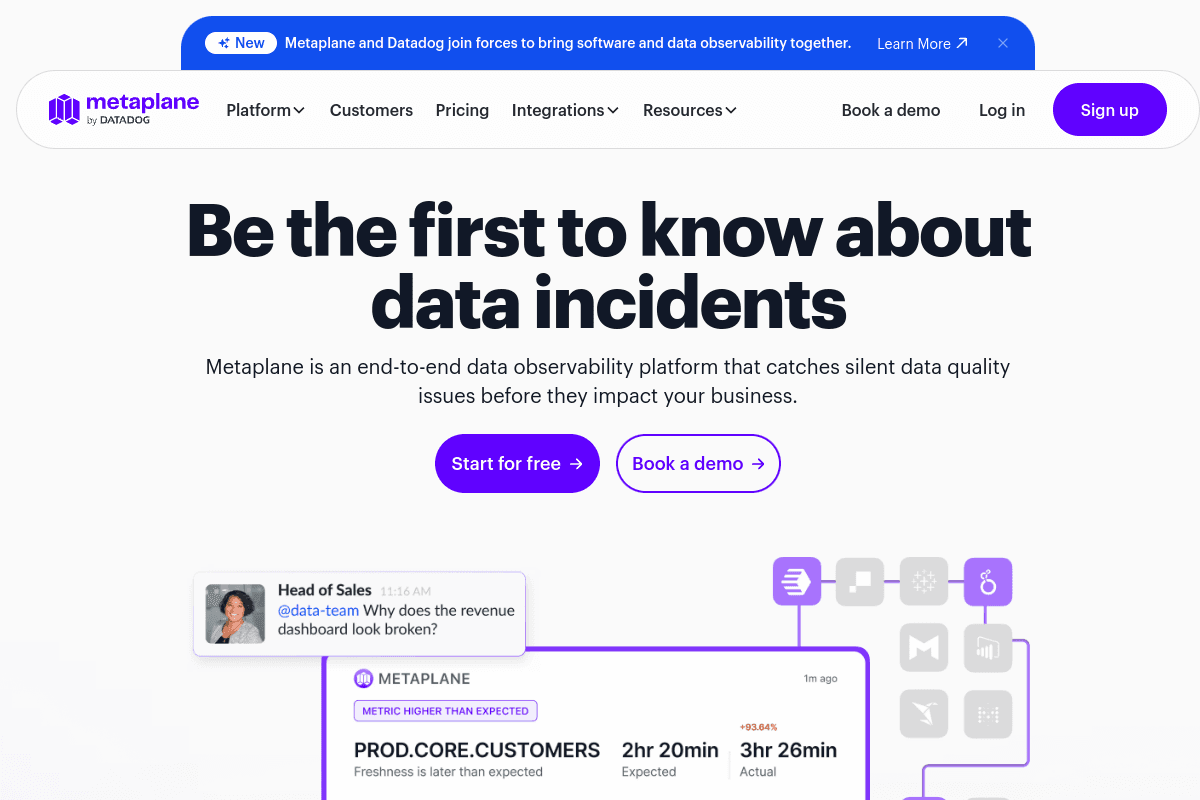
Metaplane by Datadog -- Best Value Data Observability with Free Tier
METAPLANE BY DATADOG AT A GLANCE
| Attribute | Detail |
|---|---|
| Pricing | Free (10 tables) / $10/table/mo Pro |
| Core approach | Automated ML baselining + anomaly detection |
| Parent company | Datadog (acquired April 2025) |
| Free tier includes | 10 tables, anomaly detection, lineage, 3 SQL monitors, Slack/email alerts |
Honest Limitation
The Datadog acquisition introduces strategic uncertainty -- Datadog has stated plans to fold Metaplane's capabilities into the broader Datadog platform over time, which may mean product changes, pricing adjustments, or eventual sunsetting of the standalone product. The platform lacks the depth of ML sophistication found in Monte Carlo's five-pillar approach or Anomalo's unsupervised learning with secondary checks. Enterprise governance features (compliance reporting, audit logs, advanced RBAC) are less mature than Monte Carlo or Bigeye. The $10/table/month pricing can become expensive at very large scale -- 500 tables would cost $5,000/month ($60K/year), approaching Monte Carlo's entry pricing with fewer features. No in-VPC deployment option for organisations with strict data residency requirements. The free tier's 10-table limit is useful for evaluation but insufficient for any real production workload.
Best For
Startups, mid-market data teams, and cost-conscious enterprises that want transparent, self-serve pricing, fast time-to-value without sales friction, and strong dbt/CI/CD integration -- especially teams with 50-200 monitored tables where the $10/table/month pricing delivers strong value relative to enterprise alternatives.
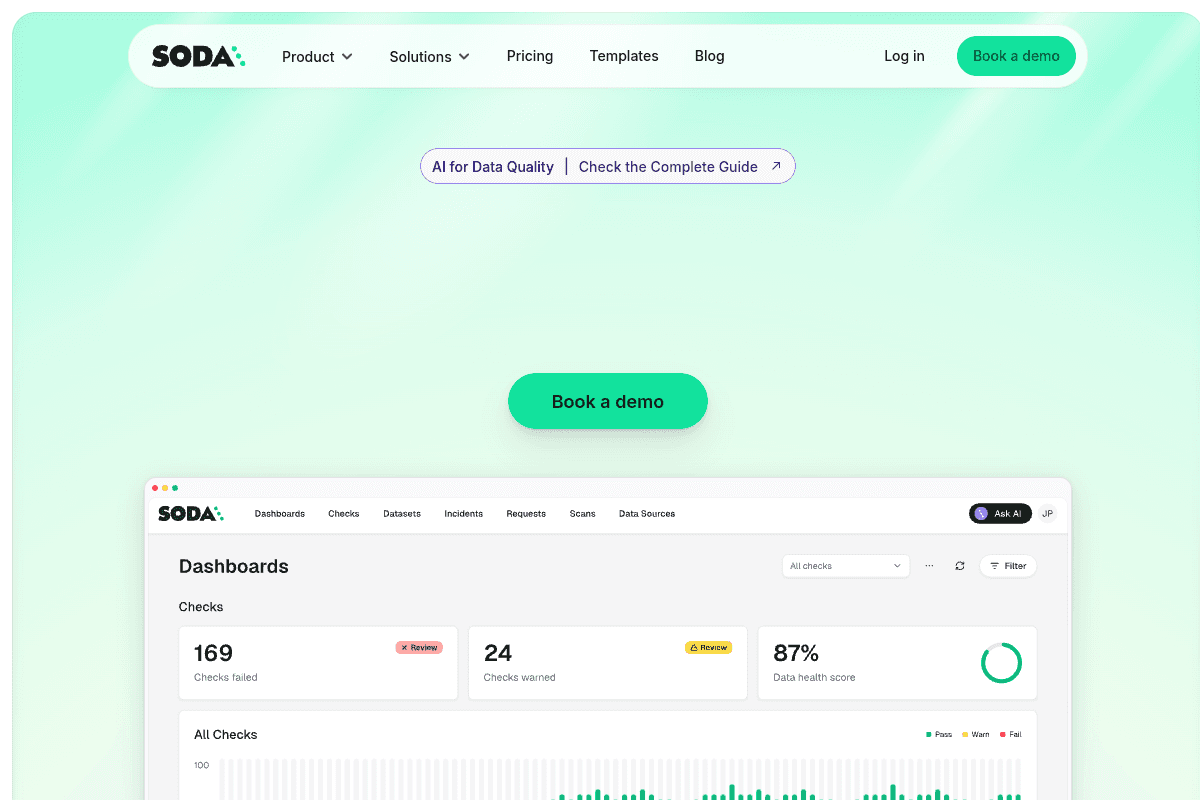
Soda -- Best AI-Native Data Contracts & Testing Platform
SODA AT A GLANCE
| Attribute | Detail |
|---|---|
| Pricing | Free / $750/mo Team / Custom Enterprise |
| Core approach | Data contracts + SodaCL checks + AI anomaly detection |
| Language | SodaCL (YAML-first checks language) |
| New capabilities | Soda AI (anomaly detection), Soda Cleanse (automated remediation) |
Honest Limitation
The Team plan at $750/month is a significant jump from the free tier, with limited middle ground for growing teams. SodaCL requires learning a new domain-specific language -- while YAML-based and readable, it still has a learning curve for teams unfamiliar with checks-as-code workflows. The platform is strongest in data engineering workflows (dbt, Airflow, CI/CD pipelines) and less focused on BI-layer monitoring or end-user data quality dashboards. ML-based anomaly detection via Soda AI is newer than Monte Carlo's or Anomalo's offerings and may not match their detection sophistication on complex datasets. The data contracts approach requires organizational buy-in from both data producers and consumers, which can be a cultural challenge. Enterprise pricing requires a sales conversation with no published rates.
Best For
Data engineering teams operating in dbt-centric, infrastructure-as-code workflows who want to enforce data quality proactively through contracts and pipeline-level checks, prevent bad data from reaching downstream consumers, and version-control their quality definitions alongside their data transformation code.
Atlan -- Best Unified Data Catalog with Embedded Observability
ATLAN AT A GLANCE
| Attribute | Detail |
|---|---|
| Pricing | Custom per-user (Starter / Premier / Enterprise) |
| Core approach | Unified data catalog + metadata + embedded observability |
| AI capability | Atlan AI -- AI-powered documentation, query, and data discovery |
| Observability partner integrations | Monte Carlo, Great Expectations, Soda, dbt tests |
Honest Limitation
Atlan is a control plane, not a detection engine. You still need a separate anomaly detection tool underneath (Monte Carlo, Soda, GX Core, or dbt tests) -- Atlan adds the context and routing layer, not the detection itself. This means the total cost is Atlan's per-user pricing plus the cost of your detection tool(s). Pricing is not transparent -- enterprise deployments covering 500+ users across multiple connected tools can see 20-40% cost increases for module attachments. The platform's strength is breadth (cataloging, governance, lineage, quality) rather than depth in any single area. Organizations with simple data stacks (one warehouse, one BI tool, under 100 tables) may not need the overhead of a full data catalog and would be better served by a focused observability tool like Metaplane or Monte Carlo.
Best For
Data-mature organizations with complex, multi-tool data stacks that need a unified control plane for data discovery, governance, lineage, and quality signal aggregation -- particularly teams already using (or planning to use) separate detection tools like Monte Carlo, Soda, or Great Expectations that need a contextual layer to make those signals operational.
Great Expectations (GX Core) -- Best Open-Source Data Validation Framework
GREAT EXPECTATIONS (GX CORE) AT A GLANCE
| Attribute | Detail |
|---|---|
| Pricing | Free (Apache 2.0 open source) |
| Core approach | Python-based data validation with Expectations |
| GX Cloud status | Discontinued June 1, 2026 (acquisition) |
| Community | 15,000+ GitHub stars, active Slack community |
Honest Limitation
GX Cloud was discontinued on June 1, 2026 following the acquisition, meaning there is no managed SaaS option -- teams must self-host all infrastructure, including storage for validation results, scheduling, alerting, and the Data Docs web server. This adds significant operational overhead compared to fully managed platforms like Monte Carlo or Metaplane. No built-in ML-driven anomaly detection -- GX Core validates against rules you define, but does not automatically detect patterns or anomalies you did not anticipate. The learning curve is steeper than SaaS alternatives, requiring Python proficiency and familiarity with the Expectations API. No built-in alerting system (Slack, email, PagerDuty) -- teams must build custom integrations or use orchestrator-level alerting. The acquisition creates uncertainty about the long-term roadmap and stewardship of the open-source project. Scaling to thousands of tables requires significant engineering investment in infrastructure and automation.
Best For
Data engineering teams with strong Python skills who want free, fully customisable, code-first data validation with zero vendor lock-in -- especially teams that prefer to own their quality infrastructure, need domain-specific custom validations, and are willing to invest engineering time in exchange for complete control and zero licensing costs.
Frequently Asked Questions
What is data observability and how is it different from data quality?
Data observability is the ability to understand, diagnose, and resolve data issues across your entire data stack by continuously monitoring data health metrics -- freshness, volume, schema changes, distribution anomalies, and lineage. Data quality is a subset focused on whether data meets defined standards (accuracy, completeness, consistency).
The key difference is approach: data quality tools enforce rules you define upfront, while data observability tools use machine learning to automatically detect anomalies you did not anticipate. In 2026, the distinction is collapsing -- leading platforms like Monte Carlo and Soda combine both ML-based anomaly detection and rule-based quality checks in a single platform.
Think of data observability as the monitoring layer that tells you when something breaks, and data quality as the testing layer that defines what correct means. Most mature data teams use both approaches together.
How much do data observability tools cost in 2026?
Pricing ranges from free open-source options to $200K+ per year for enterprise deployments. Great Expectations GX Core is free under Apache 2.0. Metaplane by Datadog offers a free tier for 10 tables and a Pro plan at $10 per monitored table per month. Soda has a free tier with pipeline testing, metrics observability, and alerting integrations, with its Team plan starting at $750 per month.
Monte Carlo uses consumption-based pricing starting around $25K per year for small-to-mid teams, scaling to $100K-$200K+ for enterprise deployments with hundreds of monitored tables. Bigeye, Anomalo, and Acceldata use custom enterprise pricing requiring sales conversations, typically ranging from $50K to $200K+ annually depending on data volume and deployment model. Atlan pricing is per-user across tiered plans (Starter, Premier, Enterprise) with custom quotes.
Budget-constrained teams should start with Metaplane's free tier or GX Core, then scale to Monte Carlo or Soda as data volumes grow.
Can data observability tools monitor AI and ML pipelines?
Yes, and this is one of the fastest-growing use cases in 2026. AI and ML models are only as good as their training data, and data observability tools provide the trust layer that ensures model inputs remain reliable. Monte Carlo monitors the data feeding ML feature stores and training pipelines, alerting when distribution shifts could cause model drift.
Anomalo scores unstructured documents for LLM readiness alongside structured table monitoring -- a unique capability for organizations building RAG-based AI applications. Bigeye has repositioned as an AI Trust Platform with its AI Guardian feature enforcing runtime data-access policies for AI applications, controlling what data models can consume. Soda enables data contracts that validate data quality before it enters ML pipelines.
The key capability to look for is distribution monitoring -- detecting subtle statistical shifts in feature data that would not trigger simple threshold alerts but could significantly degrade model performance over time.
Which data observability tool is best for small data teams?
For small data teams (under 10 people), Metaplane by Datadog is the strongest starting point -- it offers a free tier covering 10 monitored tables with automated anomaly detection, column-level lineage, and Slack alerts, then scales to $10 per table per month on the Pro plan. This is transparent, predictable pricing without sales calls or enterprise minimum commitments.
For teams with strong Python engineering skills, Great Expectations GX Core (free, open source) provides the most flexibility and customisability but requires more setup and maintenance -- you will need to host your own infrastructure for scheduling, alerting, and Data Docs. Soda's free tier is another solid option for teams that prefer a SaaS experience over self-hosted open source, offering pipeline testing and metrics observability at no cost.
Avoid Monte Carlo, Bigeye, and Anomalo for small teams -- their enterprise-focused sales processes, minimum contract sizes, and complex onboarding are designed for organizations with 50+ data sources and dedicated data platform teams.
Should I choose an all-in-one data observability platform or a best-of-breed approach?
The answer depends on your data stack maturity and team size. All-in-one platforms like Monte Carlo provide the fastest time-to-value -- connect your warehouse and get automated monitoring across freshness, volume, schema, and distribution without writing rules. This works best for teams that want comprehensive coverage with minimal setup and operational overhead.
Best-of-breed approaches combine specialised tools -- for example, Great Expectations for pipeline-level data validation, Monte Carlo or Metaplane for warehouse-level anomaly detection, and Atlan as the metadata layer that aggregates quality signals from all sources. This delivers deeper capability in each area but adds integration complexity and total cost.
A practical middle path that many mature data teams follow in 2026: start with one platform (Monte Carlo or Metaplane) for automated monitoring, then add Soda or GX Core for proactive data contracts in CI/CD pipelines. Most data teams use two to three tools in a complementary stack rather than relying on a single platform for everything.
About Geeky Expert
Geeky Expert is a leading provider of research and insights, dedicated to helping businesses make informed decisions through comprehensive analysis.