
Klaviyo vs Mailchimp vs Omnisend: Best Ecommerce Email Tool (2026)
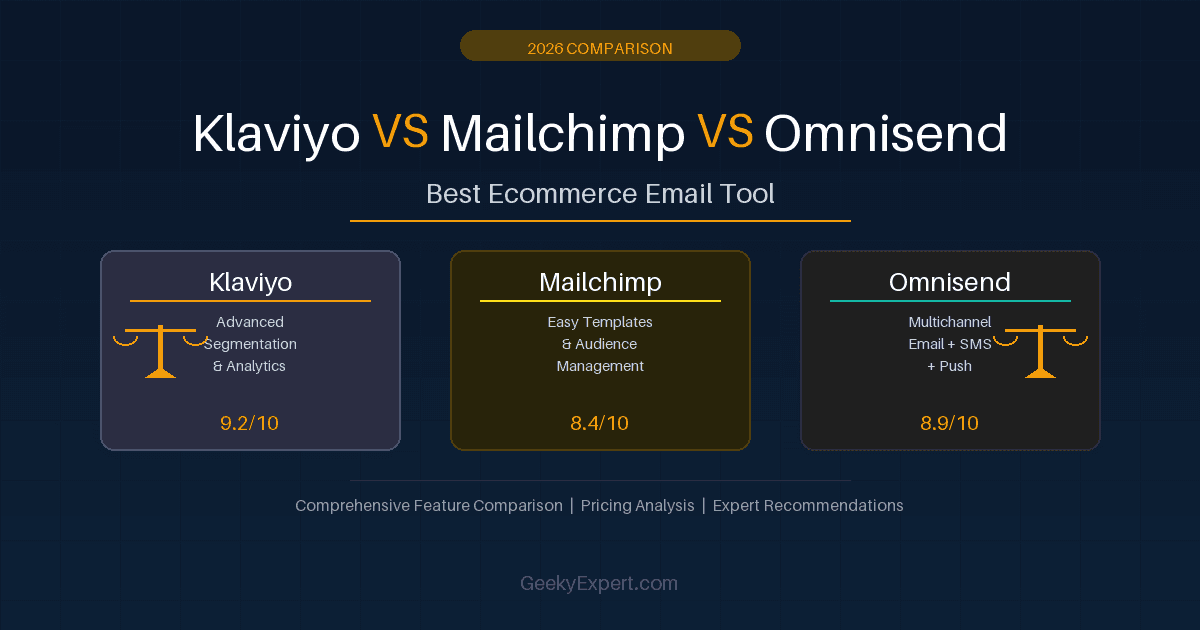
Klaviyo vs Mailchimp vs Omnisend -- which is the best ecommerce email marketing tool in 2026?
For ecommerce email marketing in 2026, Klaviyo is the best overall choice for Shopify and WooCommerce stores that need deep segmentation, predictive analytics, and revenue-driven automation. Omnisend is the best value for growing stores that want bundled email, SMS, and push notifications at a lower price. Mailchimp is best for beginners and non-ecommerce-first businesses that need a simple, familiar interface but can accept weaker Shopify integration.
Best for your situation
- ▸Shopify stores needing advanced segmentation: Klaviyo -- real-time behavioral data, predictive analytics, 350+ integrations
- ▸Growing stores wanting email + SMS + push: Omnisend -- bundled multichannel from $16/mo, strong automation presets
- ▸Beginners or content-first brands: Mailchimp -- easy drag-and-drop builder, familiar UI, broad marketing tools
- ▸Budget-conscious stores under 5K contacts: Omnisend -- most features on free tier for ecommerce
- ▸High-volume DTC brands ($1M+ revenue): Klaviyo -- CDP-level data, predictive CLV, advanced flow logic
- ▸WooCommerce stores: Omnisend -- native WooCommerce plugin rated higher than Klaviyo's
PRICING COMPARISON BY LIST SIZE (2026)
| Contacts | Klaviyo (Email) | Mailchimp (Standard) | Omnisend (Standard) |
|---|---|---|---|
| 500 | $20/mo | $20/mo | $16/mo |
| 5,000 | $100/mo | $100/mo | $81/mo |
| 25,000 | $400/mo | $275/mo | $180/mo |
| 50,000 | $720/mo | $450/mo | $330/mo |
| 100,000 | $1,380/mo | $800/mo | Custom |
Klaviyo = Email-only plan. Mailchimp = Standard plan (most popular). Omnisend = Standard plan (12x contacts email limit). SMS and push add-ons are extra on all platforms. Prices verified November 2026 from vendor sites and third-party sources.
ECOMMERCE EMAIL MARKETING MARKET (2026)
Email Marketing Market Size (2026): 2026 Market Size $13.72 billion 2031 Projected Size $22.93 billion CAGR (2026--2031) 10.82% Ecommerce Email Performance Benchmarks: Average open rate (ecommerce) 30.7% Average click rate (ecommerce) 1.9% Automated email revenue share 37% of email revenue from 2% of sends Email marketing ROI $36--45 per $1 spent Platform Market Share (Shopify App Store): Klaviyo 76,000+ active Shopify installs Omnisend 100,000+ active Shopify installs Mailchimp Third-party connector (no native app) Key Trends in 2026: • AI-powered send-time optimization and subject-line generation • Predictive analytics (CLV, churn risk, next purchase date) • Unified email + SMS + push in single automation flows • CDP-level segmentation replacing basic list management • Revenue attribution per flow, campaign, and segment Source: GeekyExpert Intelligence, Omnisend, Mailchimp, Klaviyo, 2025--2026
WHICH TOOL FITS YOUR STORE? (2026)
SHOPIFY store needing deep segmentation + predictive analytics → Klaviyo (from $20/mo, real-time Shopify data sync) → Best for DTC brands, $500K+ revenue, data-driven marketing GROWING ecommerce store wanting email + SMS + push in one → Omnisend (from $16/mo, native Shopify + WooCommerce) → Best for stores under $1M revenue wanting multichannel BEGINNER or content-first brand needing a familiar interface → Mailchimp (from $20/mo Standard, broad marketing tools) → Best for new stores, non-ecommerce-first businesses HIGH-VOLUME DTC brand ($1M+ revenue, 50K+ contacts) → Klaviyo (predictive CLV, advanced flows, CDP features) → Most expensive but highest revenue attribution accuracy WOOCOMMERCE store prioritizing ease of setup → Omnisend (native WooCommerce plugin, higher-rated) → Klaviyo also supports WooCommerce but integration is newer BUDGET-FIRST store under 500 contacts → Omnisend Free (250 contacts, 500 emails/mo, automation) → Klaviyo Free (250 profiles, 500 emails/mo, limited flows) → Mailchimp Free (250 contacts, 500 emails/mo, basic only)
Klaviyo vs Mailchimp vs Omnisend: The Ecommerce Email Marketing Showdown
This GeekyExpert research report delivers a detailed head-to-head comparison of the three dominant ecommerce email marketing platforms in 2026: Klaviyo, Mailchimp, and Omnisend. The global email marketing market reached approximately $13.72 billion in 2026 and is projected to grow to $22.93 billion by 2031 at a 10.82% CAGR, driven by AI-powered automation, predictive analytics, and the convergence of email, SMS, and push notifications into unified customer journeys. For ecommerce brands specifically, automated emails generate 37% of email-driven revenue from just 2% of total sends -- making the choice of automation platform a direct revenue decision.
Featured Email Marketing
Klaviyo -- Best Overall Ecommerce Email Marketing Platform
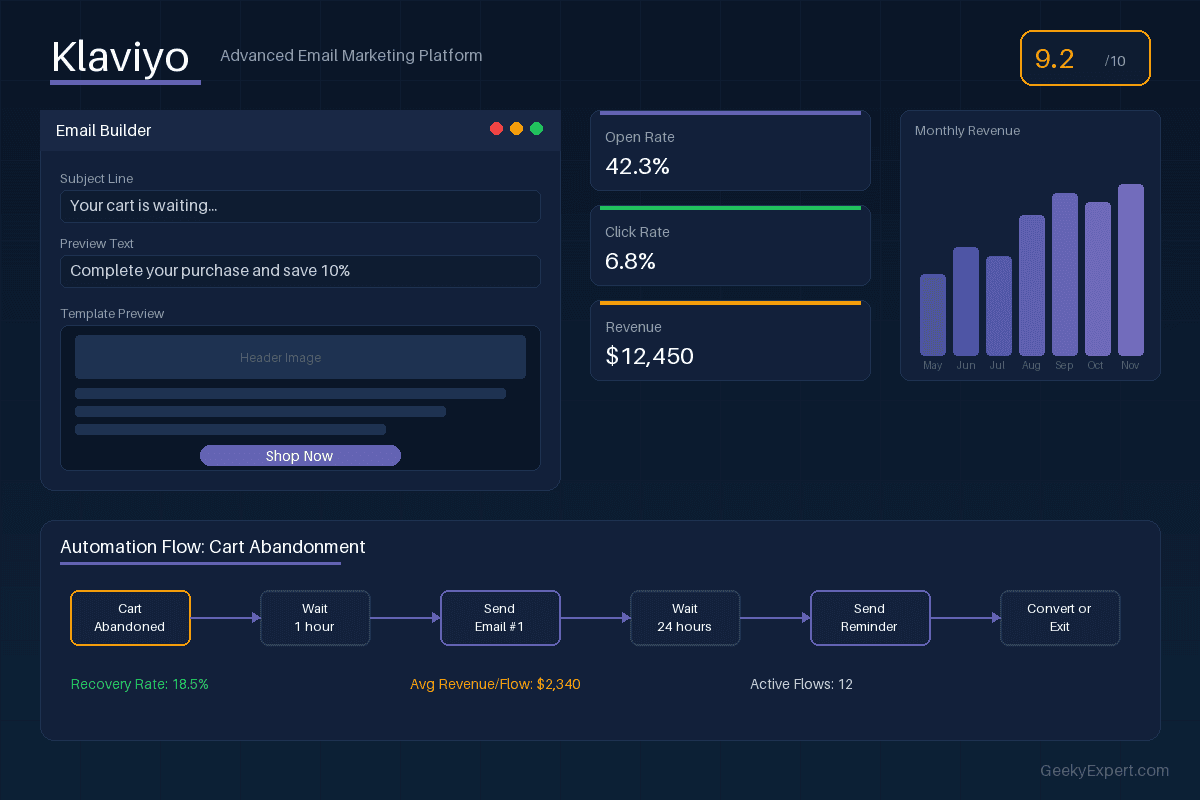
Klaviyo is the best overall ecommerce email marketing platform in 2026. Purpose-built for ecommerce from day one, Klaviyo functions as both an email marketing tool and a customer data platform (CDP), pulling real-time behavioral data from Shopify, WooCommerce, BigCommerce, and 350+ other integrations into a unified customer profile. The platform's predictive analytics -- customer lifetime value (CLV), expected next order date, churn risk scoring, and spending tier predictions -- give ecommerce brands segmentation capabilities that Mailchimp and Omnisend cannot match. Revenue attribution tracks dollars generated per flow, per campaign, and per segment, making marketing ROI transparent down to the individual automation. Klaviyo is a publicly traded company (NYSE: KVYO) with reported annual revenue exceeding $900 million, powering email and SMS for over 167,000 brands globally.
KLAVIYO VERIFIED CAPABILITIES (2026)
| Attribute | Detail |
|---|---|
| Pricing (Email only) | Free (250 profiles) | $20/mo (500) | $100/mo (5K) | $400/mo (25K) | $720/mo (50K) |
| SMS pricing | Credit-based: ~$0.01/SMS (US), separate from email plan |
| Shopify integration | Deepest native -- real-time browse, cart, purchase sync |
| Predictive analytics | CLV, churn risk, next order date, spending tier, gender prediction |
| Pre-built flows | 15+ ecommerce flows (abandoned cart, browse abandon, win-back, post-purchase) |
| Best fit | Shopify DTC brands, $500K+ revenue, data-driven marketers |
Honest Limitation
Klaviyo is the most expensive platform in this comparison at every contact tier. At 25,000 contacts, you pay $400 per month for email only versus $180 on Omnisend Standard -- that is a $2,640 annual difference. At 50,000 contacts, Klaviyo is $720 per month versus $330 on Omnisend. SMS is billed separately, adding further cost. The predictive analytics require sufficient data volume to be useful -- stores with fewer than 500 customers and 200 orders will not get meaningful predictions. Revenue attribution uses a configurable window but the default includes Apple Mail Privacy-inflated opens, which can overstate email revenue unless you manually switch to click-based attribution. The interface has a steeper learning curve than both Mailchimp and Omnisend, particularly for the flow builder's advanced conditional logic. No native web push notifications -- you need a third-party tool for push, whereas Omnisend bundles it. The free plan is limited to 250 profiles, which is not enough to evaluate the platform's segmentation power properly.
Best For
Shopify-first DTC brands generating $500K+ in annual revenue that want CDP-level customer data, predictive analytics, and granular revenue attribution. Particularly strong for fashion, beauty, health and wellness, food and beverage, and home goods ecommerce with repeat purchase potential. Also strong for stores with 10,000+ contacts that need sophisticated segmentation beyond basic demographics. Not recommended for stores under $100K revenue (the cost will not deliver ROI), stores that primarily need SMS and push alongside email on a budget (Omnisend is better), or beginners who want a simple drag-and-drop experience (Mailchimp is easier).
Omnisend -- Best Value Multichannel Ecommerce Email Platform
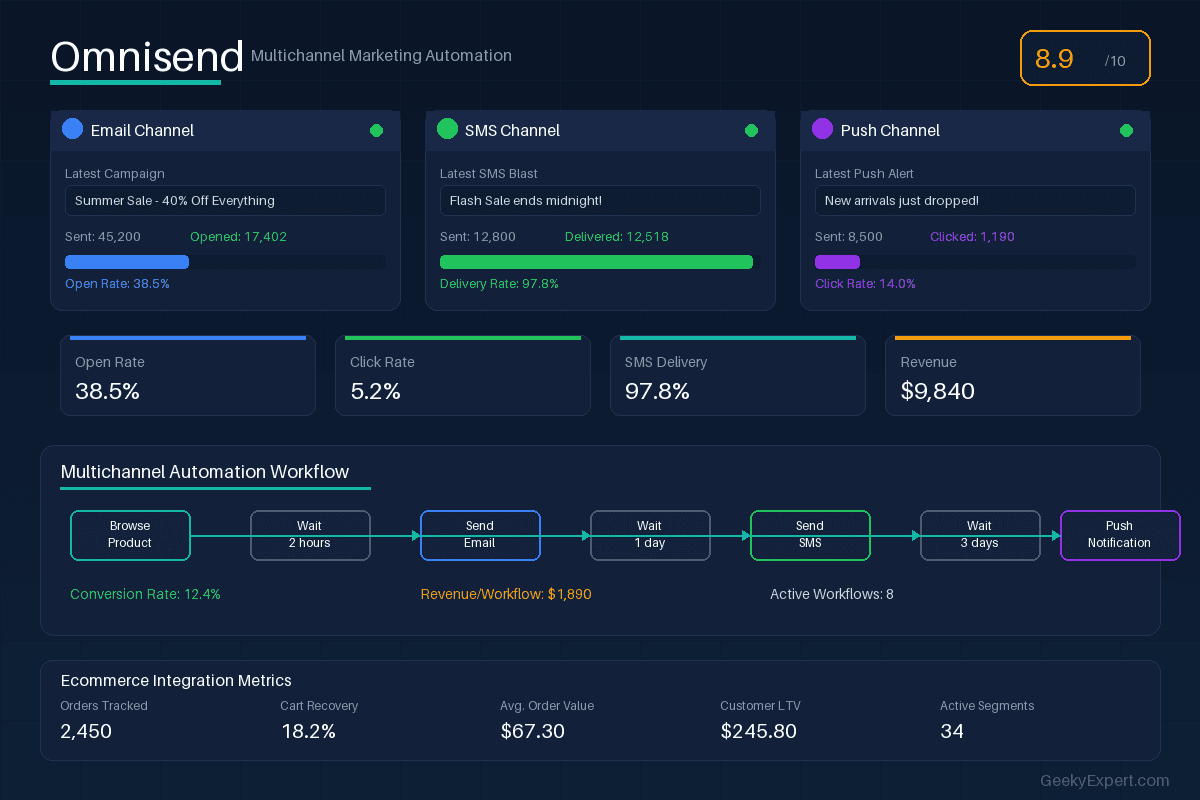
Omnisend is the best value ecommerce email marketing platform in 2026, delivering the strongest combination of features per dollar for growing ecommerce stores. Unlike Klaviyo's premium positioning or Mailchimp's general-purpose approach, Omnisend occupies the sweet spot: purpose-built for ecommerce with bundled email, SMS, and web push notifications at prices 30-55% lower than Klaviyo at every contact tier. The platform has over 100,000 active Shopify installs (more than Klaviyo's 76,000+) and is particularly strong for WooCommerce stores, where its native plugin is consistently rated higher than Klaviyo's. Omnisend's pre-built automation workflows cover every core ecommerce journey, and the unified multichannel approach means a single abandoned cart flow can send an email, then an SMS if unopened, then a push notification -- all configured in one workflow.
OMNISEND VERIFIED CAPABILITIES (2026)
| Attribute | Detail |
|---|---|
| Pricing (Standard) | Free (250 contacts) | $16/mo (500) | $81/mo (5K) | $180/mo (25K) | $330/mo (50K) |
| Pro plan | From $59/mo (2,500 contacts) -- unlimited email sends |
| Multichannel | Email + SMS + web push in unified workflows |
| Email limit (Standard) | 12x billable contacts per month (e.g., 60,000 emails at 5K contacts) |
| Shopify installs | 100,000+ active installs (Shopify App Store) |
| Best fit | Growing ecommerce stores wanting multichannel at best value |
Honest Limitation
Omnisend's segmentation is solid but lacks Klaviyo's predictive analytics layer. There is no customer lifetime value prediction, no churn risk scoring, and no expected next purchase date -- you segment based on what customers have done, not what they are predicted to do. The flow builder is simpler than Klaviyo's, with fewer conditional split options and less advanced branching logic. Revenue attribution is at the campaign and workflow level but not as granular as Klaviyo's per-segment breakdown. The Standard plan limits email sends to 12 times your billable contact count per month (60,000 emails for 5,000 contacts), which can be restrictive for stores that send frequently -- the Pro plan removes this limit but costs more. SMS is no longer available on the free plan for accounts created after May 2026. The platform serves ecommerce stores under approximately $1M revenue well, but enterprise DTC brands that need CDP-level data depth will find Klaviyo's analytics more sophisticated. Custom pricing kicks in above 150,000 contacts.
Best For
Growing ecommerce stores doing $50K-$500K in annual revenue that want email, SMS, and push notifications in one affordable platform. Particularly strong for WooCommerce stores (best native plugin), Shopify stores that prioritize value over data depth, stores with 1,000-25,000 contacts, and brands that want multichannel automation without managing separate SMS and push tools. Also the best choice for budget-conscious stores that want more ecommerce features than Mailchimp offers. Not recommended for enterprise DTC brands needing predictive analytics and CDP-level segmentation (use Klaviyo) or for non-ecommerce businesses (Mailchimp is more versatile).
Mailchimp -- Best for Beginners and Content-First Brands
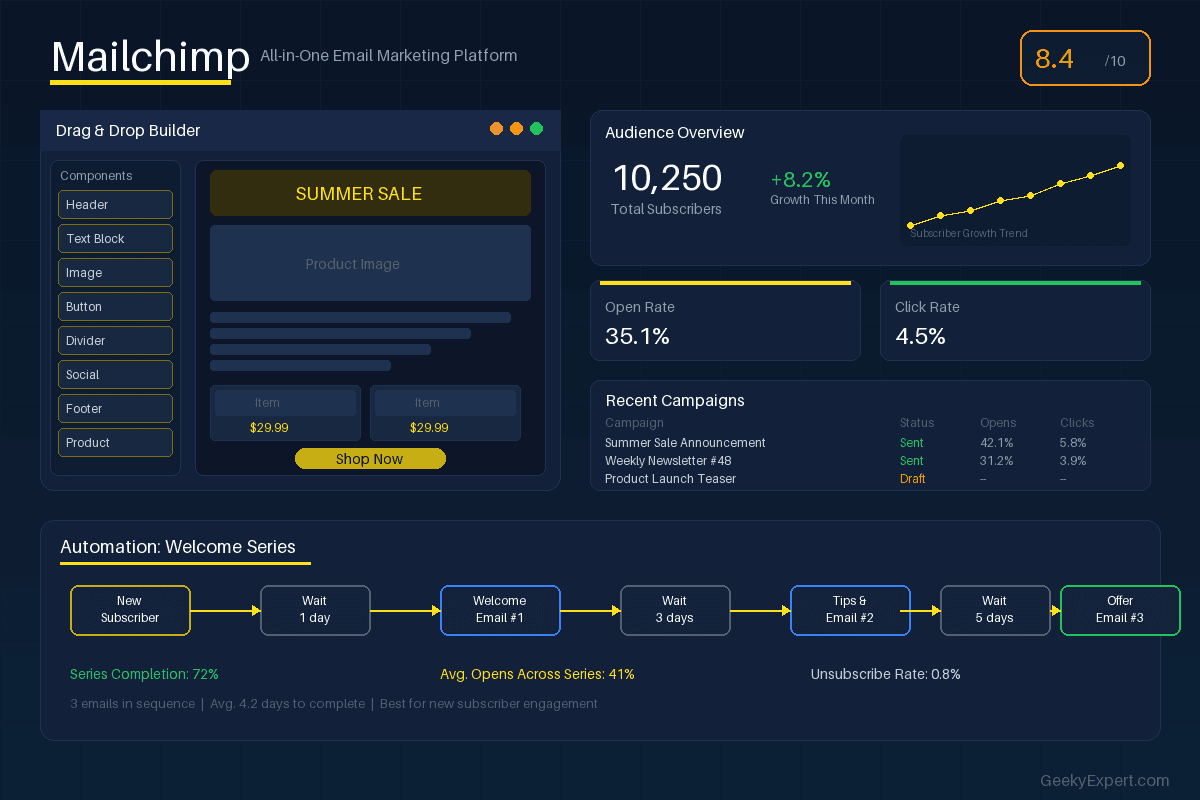
Mailchimp is the most recognized email marketing platform globally and the best starting point for ecommerce beginners in 2026. Owned by Intuit since 2021, Mailchimp serves over 11 million users and is the default email tool for many first-time store owners. Its strength lies in the polished drag-and-drop email builder, familiar interface, and broad marketing toolkit that extends beyond ecommerce into social media posting, landing pages, and basic CRM. However, for dedicated ecommerce email marketing, Mailchimp now trails both Klaviyo and Omnisend on Shopify integration depth, ecommerce-specific automation, segmentation granularity, and multichannel capabilities. Mailchimp's Shopify integration relies on a third-party connector after the native partnership ended, and its automation builder (Customer Journey Builder) is less ecommerce-focused than either competitor.
MAILCHIMP VERIFIED CAPABILITIES (2026)
| Attribute | Detail |
|---|---|
| Pricing (Standard) | Free (250 contacts) | $20/mo (500) | $100/mo (5K) | $275/mo (25K) | $450/mo (50K) |
| Plans available | Free | Essentials ($13/mo) | Standard ($20/mo) | Premium ($350/mo) |
| Shopify integration | Third-party connector (not native) |
| Owner | Intuit Inc. (NASDAQ: INTU), acquired 2021 for $12B |
| User base | 11+ million users globally |
| Best fit | Beginners, content-first brands, non-ecommerce-first businesses |
Honest Limitation
The Shopify integration is the biggest weakness. After the Mailchimp-Shopify partnership ended, the current connection via third-party connectors is less seamless than Klaviyo's or Omnisend's native Shopify apps. Real-time behavioral data sync (browse abandonment, live cart contents) is limited compared to both competitors. The automation builder (Customer Journey Builder) supports branching and conditions but is fundamentally less ecommerce-oriented -- you will not find pre-built flows for browse abandonment, price drop alerts, or back-in-stock notifications out of the box. Segmentation is the most basic of the three platforms: no predictive CLV, no churn risk scoring, and audience predictions are less actionable than Klaviyo's machine learning models. SMS is limited to the US and UK and was added late relative to Klaviyo and Omnisend. No web push notifications at all. Pricing has increased significantly -- Mailchimp cut the free plan from 500 to 250 contacts in early 2026 and raised legacy plan prices by 11-13% in April 2026. At 25,000 contacts, Mailchimp Standard at $275 per month is more expensive than Omnisend Standard at $180 per month while offering fewer ecommerce features. The platform charges based on all contacts (including unsubscribed that you have not archived), which inflates costs. Mailchimp is a general-purpose email platform that happens to support ecommerce, while Klaviyo and Omnisend are ecommerce platforms that happen to send email -- that architectural difference matters.
Best For
First-time store owners and ecommerce beginners who want the easiest onboarding experience and most familiar interface. Content-first brands (blogs, media, publishers) that also sell products but where email newsletters are the primary use case rather than transactional ecommerce flows. Businesses already deeply invested in the Mailchimp ecosystem with existing automations, templates, and integrations that would be costly to migrate. Non-Shopify stores on platforms like Squarespace or Wix where Mailchimp's integration quality is on par with competitors. Not recommended for Shopify-first stores (use Klaviyo or Omnisend), stores needing advanced ecommerce automation (Klaviyo), stores wanting bundled multichannel email + SMS + push (Omnisend), or stores with 10,000+ contacts where Mailchimp's pricing delivers less ecommerce value per dollar than Omnisend.
Frequently Asked Questions
Is Klaviyo better than Mailchimp for ecommerce?
Yes, Klaviyo is significantly better than Mailchimp for ecommerce in 2026. Klaviyo offers a native Shopify integration with real-time behavioral data sync (browse behavior, cart contents, purchase history), predictive analytics including customer lifetime value and churn risk scoring, revenue attribution per flow and campaign, and 350+ ecommerce-specific integrations.
Mailchimp's Shopify integration relies on a third-party connector that is less seamless, its automation builder is simpler with fewer ecommerce-specific templates, and it lacks predictive analytics for ecommerce. However, Klaviyo costs more -- $400 per month at 25,000 contacts versus Mailchimp's $275 for Standard -- and Mailchimp has a better email builder and is easier to learn. For stores generating under $100K in annual revenue with basic email needs, Mailchimp may be sufficient.
For stores above $500K revenue that need data-driven segmentation and automation, Klaviyo delivers measurably better ROI through higher revenue per email.
How much does Klaviyo cost compared to Omnisend?
Klaviyo is consistently more expensive than Omnisend at every contact tier in 2026. At 5,000 contacts, Klaviyo's email-only plan costs $100 per month versus Omnisend Standard at $81 per month. At 25,000 contacts, Klaviyo costs $400 per month versus Omnisend at approximately $180 per month -- more than double. At 50,000 contacts, Klaviyo is $720 per month versus Omnisend at approximately $330 per month.
Omnisend also includes SMS credits and web push notifications in its Standard plan, while Klaviyo charges separately for SMS and does not offer native push notifications. However, Klaviyo's higher price includes deeper segmentation with real-time behavioral data, predictive analytics (CLV, churn risk, next order date), and more advanced flow logic that can generate higher revenue per email for data-savvy ecommerce brands.
The value calculation depends on your store's revenue and data sophistication.
Which is the best email marketing tool for Shopify stores?
Klaviyo is the best email marketing tool for Shopify stores in 2026. It offers the deepest native Shopify integration, syncing real-time browse behavior, purchase history, cart data, and customer properties with no delay. Klaviyo has approximately 76,000 active Shopify installs and is the de facto standard for serious Shopify brands. Omnisend is the best budget alternative with a strong native Shopify app and over 100,000 active installs on the Shopify App Store.
Mailchimp's Shopify integration is the weakest of the three, relying on a third-party connector after the native partnership ended.
For Shopify stores specifically: choose Klaviyo if your store generates $500K+ revenue and needs advanced segmentation and predictive analytics; choose Omnisend if your store is under $500K revenue and wants email plus SMS plus push in one affordable platform; choose Mailchimp only if you are already deeply invested in the Mailchimp ecosystem and have minimal Shopify-specific automation needs.
Can I migrate from Mailchimp to Klaviyo or Omnisend?
Yes, both Klaviyo and Omnisend offer migration tools to move from Mailchimp. Klaviyo provides a one-click Mailchimp import that transfers contacts, lists, segments, templates, and historical campaign data -- the migration typically takes 1-3 hours for lists under 100,000 contacts. Omnisend also offers a Mailchimp import tool that transfers contacts and segments. For both platforms, you will need to rebuild automation flows manually since flow logic does not transfer between platforms.
Best practice: run both platforms in parallel for 2-4 weeks during the transition. Migrate your automations one flow at a time, starting with the highest-revenue flows (abandoned cart, welcome series, post-purchase). Verify deliverability and performance metrics match your Mailchimp benchmarks before fully cutting over. Budget 2-4 weeks for a clean migration. Do not cancel Mailchimp until you have confirmed that all critical automations are live and performing on the new platform.
Does Omnisend work with WooCommerce?
Yes, Omnisend has a native WooCommerce plugin that is generally rated higher than Klaviyo's WooCommerce integration. Omnisend's WooCommerce plugin syncs order data, customer profiles, product catalogs, and cart information directly. It supports pre-built ecommerce automation flows including abandoned cart recovery, order confirmation, shipping updates, browse abandonment, and post-purchase follow-ups.
The plugin installs directly from the WordPress plugin repository and connects to your WooCommerce store in minutes. Klaviyo also supports WooCommerce but its integration is newer and less mature than its Shopify integration. Mailchimp has WooCommerce support but lacks the ecommerce-specific automation depth of both Klaviyo and Omnisend.
For WooCommerce stores specifically, Omnisend is the recommended first choice for its balance of integration quality, multichannel features (email plus SMS plus push), and pricing. Choose Klaviyo for WooCommerce only if you need its predictive analytics and are willing to pay the premium.
Is Omnisend good for SMS marketing alongside email?
Yes, Omnisend is the best value option for combined email and SMS marketing in 2026. Omnisend's Standard plan includes SMS credits bundled with your email subscription, and you can build unified automation flows that combine email, SMS, and web push notifications in a single workflow. SMS pricing is credit-based at approximately $0.015 per US message and $0.045 per international message.
This multichannel bundling is Omnisend's key differentiator: an abandoned cart flow can send an email first, then an SMS if the email is not opened within 4 hours, then a push notification the next day -- all configured in one workflow. Klaviyo also offers SMS but charges separately from email, making the total cost higher. Mailchimp added SMS support but it is limited to the US and UK and lacks the workflow integration depth of Omnisend and Klaviyo.
Note that SMS is no longer available on the Omnisend free plan for accounts created after May 4, 2026.
What are the free plan limits for Klaviyo, Mailchimp, and Omnisend?
All three platforms offer free plans with tight limits in 2026. Klaviyo Free supports up to 250 active profiles with 500 email sends per month and includes basic automation flows and segmentation, but no SMS. Omnisend Free supports 250 contacts with 500 emails per month and 500 web push notifications per month, plus access to all automation workflow templates, but no SMS on accounts created after May 2026.
Mailchimp Free supports 250 contacts with 500 emails per month (250 per day limit) and includes basic email templates but limited automation and no SMS. Of the three, Omnisend's free plan is the most ecommerce-friendly because it includes automation workflow templates and web push notifications at no cost. Klaviyo's free plan gives access to its segmentation engine but 250 profiles is not enough data for meaningful segmentation. Mailchimp's free plan is the most limited for ecommerce use cases.
All three free plans are suitable for testing the platform but not for running a real ecommerce email program -- expect to move to a paid plan once you reach 300-500 contacts.
About Geeky Expert
Geeky Expert is a leading provider of research and insights, dedicated to helping businesses make informed decisions through comprehensive analysis.