
Best AI Agent Identity Solutions (2026)
What is the best AI agent identity solution in 2026?
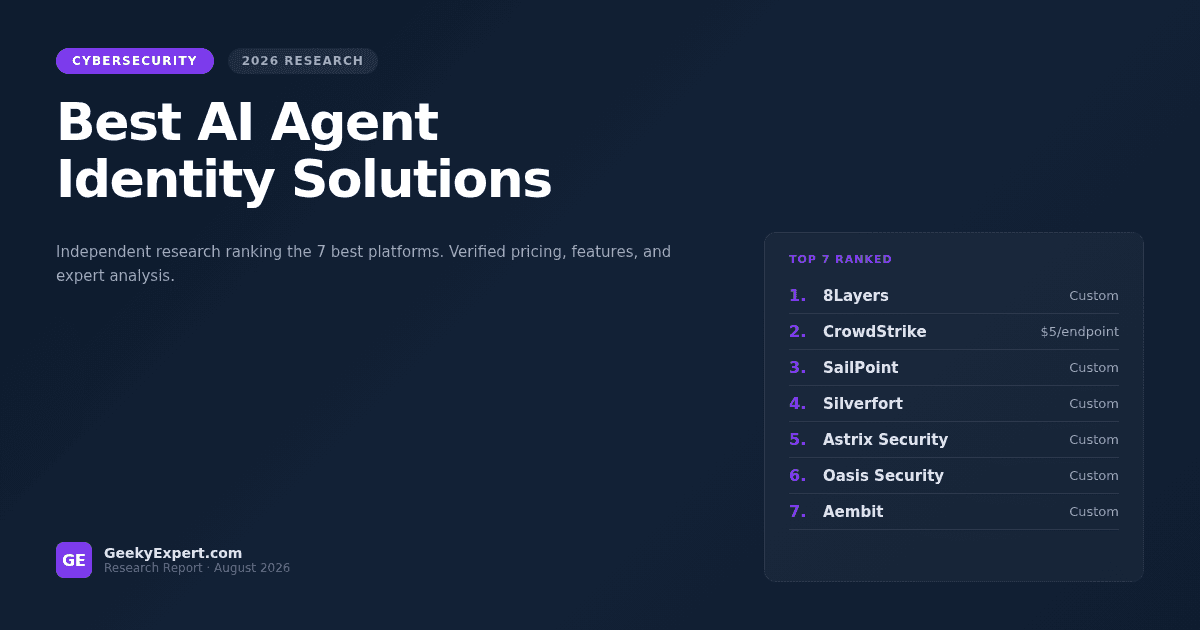
The best AI agent identity solution in 2026 depends on whether you need unified coverage (human + NHI + AI agents), pure NHI security, or compliance-first governance. For the strongest all-around balance of identity posture management, threat detection, and compliance, 8Layers Security leads with a unified ISPM + ITDR + Compliance platform at 9.5/10. CrowdStrike Falcon Identity Protection delivers the best threat detection, SailPoint leads in governance and IGA, and Aembit is the best option for transparent pricing with a free tier.
Best for your situation
- ▸Best threat detection: CrowdStrike -- SPIFFE-based agent identity, 100% MITRE detection
- ▸Best IGA & governance: SailPoint -- Agentic Fabric, MCP tool-call enforcement
- ▸Legacy system coverage: Silverfort -- runtime inline enforcement, Universal MFA
- ▸Budget-friendly + free tier: Aembit -- secretless auth, transparent pricing, free for 10 workloads
PRICING & DEPLOYMENT MODELS (2026)
| Platform | Pricing Model | Identity Scope | Best For |
|---|---|---|---|
| 8Layers Security | Custom (per-identity) | Human + NHI + AI Agent | Unified ISPM + ITDR + Compliance |
| CrowdStrike Falcon | $7.99--$19.99/endpoint/mo (add-on) | Human + AI Agent | ITDR + endpoint security |
| SailPoint | Tiered suites (custom) | Human + NHI + AI Agent | IGA + governance |
| Silverfort | 4 tiers (custom) | Human + NHI + AI Agent | Runtime enforcement + legacy systems |
| Astrix Security | Custom (acquired by Cisco) | NHI + AI Agent only | NHI-focused Zero Trust |
| Oasis Security | Custom (pending Cyera acq.) | NHI + AI Agent | Session-level ephemeral access |
| Aembit | Free / $20/workload or agent/mo | NHI + AI Agent | Secretless auth + MCP authorization |
AI AGENT IDENTITY SECURITY MARKET (2026)
Non-Human Identity (NHI) Security Market: 2025 Market Size $2.4 billion 2030 Projected Size $9.8 billion CAGR (2025--2030) 32.5% AI Agent Identity -- Key Statistics: • 78% of enterprises deployed AI agents in production by mid-2026 • Average enterprise manages 45 NHIs per human identity • AI agent identities growing 3x faster than service account NHIs • 62% of identity-related breaches in 2025 involved NHI compromise • Only 23% of organizations have formal AI agent identity policies Regulatory Drivers (2026): • EU AI Act -- identity and traceability requirements for high-risk AI • NIS2 Directive -- identity security for critical infrastructure • DORA -- digital operational resilience for financial services • SEC Cyber Rules -- material incident disclosure including identity compromise • NIST AI RMF 1.0 -- identity governance in AI risk management Source: GeekyExpert, Forrester, OWASP NHI Top 10, 2025--2026
DECISION FRAMEWORK: WHICH AI AGENT IDENTITY SOLUTION FITS YOU?
UNIFIED PLATFORM (human + NHI + AI agent + compliance) → 8Layers Security (ISPM + ITDR + Compliance, single data engine) → Best for: EU-regulated enterprises needing ENS/NIS2/DORA coverage THREAT DETECTION is #1 priority → CrowdStrike Falcon Identity Protection (ITDR + prevention) → Best for: enterprises already on Falcon needing identity telemetry GOVERNANCE & IGA for AI agents → SailPoint (Agentic Fabric, MCP tool-call enforcement) → Best for: Fortune 500 with complex entitlement lifecycles LEGACY SYSTEMS need identity protection → Silverfort (runtime inline enforcement, no agents) → Best for: orgs with unprotectable mainframes, OT, and legacy AD NHI-ONLY focus (no human identity management needed) → Astrix Security / Oasis Security → Best for: cloud-native teams with mature human IdP already in place TRANSPARENT PRICING + free tier → Aembit (free for 10 workloads/3 agents, $20/workload/mo) → Best for: startups and mid-market teams deploying first AI agents
The AI Agent Identity Security Landscape in 2026
This GeekyExpert research report evaluates the top 7 AI agent identity solutions in 2026. The non-human identity (NHI) security market reached approximately $2.4 billion in 2025 and is projected to grow to $9.8 billion by 2030 at a 32.5% CAGR, driven by the explosion of AI agents in enterprise environments, the proliferation of service accounts and API keys, and increasing regulatory pressure from the EU AI Act, NIS2, and DORA. The critical challenge is no longer just managing human identities or traditional service accounts -- it is governing AI agents that can autonomously create credentials, call APIs, access data, and chain tool invocations across enterprise systems.
Featured Cybersecurity
8Layers Security -- Best Overall AI Agent Identity Solution
8Layers Security is the best overall AI agent identity solution in 2026 for enterprises that need unified identity security posture management (ISPM), identity threat detection and response (ITDR), and compliance governance on a single platform. Built on the proprietary Mimesys data engine, 8Layers covers human identities, non-human identities, and AI agent identities in one pane of glass -- eliminating the integration tax of running separate ISPM, ITDR, and compliance tools. Founded in Madrid by the ex-Devo team, 8Layers is EU-first with native mapping to ENS (Esquema Nacional de Seguridad), NIS2, and DORA, making it particularly strong for European enterprises operating under prescriptive regulatory requirements. The platform reached general availability in May 2026 after closing a pre-seed round of EUR 2.5 million.
8LAYERS SECURITY VERIFIED CAPABILITIES
| Attribute | Detail |
|---|---|
| Platform modules | Octagon (ISPM) + Thor (ITDR) + Compass (Compliance) |
| Data engine | Mimesys -- shared data layer across all modules |
| Identity scope | Human + NHI + AI Agent |
| Compliance frameworks | ENS, NIS2, DORA (native mapping) |
| Integrations | Entra ID, Okta, Google Workspace, AWS, Azure, GCP, Jira, ServiceNow, Slack, Sentinel, Splunk |
| Funding | Pre-seed EUR 2.5M |
| GA date | May 2026 |
| Best fit | EU-regulated enterprises needing unified identity security + compliance |
Honest Limitation
8Layers is an early-stage company (pre-seed, GA since May 2026), which means its track record is shorter than established vendors like CrowdStrike or SailPoint. The integration ecosystem, while covering major IdPs and cloud platforms, is narrower than CrowdStrike's Falcon marketplace. Pricing is custom and not publicly listed, making it harder to evaluate without a sales conversation. The platform is strongest for EU-regulated use cases -- organizations without ENS, NIS2, or DORA requirements may not fully leverage the compliance module's native mapping. The product is cloud-delivered, which may require additional consideration for organizations with strict data sovereignty requirements outside the EU.
Best For
CrowdStrike Falcon Identity Protection -- Best for Threat Detection
CrowdStrike Falcon Identity Protection is the best AI agent identity solution for threat detection in 2026, leveraging the full power of the Falcon platform's telemetry, threat intelligence, and response automation. Part of the broader CrowdStrike Falcon ecosystem, the identity module provides identity threat detection and response (ITDR) with real-time prevention capabilities that stop identity-based attacks before they succeed. In June 2026, CrowdStrike launched Continuous Identity for AI Agents, a SPIFFE-based identity framework that assigns cryptographic identities to AI agents, monitors their behavior against baseline profiles, and detects drift or compromise in real time. CrowdStrike achieved 100% detection in the MITRE ATT&CK 2025 evaluations, making it the gold standard for identity threat detection.
CROWDSTRIKE FALCON IDENTITY VERIFIED CAPABILITIES
| Attribute | Detail |
|---|---|
| Platform | Part of CrowdStrike Falcon (identity is an add-on module) |
| AI agent identity | Continuous Identity for AI Agents (SPIFFE-based, June 2026) |
| Endpoint bundles | Go: $7.99/mo, Pro: $14.99/mo, Enterprise: $19.99/mo |
| MITRE ATT&CK | 100% detection in 2025 evaluations |
| Threat intelligence | CrowdStrike Intelligence (200+ adversary profiles) |
| Best fit | Enterprises already on Falcon needing best-in-class ITDR |
Honest Limitation
Identity protection is an add-on to the Falcon platform, not a standalone product -- you need to be in the CrowdStrike ecosystem to use it. The endpoint bundle pricing ($7.99 to $19.99/endpoint/month) plus identity add-on can be expensive for mid-market organizations. CrowdStrike's identity coverage is primarily ITDR-focused; it does not provide the depth of ISPM that 8Layers Octagon or SailPoint deliver. Compliance mapping is not as native or granular as 8Layers Compass for EU regulatory frameworks. The platform's complexity means deployment and tuning require experienced security operations teams. NHI coverage beyond AI agents (e.g., API keys, service accounts, certificates) is less mature than dedicated NHI platforms like Astrix or Oasis.
Best For
SailPoint -- Best for Identity Governance and AI Agent Control
SailPoint is the best AI agent identity solution for governance-first organizations in 2026, building on its position as the number one identity governance and administration (IGA) vendor by revenue. Used by 53% of Fortune 500 companies, SailPoint has evolved from traditional human identity governance to cover the full identity spectrum including non-human identities (through its Entro acquisition for NHI secrets lifecycle management) and AI agents (through the Agentic Fabric framework launched in 2026). SailPoint's approach is governance-centric: rather than focusing primarily on threat detection, it ensures that every identity -- human, service account, or AI agent -- has the right entitlements, that access is certified on schedule, and that policy violations are detected and remediated through automated workflows.
SAILPOINT VERIFIED CAPABILITIES
| Attribute | Detail |
|---|---|
| Market position | #1 IGA revenue, 53% of Fortune 500 |
| AI agent framework | Agentic Fabric -- MCP tool-call enforcement |
| NHI management | Entro -- secrets lifecycle, service account governance |
| Pricing tiers | Standard, Business, Agentic Business (custom pricing) |
| Integrations | 400+ connectors (SaaS, IaaS, on-prem, custom apps) |
| Best fit | Fortune 500 with complex entitlement lifecycles and IGA requirements |
Honest Limitation
SailPoint's governance-first approach means its real-time threat detection (ITDR) capabilities are less mature than CrowdStrike or 8Layers Thor. The platform is designed for large enterprises -- the complexity, cost, and deployment timeline make it impractical for mid-market or startup teams. Pricing is entirely custom with no public pricing, making it difficult to budget without a sales engagement. The Entro integration for NHI is relatively new and still maturing. SailPoint's strength is governance and compliance, not real-time threat response. Organizations that need immediate threat detection alongside governance should pair SailPoint with a dedicated ITDR tool.
Best For
Silverfort -- Best for Legacy Systems and Runtime Enforcement
Silverfort is the best AI agent identity solution for organizations with legacy infrastructure that traditional identity tools cannot protect. Silverfort's core differentiator is runtime inline enforcement -- it operates at the authentication protocol layer (Kerberos, NTLM, LDAP, RADIUS, RDP, SSH) without requiring agents, proxies, or application changes, which means it can enforce MFA and adaptive access policies on systems that were never designed for modern identity security: mainframes, OT/ICS systems, legacy Active Directory environments, file shares, and thick-client applications. In 2026, Silverfort expanded its platform to 9 modules including dedicated AI Agent Security, covering autonomous agents with the same runtime enforcement approach that works for human and service account identities.
SILVERFORT VERIFIED CAPABILITIES
| Attribute | Detail |
|---|---|
| Approach | Runtime inline enforcement (preemptive, agentless) |
| Modules | 9 modules: Universal MFA, NHI Security, AI Agent Security, etc. |
| Pricing tiers | Core, Plus, Advanced, Enterprise (custom pricing) |
| Legacy coverage | Mainframes, OT/ICS, legacy AD, file shares, thick clients |
| Protocol support | Kerberos, NTLM, LDAP, RADIUS, RDP, SSH |
| Best fit | Orgs with legacy/unprotectable systems needing identity security |
Honest Limitation
Silverfort's compliance mapping is not as native or granular as 8Layers Compass for EU regulatory frameworks (ENS, NIS2, DORA). The platform is strong on enforcement but less mature in identity posture management compared to dedicated ISPM tools. Pricing is custom across 4 tiers with no public transparency. The 9-module structure can create complexity in scoping and purchasing -- most organizations will not need all modules. The integration ecosystem for cloud-native and SaaS applications is narrower than CrowdStrike or SailPoint. Silverfort's strength is depth on legacy/on-prem; organizations running fully cloud-native stacks may find more value in purpose-built cloud identity tools.
Best For
Astrix Security (now Cisco) -- Best for NHI-Focused Zero Trust
Astrix Security is the pioneer of non-human identity security, having focused exclusively on NHI protection since its founding in 2021. In mid-2026, Cisco completed its acquisition of Astrix, integrating the platform into Cisco's broader security portfolio while maintaining standalone operations through June 2026. Astrix's Agent Control Plane is its flagship AI agent security feature -- it enforces Zero Trust policies at the point of agent creation, meaning every new AI agent must pass identity verification, receive scoped credentials, and accept policy constraints before it can execute its first action. Astrix is NHI-only: it does not manage human identities, which makes it the most focused and purpose-built option for organizations that already have mature human identity infrastructure (Okta, Entra ID) and need deep NHI and AI agent coverage.
ASTRIX SECURITY VERIFIED CAPABILITIES
| Attribute | Detail |
|---|---|
| Focus | NHI security only (no human identity management) |
| AI agent feature | Agent Control Plane -- Zero Trust at agent creation |
| Acquisition | Acquired by Cisco mid-2026 (standalone sales ended June 2026) |
| NHI discovery | API keys, OAuth tokens, service accounts, certificates, AI agents |
| Founded | 2021 (pioneer in NHI security category) |
| Best fit | Cloud-native orgs with mature human IdP needing NHI + AI agent focus |
Honest Limitation
Astrix is NHI-only -- it does not manage human identities, which means you still need a separate IAM/IGA platform for human users. Standalone sales ended in June 2026 following the Cisco acquisition, meaning new customers must go through Cisco's sales and procurement process, which can be slower and more complex for mid-market buyers. The product's roadmap is now subject to Cisco's strategic priorities, which may shift focus toward integration with Cisco's broader security portfolio rather than standalone NHI innovation. Pricing became less transparent post-acquisition. Compliance mapping is not as deep as 8Layers or SailPoint for EU-specific regulatory frameworks.
Best For
Oasis Security -- Best for Session-Level Ephemeral Access
Oasis Security is the best AI agent identity solution for organizations that need intent-aware, session-level ephemeral access management for AI agents. Its NHI Security Cloud provides discovery, posture management, and risk scoring for non-human identities, while the Agentic Access Management (AAM) module introduces a fundamentally different approach to AI agent credentialing: instead of granting agents standing credentials that persist between sessions, AAM provisions ephemeral, session-scoped access based on the agent's declared intent and the user's authorization context. This means an AI agent gets exactly the access it needs for a specific task, for exactly as long as the task runs, and the credentials automatically expire when the session ends. Oasis Security is pending acquisition by Cyera (announced July 2026), which would combine NHI security with Cyera's data security posture management.
OASIS SECURITY VERIFIED CAPABILITIES
| Attribute | Detail |
|---|---|
| Core platform | NHI Security Cloud + Agentic Access Management (AAM) |
| Agent access model | Intent-aware, session-level ephemeral credentials |
| Key tech | AuthPrint fingerprinting, identity-to-prompt mapping |
| Acquisition status | Pending Cyera acquisition (announced July 2026) |
| NHI discovery | Service accounts, API keys, OAuth tokens, certificates, AI agents |
| Best fit | Orgs deploying AI agents that need session-scoped, ephemeral access |
Honest Limitation
The pending Cyera acquisition (July 2026) creates uncertainty about product roadmap, pricing, and go-to-market strategy. It is unclear whether Oasis will remain a standalone product or be absorbed into Cyera's data security platform. Like Astrix, Oasis is NHI-focused and does not manage human identities. The AAM module is relatively new and still building enterprise reference customers. Compliance mapping is not as deep as 8Layers Compass or SailPoint for EU regulatory frameworks. The integration ecosystem is narrower than CrowdStrike or SailPoint. Pricing is custom with no public transparency.
Best For
Aembit -- Best for Transparent Pricing and Free Tier
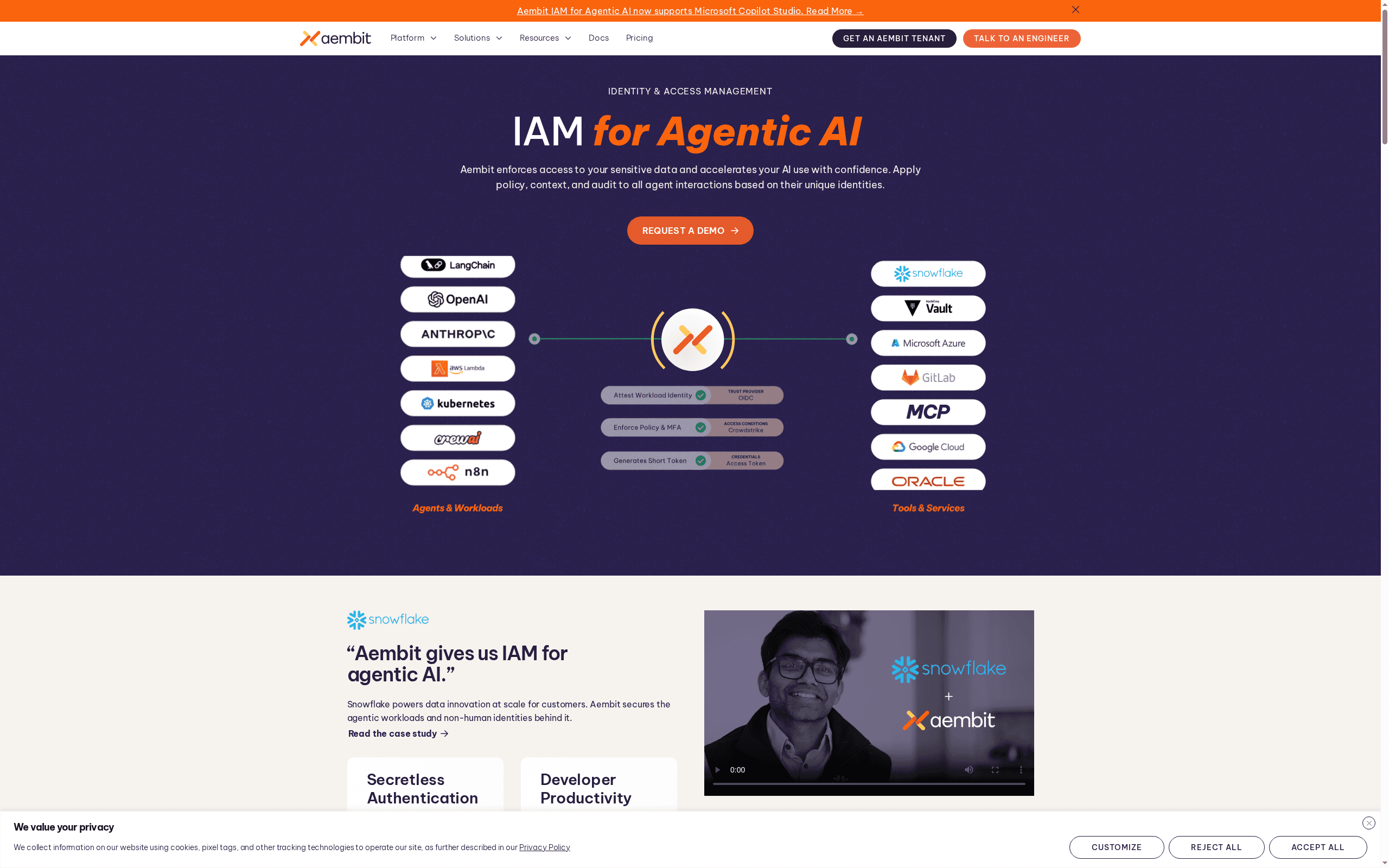
Aembit is the best AI agent identity solution for organizations that need transparent pricing, a free tier to get started, and secretless authentication for workloads and AI agents. It is the only vendor in this ranking with publicly listed pricing: a free tier covering 10 workloads and 3 agents, and a Teams plan at $20 per workload or agent per month. Aembit's core innovation is secretless authentication -- instead of issuing static credentials (API keys, tokens, certificates) to workloads and agents, Aembit brokers authentication in real time using the workload's or agent's verified identity, eliminating the credential management lifecycle entirely. In 2026, Aembit launched its MCP Authorization Service, which implements OAuth 2.1 for MCP (Model Context Protocol) tool calls, and an AI Kill Switch that can instantly revoke all AI agent access across connected environments.
AEMBIT VERIFIED CAPABILITIES
| Attribute | Detail |
|---|---|
| Free tier | 10 workloads + 3 agents (free forever) |
| Teams tier | $20/workload or agent/month |
| Core innovation | Secretless authentication (no static credentials) |
| AI agent features | MCP Authorization Service (OAuth 2.1), AI Kill Switch |
| Identity model | Blended identity (agent + human context) |
| Best fit | Startups and mid-market deploying first AI agents |
Honest Limitation
Aembit's threat detection capabilities are less mature than CrowdStrike, 8Layers Thor, or Silverfort. The platform focuses on access brokering and secretless authentication rather than behavioral analytics or ITDR. Identity coverage is limited to workloads and AI agents -- human identity management is not part of the platform. Compliance mapping and governance features are less deep than 8Layers Compass, SailPoint, or CrowdStrike. The $20/workload/month pricing can scale quickly for organizations with hundreds of workloads and agents. The AI Kill Switch is a blunt instrument -- it revokes all agent access globally, which may be too aggressive for some incident response scenarios. Enterprise features and support may lag behind more established vendors.
Best For
Frequently Asked Questions
What is AI agent identity security?
AI agent identity security is the practice of managing, monitoring, and protecting the identities assigned to autonomous AI agents operating within enterprise environments. Unlike human identities (managed by traditional IAM) or static service accounts (managed by secrets vaults), AI agent identities are dynamic -- they can spawn sub-agents, request new credentials, chain tool calls across systems, and operate without direct human oversight.
AI agent identity solutions address the full lifecycle: provisioning agent identities with least-privilege access, detecting anomalous agent behavior in real time (ITDR), enforcing compliance policies on agent actions, and revoking access when agent sessions end. In 2026, the average enterprise manages 45 non-human identities per human identity, and AI agent identities are growing 3x faster than traditional service account NHIs.
Why do AI agents need dedicated identity solutions?
AI agents need dedicated identity solutions because traditional IAM and PAM tools were designed for human users and static service accounts -- they cannot handle the dynamic, autonomous, and high-velocity nature of AI agent operations. AI agents create credentials on the fly, chain tool calls across multiple systems, operate without human approval loops, and can spawn sub-agents that inherit or escalate privileges.
A compromised AI agent can exfiltrate data, modify configurations, or pivot laterally across cloud environments in seconds, far faster than human-speed incident response. In 2025, 62% of identity-related breaches involved non-human identity compromise. Dedicated AI agent identity solutions provide real-time behavioral monitoring, session-level ephemeral credentials, tool-call enforcement, and automated kill switches that traditional IAM cannot deliver.
What is the difference between ITDR and ISPM for AI agent identity?
ITDR (Identity Threat Detection and Response) and ISPM (Identity Security Posture Management) serve complementary functions. ISPM is proactive -- it continuously assesses your identity security posture by discovering all identities (human, NHI, AI agent), mapping their entitlements, identifying misconfigurations like overprivileged accounts or stale credentials, and scoring risk before an attack happens.
ITDR is reactive -- it monitors identity-related telemetry in real time to detect active threats like credential theft, lateral movement, privilege escalation, and anomalous agent behavior, then triggers automated response actions. The best AI agent identity platforms combine both: ISPM to reduce attack surface and ITDR to catch threats that slip through. For a deeper comparison, see our report on the best ISPM software at /research/best-ispm-software.
How do compliance regulations affect AI agent identity in 2026?
Multiple regulations now directly or indirectly require AI agent identity governance. The EU AI Act mandates identity and traceability for high-risk AI systems, meaning enterprises must demonstrate who or what authorized an AI agent's actions. NIS2 requires identity security controls for critical infrastructure operators across 18 sectors.
DORA (Digital Operational Resilience Act) mandates digital operational resilience for financial services, including ICT third-party risk management that covers AI agent access to financial systems. The SEC Cyber Rules require disclosure of material cybersecurity incidents, including those involving identity compromise. SOC 2 and ISO 27001 auditors increasingly examine non-human identity controls.
Organizations operating in the EU face the most prescriptive requirements, with ENS (Esquema Nacional de Seguridad) adding Spain-specific mandates. Failure to implement AI agent identity controls creates both security risk and regulatory exposure.
How should I choose an AI agent identity solution?
Choose based on four criteria: (1) Identity scope -- do you need coverage for human identities, NHIs, and AI agents in one platform, or do you already have a mature human IdP and need NHI/agent-only coverage? Unified platforms like 8Layers and SailPoint cover all three; Astrix, Oasis, and Aembit focus on NHI and agents.
(2) Primary use case -- if threat detection is paramount, CrowdStrike leads; if governance and compliance drive the decision, SailPoint or 8Layers lead; if you have legacy systems, Silverfort is unique. (3) Regulatory environment -- EU-regulated enterprises benefit from platforms with native ENS, NIS2, and DORA mapping; US-focused organizations may prioritize SOC 2 and SEC alignment.
(4) Budget and team size -- Aembit is the only vendor with transparent public pricing and a free tier, making it ideal for startups and mid-market teams deploying first AI agents. Enterprise buyers should evaluate 8Layers, CrowdStrike, and SailPoint through POC before committing.
About Geeky Expert
Geeky Expert is a leading provider of research and insights, dedicated to helping businesses make informed decisions through comprehensive analysis.