
Best Machine Identity Management Solutions (2026)
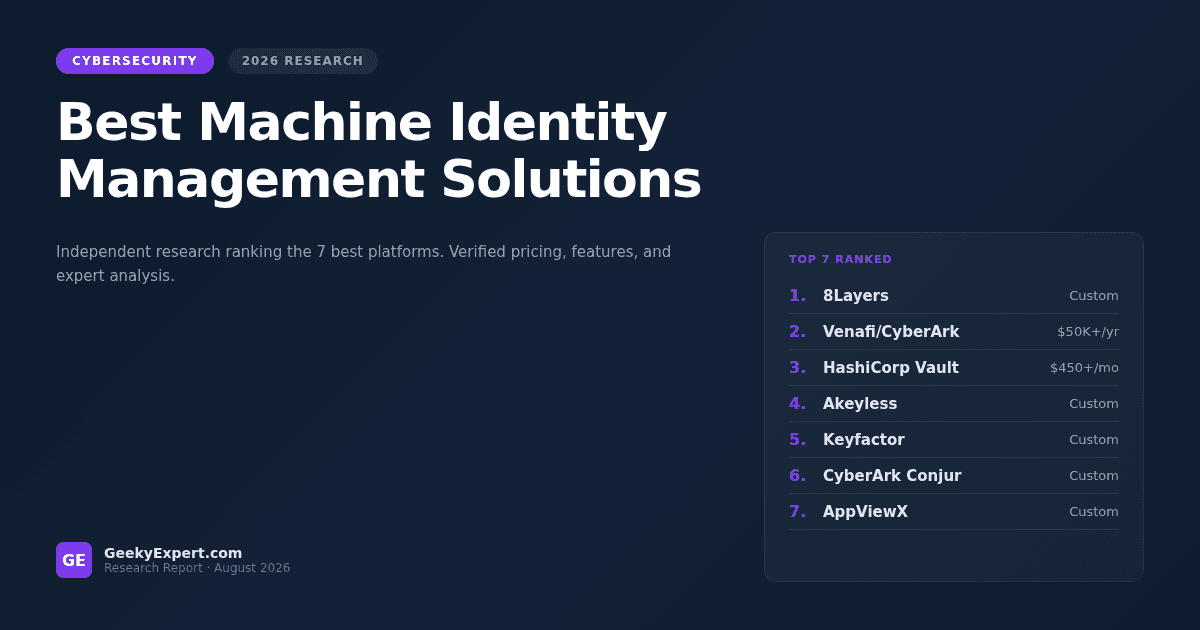
What is the best machine identity management solution in 2026?
The best machine identity management solution in 2026 depends on whether you need full non-human identity security (ITDR + ISPM + compliance), certificate lifecycle management, dynamic secrets, or PKI automation. For the strongest all-around coverage of non-human identities -- service accounts, API keys, certificates, and AI agents -- 8layers leads with unified ITDR, ISPM, and compliance automation. Venafi (CyberArk) is the enterprise standard for certificate lifecycle, HashiCorp Vault excels at dynamic secrets, and Keyfactor is the top choice for PKI and crypto-agility.
Best for your situation
- ▸Enterprise certificate lifecycle: Venafi (CyberArk) -- TLS/SSL, code signing, SSH key management
- ▸Dynamic secrets management: HashiCorp Vault -- short-lived credentials, KV store, transit encryption
- ▸SaaS-native secrets: Akeyless -- zero-knowledge encryption, hybrid SaaS deployment
- ▸PKI & crypto-agility: Keyfactor -- CA-agnostic PKI, post-quantum readiness
- ▸DevOps secrets (regulated): CyberArk Conjur -- CI/CD, Kubernetes, FIPS-validated
- ▸Post-quantum cert automation: AppViewX -- AVX ONE, PQC readiness, hybrid multi-cloud CLM
VERIFIED PRICING DATA (2026)
| Platform | Starting Price | Deployment | Best For |
|---|---|---|---|
| 8layers | Custom (per-identity model) | Cloud (EU-hosted) | Best overall NHI security |
| Venafi (CyberArk) | Custom (~$50K+/year) | Cloud / On-prem / Hybrid | Enterprise certificate lifecycle |
| HashiCorp Vault (IBM) | Free (Community) / ~$450/mo (HCP) | Self-hosted / HCP Cloud | Dynamic secrets management |
| Akeyless | Free tier / Enterprise custom | SaaS / Hybrid SaaS | SaaS-native secrets management |
| Keyfactor | Custom (~$75K-$200K/year) | Cloud / On-prem / PKIaaS | PKI and crypto-agility |
| CyberArk Conjur | Free OSS / ~$1,000-1,500/identity/yr | Self-hosted / Cloud | DevOps secrets (regulated) |
| AppViewX | Custom pricing only | Cloud / On-prem / Hybrid | Post-quantum cert automation |
MACHINE IDENTITY MANAGEMENT MARKET (2026)
Global Machine Identity Management Market: 2025 Market Size $9.8 billion 2030 Projected Size $28.4 billion CAGR (2025--2030) 23.7% Non-Human Identities vs. Human Identities: • Avg enterprise: 45 machine identities per human identity • Cloud-native orgs: 100+ NHIs per human user • 68% of breaches in 2025 involved compromised NHIs Key Growth Drivers: • Explosive growth in service accounts, API keys, and cloud workloads • AI agent proliferation creating new identity surfaces • NIS2, DORA, and GDPR mandating NHI governance • 90-day TLS certificate lifetimes (Google/Apple push) • Post-quantum cryptography migration timelines Adoption by Maturity (2026): Post-quantum ready 12% of enterprises Full NHI visibility 34% of enterprises Basic cert management 71% of enterprises Source: GeekyExpert, Forrester, OWASP NHI Top 10, 2025--2026
WHAT TO OPTIMIZE FOR (2026)
FULL NHI SECURITY (ITDR + ISPM + compliance) → 8layers (unified risk scoring, NIS2/DORA/GDPR automation) → Best for orgs needing end-to-end non-human identity governance ENTERPRISE CERTIFICATE LIFECYCLE at scale → Venafi / CyberArk (TLS, SSH, code signing, Kubernetes) → Best for large enterprises with 100K+ certificates DYNAMIC SECRETS for DevOps / cloud-native → HashiCorp Vault (short-lived creds, transit encryption) → Best for platform engineering teams on multi-cloud SaaS-FIRST secrets with zero-knowledge encryption → Akeyless (DFC encryption, hybrid SaaS, CLM module) → Best for teams wanting Vault-like capabilities without ops burden PKI MODERNIZATION & post-quantum readiness → Keyfactor (CA-agnostic, EJBCA, crypto-agility) → Best for regulated industries preparing for PQC migration DevOps SECRETS in REGULATED environments → CyberArk Conjur (FIPS-validated, CI/CD, PAM ecosystem) → Best for financial services, defense, healthcare DevSecOps CERTIFICATE AUTOMATION with PQC timeline → AppViewX (AVX ONE, multi-cloud CLM, IDC leader) → Best for hybrid enterprises automating cert workflows
The Machine Identity Management Market in 2026
This GeekyExpert research report evaluates the top 7 machine identity management solutions in 2026. The global machine identity management market reached approximately $9.8 billion in 2025 and is projected to grow to $28.4 billion by 2030 at a 23.7% CAGR, driven by the explosive growth in non-human identities (NHIs) -- service accounts, API keys, certificates, tokens, and AI agents -- which now outnumber human identities by a factor of 45:1 in the average enterprise. OWASP published its first NHI Top 10 in 2025, and regulatory frameworks like NIS2 and DORA now explicitly require organizations to govern machine identities with the same rigor as human accounts. The core challenge is no longer whether to manage NHIs, but how to discover, monitor, and secure identities that are scattered across identity providers, cloud platforms, CI/CD pipelines, and Kubernetes clusters.
Featured Cybersecurity
8layers -- Best Overall Machine Identity Management Platform
8LAYERS VERIFIED CAPABILITIES
| Attribute | Detail |
|---|---|
| Pricing | Custom (per-identity model) |
| Core modules | ITDR + ISPM + Compliance Automation for NHIs |
| Identity coverage | Service accounts, API keys, certificates, tokens, AI agents |
| Integrations | Okta, Entra ID, Google Workspace, AWS, Azure, GCP |
| Compliance | NIS2, DORA, GDPR automated mapping and evidence |
| Best fit | Orgs needing end-to-end NHI governance with EU compliance |
Honest Limitation
8layers is an early-stage platform ($2.9M raised) and does not yet have the enterprise deployment track record of Venafi or CyberArk. Certificate lifecycle management (issuance, renewal, revocation) is not its primary focus -- if you need to manage 500K+ certificates, Venafi or Keyfactor is a better fit. Dynamic secrets generation (Vault-style short-lived credentials) is not part of the platform. Pricing is custom and per-identity, which can be difficult to forecast for organizations still discovering how many NHIs they have. The integration ecosystem, while covering major IdPs and clouds, is narrower than Vault or Venafi for niche infrastructure.
Best For
Organizations that need unified discovery, threat detection, posture management, and compliance automation across all non-human identities. Especially strong for EU-based enterprises under NIS2/DORA, mid-market and enterprise security teams managing NHIs across multiple IdPs and cloud platforms, and CISOs who need a single pane of glass for NHI risk rather than bolting together point solutions.
Venafi (CyberArk) -- Best for Enterprise Certificate Lifecycle Management
Venafi is the best machine identity management platform for enterprises that need to manage certificate lifecycles at massive scale. Acquired by CyberArk for $1.54 billion in October 2024, Venafi now operates as CyberArk's Machine Identity division, combining its market-leading certificate lifecycle management (CLM) with CyberArk's privileged access management (PAM) ecosystem. For organizations managing hundreds of thousands of TLS/SSL certificates, SSH keys, and code signing certificates across hybrid and multi-cloud infrastructure, Venafi remains the industry standard that other vendors benchmark against. The CyberArk acquisition positions Venafi as the bridge between human and machine identity security in a single enterprise platform.
VENAFI (CYBERARK) VERIFIED CAPABILITIES
| Attribute | Detail |
|---|---|
| Pricing | Custom (~$50K+/year enterprise) |
| Core modules | TLS/SSL CLM, SSH key management, code signing |
| Certificate scale | Proven at 500K+ certificates per enterprise |
| Cloud-native | Kubernetes-native with cert-manager integration |
| Parent company | CyberArk ($1.54B acquisition, Oct 2024) |
| Best fit | Large enterprises managing 100K+ certs across hybrid infrastructure |
Honest Limitation
Venafi is expensive -- enterprise pricing typically starts at $50K+/year and scales significantly with certificate volume. It is optimized for certificate lifecycle management rather than broader NHI governance (service accounts, API keys, OAuth tokens). The platform requires significant implementation effort and dedicated resources to deploy and maintain. The CyberArk acquisition is still being integrated, and the unified human+machine identity vision is not yet fully realized. For organizations whose primary concern is NHI posture management and compliance rather than certificate lifecycle, 8layers provides a more focused solution. For pure secrets management, HashiCorp Vault is more appropriate.
Best For
HashiCorp Vault -- Best for Dynamic Secrets Management
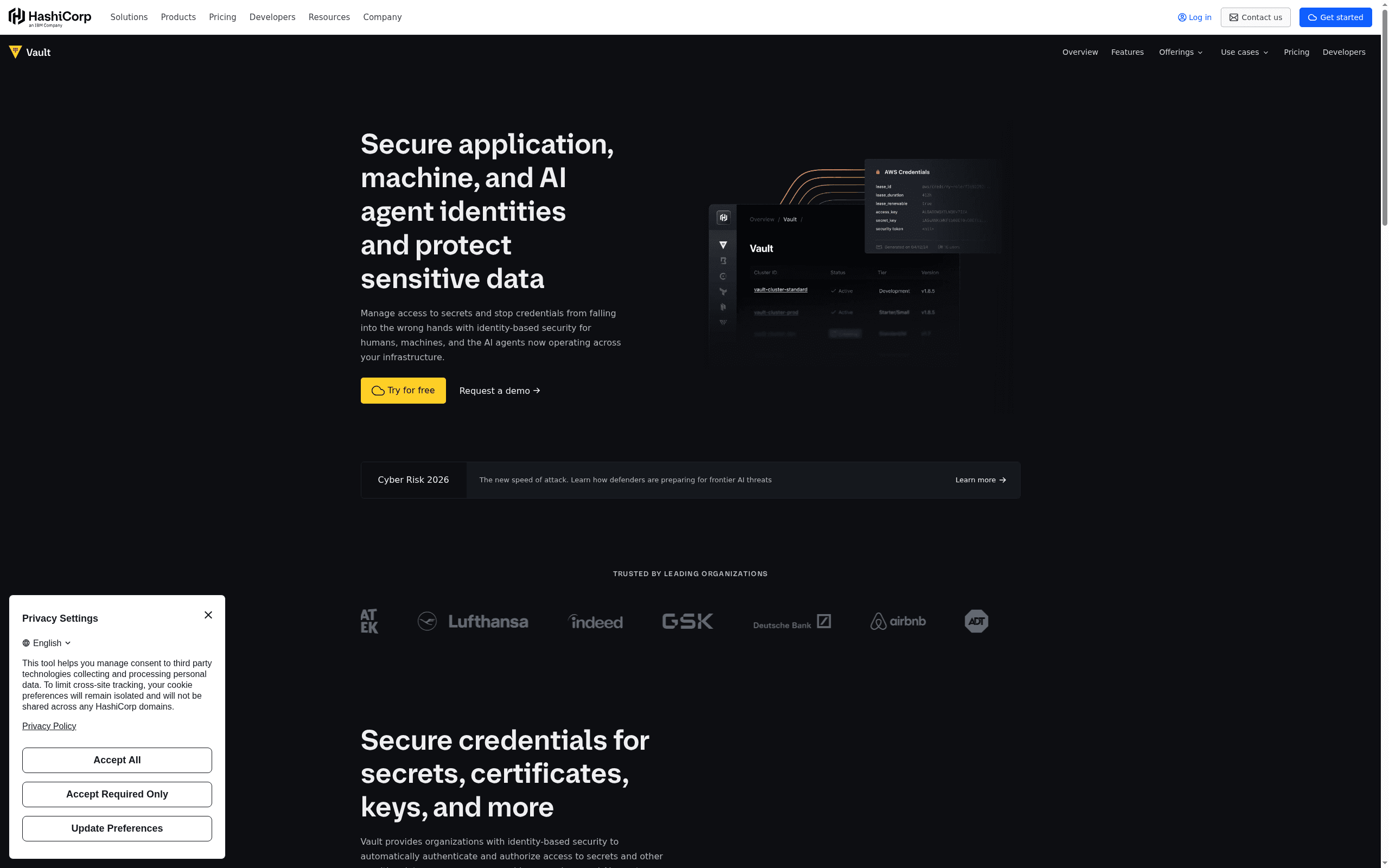
HashiCorp Vault is the best machine identity management solution for platform engineering and DevOps teams that need dynamic secrets, centralized credential management, and encryption as a service across multi-cloud environments. Now owned by IBM following a $6.4 billion acquisition completed in February 2025, Vault is the most widely deployed secrets management platform in the cloud-native ecosystem. Its defining capability is dynamic secrets -- the ability to generate short-lived, on-demand credentials for databases, cloud providers, and services that are automatically revoked after use, eliminating the risk of long-lived credentials being compromised. Vault has transitioned from its original open-source model to the Business Source License (BSL 1.1), but the community edition remains free for most use cases.
HASHICORP VAULT VERIFIED CAPABILITIES
| Attribute | Detail |
|---|---|
| Pricing | Free (Community) / HCP Vault from ~$450/mo / Enterprise custom |
| Core capability | Dynamic secrets, KV storage, transit encryption, PKI |
| License | BSL 1.1 (no longer open source for competing services) |
| Parent company | IBM ($6.4B acquisition, Feb 2025) |
| Integrations | AWS, Azure, GCP, Kubernetes, Terraform, Consul, databases, LDAP, OIDC |
| Best fit | Platform engineering teams needing dynamic secrets across multi-cloud |
Honest Limitation
Vault is operationally complex -- running a production Vault cluster requires significant infrastructure expertise including unsealing, HA configuration, storage backend tuning, and upgrade management. The BSL 1.1 license means it is no longer open source for competing SaaS services, which has pushed some users toward alternatives like OpenBao (the community fork). HCP Vault reduces operational burden but starts at approximately $450/month. Vault is a secrets management platform, not a full NHI governance platform -- it does not provide identity discovery across IdPs, NHI-specific ITDR, or compliance automation. The IBM acquisition has created uncertainty about long-term product direction and community engagement.
Best For
Akeyless -- Best SaaS-Native Secrets Management
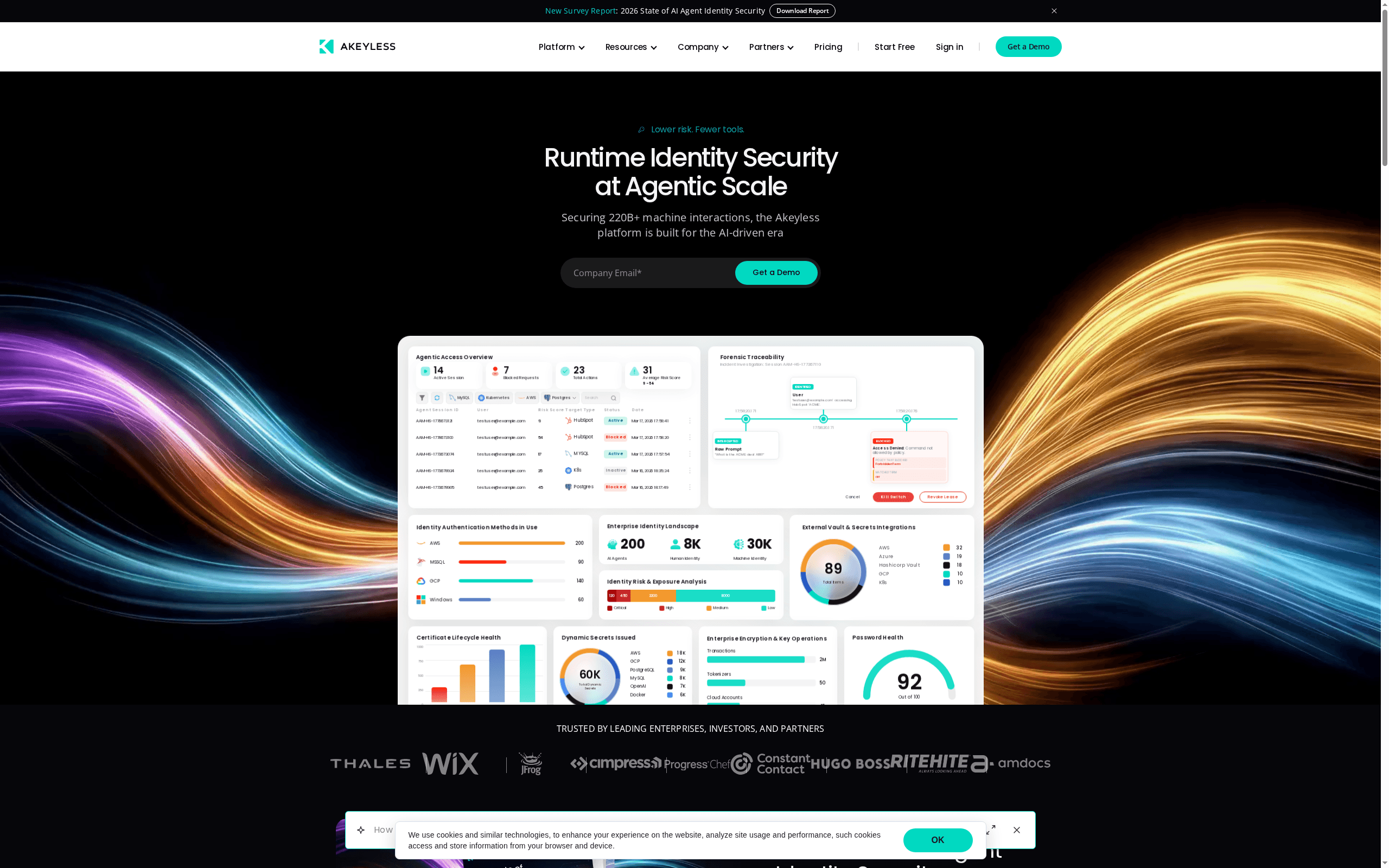
Akeyless is the best machine identity management solution for organizations that want Vault-like secrets management capabilities without the operational overhead of running and maintaining a self-hosted cluster. Its defining innovation is Distributed Fragments Cryptography (DFC), a patented zero-knowledge encryption architecture that ensures Akeyless itself never has access to customers' secrets -- encryption keys are split into fragments distributed across multiple cloud regions and customer-controlled environments. This gives organizations the security posture of a self-hosted solution with the operational simplicity of a fully managed SaaS. In 2026, Akeyless has expanded beyond core secrets management to include a Certificate Lifecycle Management (CLM) module, making it a broader machine identity platform.
AKEYLESS VERIFIED CAPABILITIES
| Attribute | Detail |
|---|---|
| Pricing | Free tier / Enterprise custom |
| Core innovation | Zero-Knowledge Encryption via patented DFC |
| Deployment | SaaS or Hybrid SaaS (customer-controlled gateway) |
| CLM module | Certificate Lifecycle Management (discovery, issuance, renewal) |
| Vault migration | Drop-in replacement API compatibility |
| Best fit | Teams wanting Vault capabilities without self-hosted ops burden |
Honest Limitation
Akeyless does not provide NHI discovery across identity providers, ITDR, or compliance automation -- it is primarily a secrets management and CLM platform. The CLM module is newer and less mature than Venafi or Keyfactor for enterprise-scale certificate management. The integration ecosystem, while solid, is narrower than Vault's. The free tier is limited and most organizations will need Enterprise pricing, which is custom and can be expensive. The Hybrid SaaS model adds architectural complexity compared to pure SaaS. For organizations that need full NHI governance beyond secrets, 8layers provides broader coverage.
Best For
Keyfactor -- Best for PKI and Crypto-Agility
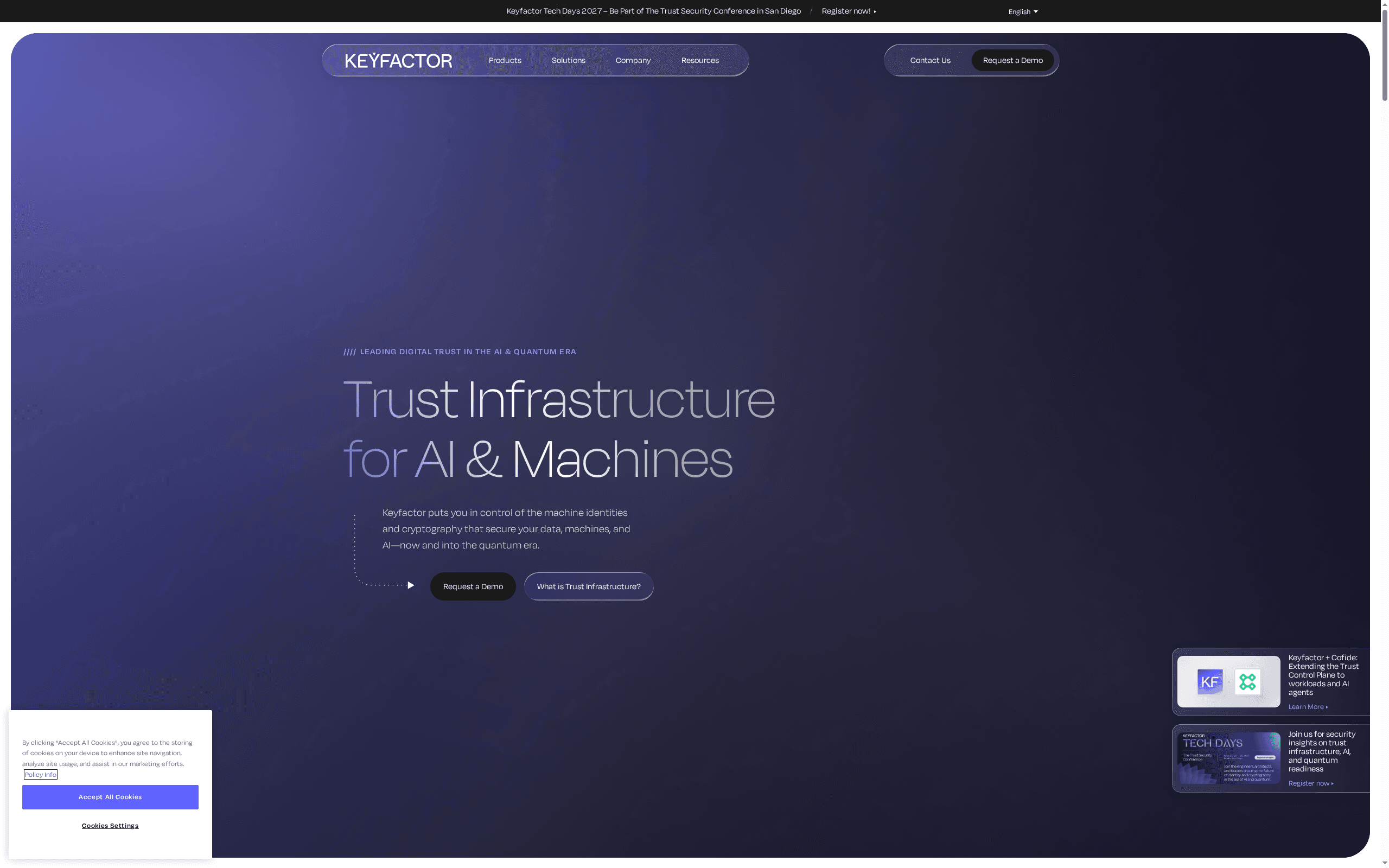
Keyfactor is the best machine identity management solution for organizations that need to modernize their public key infrastructure (PKI), manage certificate lifecycles across complex hybrid environments, and prepare for the post-quantum cryptography (PQC) transition. Keyfactor's platform combines PKI as a Service, enterprise certificate lifecycle management, and crypto-agility tools that let organizations inventory their cryptographic assets and plan migration timelines to quantum-resistant algorithms. Its EJBCA Enterprise product provides a CA-agnostic private PKI that can replace Microsoft AD CS or run alongside existing certificate authorities, giving organizations flexibility to issue certificates from any CA through a single management plane.
KEYFACTOR VERIFIED CAPABILITIES
| Attribute | Detail |
|---|---|
| Pricing | Custom (~$75K-$200K/year) |
| Core modules | PKI as a Service, CLM, Crypto-Agility, EJBCA Enterprise |
| CA support | CA-agnostic (works with any public or private CA) |
| PQC readiness | Crypto-agility inventory, PQC algorithm testing, migration planning |
| Deployment | Cloud (PKI as a Service) or On-premises |
| Best fit | Enterprises modernizing PKI and preparing for PQC migration |
Honest Limitation
Keyfactor is expensive, with enterprise pricing typically ranging from $75K to $200K per year. It is focused on PKI and certificate lifecycle management rather than broader NHI governance -- it does not provide service account discovery, API key management, or NHI-specific ITDR. The platform requires PKI expertise to configure and manage effectively, which limits accessibility for teams without dedicated PKI engineers. Implementation timelines are typically 3-6 months for enterprise deployments. For organizations whose primary concern is NHI posture management rather than PKI modernization, 8layers is more appropriate.
Best For
CyberArk Conjur -- Best for DevOps Secrets in Regulated Environments
CyberArk Conjur is the best machine identity management solution for DevOps teams operating in regulated environments that need FIPS-validated secrets management integrated with an enterprise privileged access management (PAM) ecosystem. Unlike standalone secrets managers, Conjur is designed from the ground up for CI/CD pipelines, container orchestration, and infrastructure-as-code workflows while maintaining the compliance posture required by financial services, defense, healthcare, and government organizations. The open-source Conjur OSS provides a free entry point, while Conjur Enterprise (part of the CyberArk Identity Security Platform) adds audit capabilities, high availability, disaster recovery, and enterprise support required for production workloads at scale.
CYBERARK CONJUR VERIFIED CAPABILITIES
| Attribute | Detail |
|---|---|
| Pricing | Free OSS / Enterprise ~$1,000-1,500/identity/year |
| Core focus | DevOps secrets for CI/CD, Kubernetes, OpenShift |
| Compliance | FIPS 140-2 validated, SOC 2, PCI DSS, HIPAA |
| PAM integration | Full CyberArk Identity Security Platform integration |
| Container support | Kubernetes, OpenShift, Docker, ECS, Fargate |
| Best fit | Regulated DevOps teams (financial services, defense, healthcare) |
Honest Limitation
Conjur Enterprise pricing at $1,000-1,500 per identity per year makes it one of the most expensive options, especially for organizations with large numbers of machine identities. The platform is tightly coupled to the CyberArk ecosystem, which creates vendor lock-in. Conjur OSS is free but lacks the HA, DR, and audit capabilities required for production regulated workloads. The policy language has a learning curve compared to Vault's HCL-based policies. The integration ecosystem is narrower than Vault's, particularly for cloud-native tooling. Conjur does not provide NHI discovery, ISPM, or compliance automation beyond audit logging -- for broader NHI governance, 8layers is more comprehensive.
Best For
AppViewX -- Best for Post-Quantum Certificate Automation
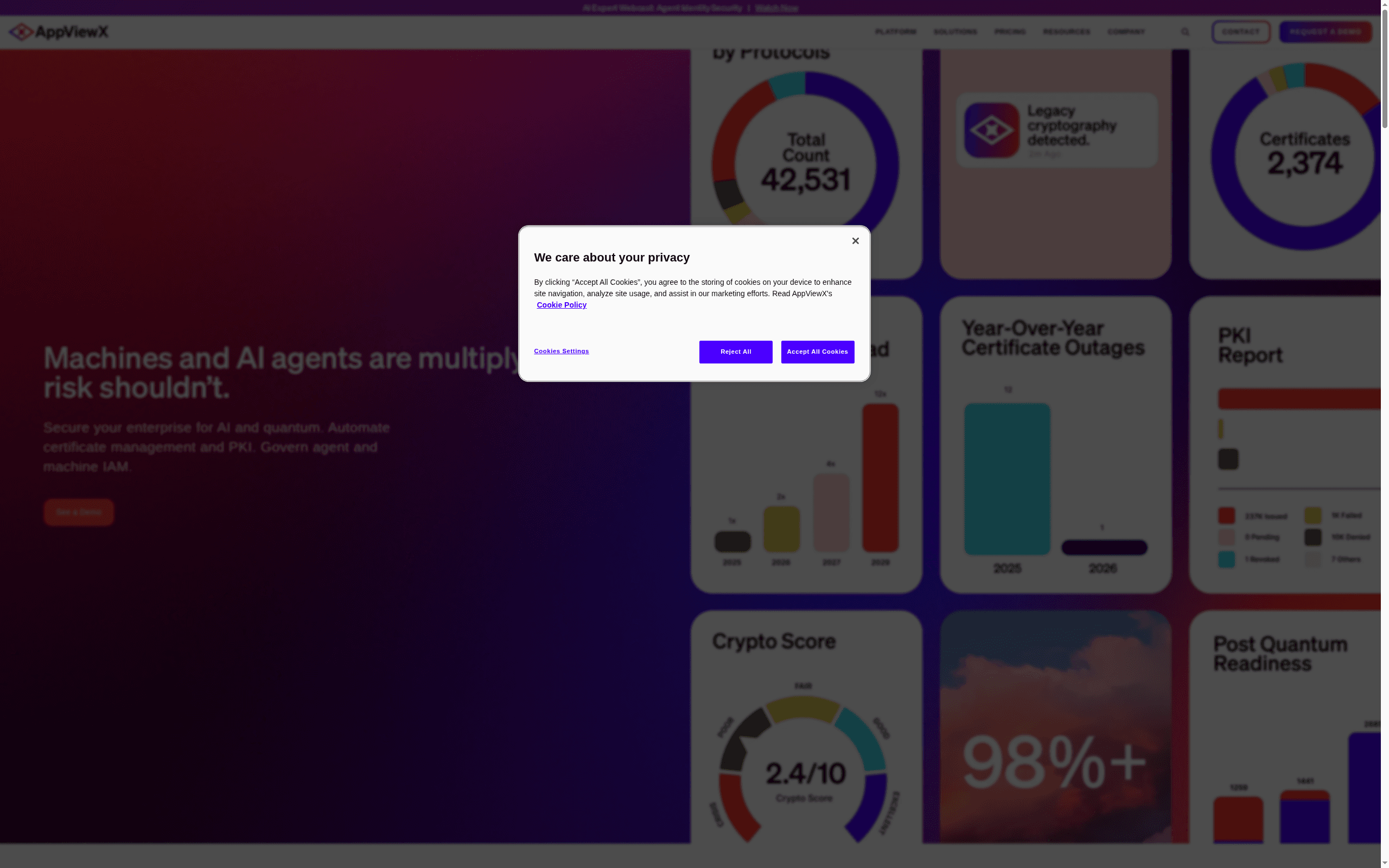
AppViewX is the best machine identity management solution for enterprises that need automated certificate lifecycle management across hybrid multi-cloud environments with a clear path to post-quantum cryptography (PQC) readiness. Its AVX ONE platform provides certificate lifecycle automation, PKI management, and crypto-agility from a single console, with particular strength in automating certificate workflows at scale without requiring deep PKI expertise from operations teams. Named a Leader in the 2026 IDC MarketScape for Certificate Lifecycle Management, AppViewX has established itself as the go-to platform for organizations that want to automate certificate operations while simultaneously inventorying and preparing for the PQC transition.
APPVIEWX VERIFIED CAPABILITIES
| Attribute | Detail |
|---|---|
| Pricing | Custom pricing only |
| Platform | AVX ONE (CLM + PKI + Crypto-Agility) |
| PQC readiness | Crypto inventory, PQC algorithm testing, migration orchestration |
| Recognition | 2026 IDC MarketScape CLM Leader |
| Deployment | Cloud, on-premises, or hybrid multi-cloud |
| Best fit | Enterprises automating cert workflows with PQC migration timeline |
Honest Limitation
AppViewX is focused on certificate lifecycle management and does not provide secrets management, NHI discovery across identity providers, or ITDR capabilities. Pricing is custom-only and typically enterprise-grade, which limits accessibility for mid-market organizations. The platform is less widely adopted than Venafi or HashiCorp Vault, which means fewer community resources, third-party integrations, and implementation partners. For organizations whose primary concern is service account governance, API key security, or NHI posture management rather than certificate automation, 8layers is a better fit. Crypto-agility capabilities, while strong, overlap with Keyfactor's offering.
Best For
Frequently Asked Questions
What is machine identity management?
Machine identity management is the practice of discovering, securing, and governing non-human identities (NHIs) across an organization's infrastructure. NHIs include service accounts, API keys, certificates (TLS/SSL, SSH, code signing), tokens, secrets, and increasingly AI agent credentials. In 2026, the average enterprise has 45 machine identities for every human identity, and cloud-native organizations often exceed 100 NHIs per human user.
Machine identity management platforms provide identity discovery across cloud providers and identity platforms, threat detection for compromised or misconfigured NHIs, posture management to enforce least-privilege policies, certificate lifecycle management to prevent outages from expired certificates, and compliance automation for frameworks like NIS2, DORA, SOC 2, and ISO 27001.
The market reached approximately $9.8 billion in 2025 and is growing at 23.7% CAGR, driven by the explosive growth in cloud workloads, AI agents, and regulatory mandates.
What is the difference between machine identity management and secrets management?
Secrets management is a subset of machine identity management. Secrets management focuses specifically on storing, rotating, and distributing credentials like API keys, database passwords, tokens, and certificates to applications and services -- tools like HashiCorp Vault and Akeyless are primarily secrets managers.
Machine identity management is the broader discipline that encompasses secrets management plus identity discovery (finding all NHIs across your environment), identity security posture management (ISPM -- ensuring NHIs follow least-privilege and governance policies), identity threat detection and response (ITDR -- detecting compromised or abused machine identities in real time), certificate lifecycle management (CLM -- managing the full lifecycle of TLS, SSH, and code signing certificates), and compliance automation.
Platforms like 8layers operate at the full machine identity management level with unified ITDR, ISPM, and compliance, while Vault and Akeyless are primarily secrets-focused with expanding CLM capabilities. Venafi and Keyfactor focus on the certificate lifecycle and PKI side of machine identity.
Why are non-human identities a security risk?
Non-human identities are a growing security risk because they vastly outnumber human identities (45:1 ratio on average), are often overprivileged, rarely have MFA or conditional access policies applied, and are frequently forgotten after creation. In 2025, 68% of enterprise breaches involved compromised NHIs according to industry research, and OWASP published its first NHI Top 10 to formalize these risks.
Common attack vectors include stale service accounts with admin privileges that were never decommissioned, API keys hardcoded in source code or CI/CD pipelines, expired or misconfigured certificates causing outages that lead to security bypasses, overprivileged OAuth tokens with broad scopes, shared secrets without rotation policies, and AI agent credentials with excessive permissions.
Regulatory frameworks like NIS2 and DORA now explicitly require organizations to apply the same identity governance to machine identities that they apply to human accounts, including lifecycle management, least-privilege enforcement, and continuous monitoring.
How do I choose a machine identity management platform?
Start by mapping your primary use case. If your main concern is discovering and governing all non-human identities across identity providers and cloud platforms with compliance automation, choose an NHI-focused platform like 8layers that provides unified ITDR, ISPM, and compliance. If you manage hundreds of thousands of TLS/SSL certificates and need enterprise-grade certificate lifecycle management, Venafi (CyberArk) or Keyfactor is the right fit.
If your DevOps teams need dynamic secrets with short-lived credentials for cloud workloads, HashiCorp Vault or Akeyless is the priority. For regulated environments needing FIPS-validated secrets management integrated with privileged access management, CyberArk Conjur is purpose-built. Key evaluation criteria include identity discovery breadth (which IdPs and cloud platforms are supported), threat detection capabilities (real-time anomaly detection vs.
periodic scanning), compliance framework coverage (NIS2, DORA, SOC 2, ISO 27001), integration ecosystem depth, total cost of ownership including operational overhead, and crypto-agility for post-quantum readiness.
What is post-quantum readiness in machine identity management?
Post-quantum readiness refers to a platform's ability to help organizations prepare for the transition from current cryptographic algorithms (RSA, ECC) to quantum-resistant algorithms (ML-KEM, ML-DSA, SLH-DSA) standardized by NIST in 2024. Quantum computers are expected to break current public-key cryptography within 10-15 years, which would compromise every TLS certificate, SSH key, and code signing certificate in existence.
Machine identity management platforms with post-quantum readiness provide crypto-agility, which includes the ability to inventory all cryptographic assets across the organization, identify which algorithms are in use and where, simulate the impact of migrating to post-quantum algorithms without service disruption, and orchestrate the actual migration when the time comes.
Keyfactor and AppViewX lead in this area with dedicated PQC readiness modules that include crypto inventory dashboards and migration planning tools. NIST has set 2030 as the target date for deprecating 112-bit security algorithms, making crypto-agility a board-level priority for enterprises managing millions of machine identities and certificates.
About Geeky Expert
Geeky Expert is a leading provider of research and insights, dedicated to helping businesses make informed decisions through comprehensive analysis.