
Best AI Recruiting & ATS Software (2026)
Why AI Recruiting & ATS Software Matters in 2026
The distinction between a traditional ATS and an AI-powered recruiting platform is no longer academic. Legacy systems store resumes and track pipeline stages. Modern AI recruiting platforms actively source passive candidates from databases of hundreds of millions of profiles, rank applicants by predicted job fit, automate candidate communication through conversational AI, and surface bias indicators before they reach hiring managers. The gap between these two approaches is widening every quarter.
What is the best AI recruiting & ATS software in 2026?
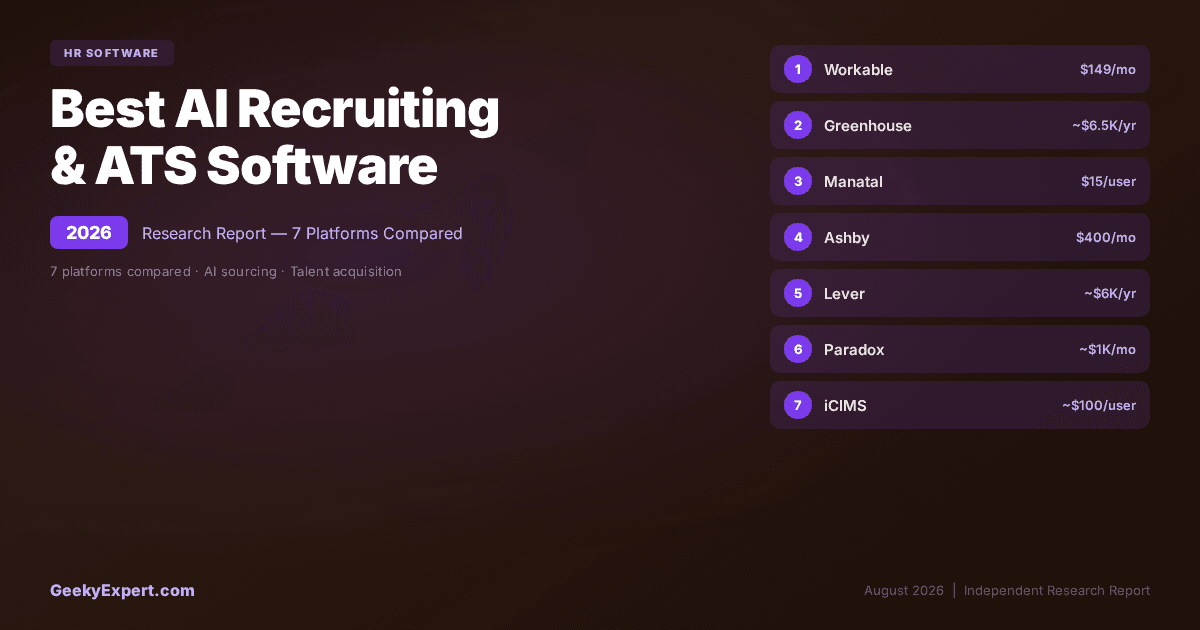
The best AI recruiting & ATS software in 2026 is Workable -- it combines AI-powered recruiting, a 400M+ candidate database, and built-in HR tools in a single platform from $149/month (Starter, up to 50 employees). Greenhouse leads for enterprise structured hiring with bias reduction. Manatal is the best budget option for SMBs at just $15/user/month.
Best for your situation
- ▸All-in-one AI recruiting + HR: Workable -- $149/mo
- ▸Enterprise structured hiring: Greenhouse -- ~$6,500/yr
- ▸Budget SMB recruiting: Manatal -- $15/user/mo
- ▸High-volume conversational AI: Paradox -- ~$1,000/mo
VERIFIED PLATFORM & PRICING DATA (2026)
| Platform | Entry Price | Strength | Best For |
|---|---|---|---|
| Workable | $149/mo (up to 50 emp) | All-in-one AI recruiting + HR | Mid-size companies |
| Greenhouse | ~$6,500/yr | Structured hiring + bias reduction | Enterprise / DEI-focused |
| Manatal | $15/user/mo | AI sourcing from 2,500+ channels | Budget-conscious SMBs |
| Ashby | $400/mo | Analytics-first ATS | Data-driven recruiting teams |
| Lever (Employ) | ~$6,000/yr | Unified CRM + ATS | Candidate nurturing teams |
| Paradox (Workday) | ~$1,000/mo | Conversational AI "Olivia" | High-volume hiring |
| iCIMS | ~$100/user/mo | Enterprise modular talent cloud | Large enterprise / 10,000+ hires |
The AI Recruiting Revolution in Numbers
AI RECRUITMENT MARKET DATA
The Shift
| Traditional ATS | AI Recruiting Platform | |
|---|---|---|
| Resume storage + keyword search | → | Predictive candidate matching |
| Manual job board posting | → | AI-powered passive candidate sourcing |
| Email-based scheduling | → | Conversational AI screening + auto-scheduling |
| Gut-feel hiring decisions | → | Structured scorecards + bias detection |
What to Optimise For
Choosing the right AI recruiting platform depends on your hiring volume, team size, and whether you need a standalone ATS or a platform that extends into onboarding and HR. The three most common buying scenarios map to different tools.
THREE OPTIMISATION TARGETS FOR AI RECRUITING PLATFORMS
| Optimisation Target | Platform | Approach | Best When |
|---|---|---|---|
| All-in-One Recruiting + HR | Workable | AI sourcing, ATS, onboarding, HR in one | You want recruiting and HR on one platform without stitching tools together |
| Enterprise Structured Hiring | Greenhouse | Structured scorecards, DEI analytics, 500+ integrations | You need bias reduction, compliance, and deep integration ecosystem |
| Budget AI Recruiting | Manatal | AI candidate scoring, 2,500+ source channels, CRM | You need powerful AI features at a fraction of enterprise pricing |
Featured HR Tech & Employee Experience
Workable -- Best All-in-One AI Recruiting + HR Platform

WORKABLE AT A GLANCE
| Attribute | Detail |
|---|---|
| Pricing | $149/mo Starter (up to 50 employees) |
| Core feature | 400M+ candidate database with AI sourcing |
| Notable stat | Used by 27,000+ companies globally |
| Deployment time | 1--3 weeks |
Honest Limitation
The Starter plan caps at 50 employees -- growing teams will need to move to Standard or Premier pricing, which increases cost significantly. AI sourcing quality depends on role type; niche technical roles and executive searches may still require specialised sourcing tools. Less customisable than Greenhouse for enterprise-grade structured hiring workflows and compliance reporting. The HR module is functional but not as deep as dedicated HRIS platforms.
Best For
Mid-size companies (20--500 employees) making 10--200 hires per year who want AI-powered recruiting, applicant tracking, and basic HR tools in one platform without managing multiple vendor relationships.
Greenhouse -- Best for Enterprise Structured Hiring with Bias Reduction

Greenhouse is the best AI recruiting platform for enterprise organisations that need structured hiring methodology with built-in bias reduction and DEI analytics. Its scorecard-driven approach forces consistent evaluation criteria across every interview, and its DEI dashboards track pipeline diversity at each funnel stage. Approximately $6,500/year for mid-market deployments.
GREENHOUSE AT A GLANCE
| Attribute | Detail |
|---|---|
| Pricing | ~$6,500/yr (mid-market) |
| Core feature | Structured hiring + bias reduction |
| Notable stat | 500+ integrations, used by 7,500+ companies |
| Deployment time | 6--12 weeks |
Honest Limitation
Enterprise pricing starts around $6,500/year and scales significantly with headcount and modules -- not suitable for budget-conscious small teams. Implementation takes 6--12 weeks for full deployment with scorecard design and interviewer training. The structured approach requires organisational buy-in; teams accustomed to informal hiring will face a learning curve. Limited built-in sourcing compared to Workable's 400M+ candidate database -- Greenhouse relies on integrations for sourcing.
Best For
Mid-market to enterprise organisations (200--10,000+) that need structured, auditable hiring processes with bias reduction, DEI analytics, and a deep integration ecosystem to connect with their existing HR tech stack.
Manatal -- Best Budget AI Recruiting for SMBs

MANATAL AT A GLANCE
| Attribute | Detail |
|---|---|
| Pricing | $15/user/month (Professional) |
| Core feature | AI candidate scoring from 2,500+ sources |
| Notable stat | 10,000+ customers across 135 countries |
| Deployment time | 1--2 weeks |
Honest Limitation
AI matching accuracy is good but not as refined as enterprise platforms like Greenhouse or Workable for complex, senior-level roles. Limited structured hiring methodology -- no built-in bias reduction or DEI analytics comparable to Greenhouse. Integration ecosystem is smaller than enterprise competitors (no 500+ integration marketplace). Reporting and analytics are adequate but lack the depth of Ashby or Greenhouse for data-driven recruiting teams. Not built for high-volume hiring (1,000+ hires/year) -- the platform is optimised for SMB scale.
Best For
Small and mid-size businesses (5--200 employees) making 5--100 hires per year who want AI-powered candidate scoring and broad sourcing capabilities without paying enterprise ATS pricing.
Ashby -- Best Data-Driven Analytics-First ATS

Ashby is the best AI recruiting platform for data-driven recruiting teams that want analytics at the centre of their hiring process, not bolted on as an afterthought. Its unified ATS, CRM, and scheduling platform was built analytics-first, delivering recruiting operations dashboards that show pipeline velocity, bottleneck analysis, source ROI, and interviewer calibration in real time. From $400/month.
ASHBY AT A GLANCE
| Attribute | Detail |
|---|---|
| Pricing | $400/month |
| Core feature | Analytics-first ATS + CRM + scheduling |
| Notable stat | Used by fast-scaling tech companies (Notion, Figma, Ramp) |
| Deployment time | 2--4 weeks |
Honest Limitation
At $400/month, it's more expensive than Manatal and positioned above SMB budgets. The analytics-first approach means a steeper learning curve for teams not accustomed to data-driven recruiting. Smaller integration marketplace than Greenhouse's 500+. Less established brand recognition than Greenhouse or Lever, which can be a factor in enterprise procurement. Limited HR and onboarding capabilities -- it's a recruiting platform, not an HR suite.
Best For
Growth-stage and mid-market companies (50--2,000 employees) with dedicated recruiting teams who want to optimise hiring through data -- pipeline velocity, source ROI, interviewer calibration, and conversion analytics -- rather than managing recruiting by gut feel.
Lever (Employ) -- Best Unified CRM + ATS for Candidate Nurturing

Lever (now part of Employ Inc.) is the best AI recruiting platform for teams that prioritise candidate relationship management alongside applicant tracking. Its unified CRM + ATS architecture treats every candidate as a long-term relationship, not a one-time transaction -- making it the strongest choice for organisations that source extensively and nurture passive candidates over months before they're ready to convert. Approximately $6,000/year.
LEVER (EMPLOY) AT A GLANCE
| Attribute | Detail |
|---|---|
| Pricing | ~$6,000/yr |
| Core feature | Unified CRM + ATS for candidate nurturing |
| Notable stat | 5,000+ customers, part of Employ Inc. |
| Deployment time | 4--8 weeks |
Honest Limitation
The Employ Inc. acquisition has introduced uncertainty about Lever's long-term product roadmap -- teams should evaluate current capabilities, not future promises. At ~$6,000/year, it's enterprise-priced without the same integration depth as Greenhouse (300+ vs 500+). The CRM capabilities shine for sourcing-heavy teams but add complexity for organisations where 90% of candidates come from inbound applications. Analytics are solid but not as deep as Ashby's recruiting operations dashboards.
Best For
Mid-market to enterprise teams (100--5,000 employees) with dedicated sourcing functions who need to manage long-term candidate relationships and run automated nurture campaigns alongside standard applicant tracking.
Paradox (Workday) -- Best Conversational AI for High-Volume Hiring

Paradox is the best AI recruiting platform for high-volume hiring organisations that need conversational AI to automate candidate screening, scheduling, and communication at scale. Its AI assistant "Olivia" handles the front end of recruiting -- answering candidate questions, conducting screening conversations, scheduling interviews, and sending reminders -- through SMS, WhatsApp, webchat, and other messaging channels. Now part of Workday. Approximately $1,000/month.
PARADOX (WORKDAY) AT A GLANCE
| Attribute | Detail |
|---|---|
| Pricing | ~$1,000/month |
| Core feature | Conversational AI assistant "Olivia" |
| Notable stat | Used by McDonald's, Unilever, major retail/hospitality chains |
| Deployment time | 4--8 weeks |
Honest Limitation
Conversational AI works best for standardised, high-volume roles (retail, hospitality, logistics, healthcare) -- it's less effective for complex knowledge-worker roles where nuanced qualification assessment is needed. At ~$1,000/month, it's a significant investment that only delivers ROI at scale (100+ hires/month). Paradox works best as an overlay on top of an existing ATS (especially Workday), not as a standalone ATS. The Workday acquisition may affect pricing and integration priorities for non-Workday customers.
Best For
Enterprise and large mid-market organisations (500--100,000+ employees) making 500+ hires per year in high-volume frontline roles (retail, hospitality, logistics, healthcare) who need to automate candidate screening, scheduling, and communication at scale.
iCIMS -- Best Enterprise Modular Talent Cloud

iCIMS is the best AI recruiting platform for large enterprise organisations that need a modular, end-to-end talent cloud spanning recruiting, onboarding, talent mobility, and employer branding. Its suite approach lets enterprises deploy the modules they need -- ATS, CRM, video interviewing, career sites, text engagement, onboarding -- and add more as requirements grow. Approximately $100/user/month for enterprise deployments.
iCIMS AT A GLANCE
| Attribute | Detail |
|---|---|
| Pricing | ~$100/user/month (enterprise) |
| Core feature | Modular enterprise talent cloud |
| Notable stat | 4,000+ enterprise customers, processes 4M+ hires/year |
| Deployment time | 8--16 weeks |
Honest Limitation
Enterprise pricing at ~$100/user/month makes it prohibitively expensive for SMBs and mid-market companies. Implementation takes 8--16 weeks and requires dedicated project management. The user interface has improved but still lags behind modern platforms like Ashby and Workable in terms of design and intuitiveness. The modular approach means each additional capability is a separate cost; total cost of ownership can be significantly higher than the base ATS price suggests. Steepest learning curve in this category.
Best For
Large enterprise organisations (2,000--100,000+ employees) making 1,000+ hires per year across multiple locations and countries who need a modular, compliant, scalable talent cloud with deep HRIS integration and enterprise-grade security.
Frequently Asked Questions
What is AI recruiting software vs traditional ATS?
A traditional ATS (applicant tracking system) stores resumes and tracks candidates through pipeline stages -- it's a database with workflow management.
AI recruiting software adds intelligent automation on top: predictive candidate matching that scores applicants by predicted job fit, AI-powered sourcing from databases of hundreds of millions of profiles, conversational AI assistants that screen candidates through natural language, resume parsing with contextual understanding beyond keyword matching, and bias-detection algorithms that flag inconsistent evaluation patterns. In 2026, 87% of companies use AI in recruitment.
The lines between ATS and AI recruiting are blurring as legacy vendors add AI features, but purpose-built AI platforms like Workable, Manatal, and Paradox deliver meaningfully deeper AI capabilities than retrofitted traditional systems.
How much does AI recruiting software cost in 2026?
Pricing varies widely by platform, company size, and hiring volume. Budget options start at $15/user/month (Manatal). Mid-market platforms include Workable at $149/month (Starter, up to 50 employees) and Ashby at $400/month. Enterprise platforms price based on company size: Greenhouse at approximately $6,500/year, Lever at approximately $6,000/year, Paradox at approximately $1,000/month, and iCIMS at approximately $100/user/month.
Factor in implementation costs (1--2 weeks for Manatal vs 8--16 weeks for iCIMS), training time, and add-on module fees. Most platforms offer 10--20% discounts for annual billing. For a 50-person company making 30 hires per year, expect to spend $1,800--$7,500 annually. For a 500-person enterprise, budget $10,000--$50,000+ depending on platform and modules.
Can AI recruiting software replace human recruiters?
No. AI recruiting software automates repetitive, time-intensive tasks -- resume screening, interview scheduling, candidate sourcing, initial outreach, and status updates -- but cannot replace the human judgment required for culture fit assessment, complex salary negotiations, relationship building with senior candidates, and final hiring decisions.
The platforms in this report are designed to augment recruiters by handling high-volume administrative work so hiring teams can focus on evaluation and candidate experience. Companies that try to fully automate hiring typically see worse outcomes in candidate quality and employer brand perception. The correct framing is that AI lets a recruiter handle 3--5x more requisitions at the same quality level, not that AI eliminates the recruiter role.
What should small businesses look for in AI recruiting software?
Small businesses should prioritise four factors: (1) Transparent pricing without enterprise minimums -- Manatal at $15/user/month and Workable Starter at $149/month are the strongest options. (2) Fast deployment -- avoid platforms requiring 8--16 week implementations; look for 1--3 week setup. (3) Built-in job board distribution so you don't pay separately for Indeed, LinkedIn, and other posting fees.
(4) AI features that reduce manual screening time, such as automated candidate scoring and interview scheduling. Avoid enterprise tools like iCIMS or Greenhouse unless you're making 100+ hires per year -- their complexity, implementation time, and cost don't justify the investment for small teams. Also consider whether you need separate HR tools or want an all-in-one platform like Workable that covers recruiting and basic HR in one subscription.
How do AI ATS platforms handle bias in hiring?
AI ATS platforms address hiring bias through several mechanisms: structured scorecards that force consistent evaluation criteria across every interview (Greenhouse leads here), anonymised resume screening that hides candidate names and demographic information during initial review, DEI analytics dashboards that track pipeline diversity at each funnel stage and identify where underrepresented candidates drop off, interviewer calibration scores that flag evaluators with statistically inconsistent pass/fail rates (Ashby), and automated bias alerts when evaluation patterns suggest inconsistency.
However, AI can also introduce bias if trained on historically biased hiring data -- a model trained on a company's past hires may perpetuate existing demographic skews. Best practice is to use structured interviews alongside AI recommendations, audit AI scoring models regularly, and track DEI metrics at every pipeline stage. Greenhouse offers the most comprehensive bias-reduction toolkit with its structured hiring methodology.
About Geeky Expert
Geeky Expert is a leading provider of research and insights, dedicated to helping businesses make informed decisions through comprehensive analysis.