
Best Compensation Management Software (2026)
Why Compensation Management Software Matters in 2026
What is the best compensation management software in 2026?
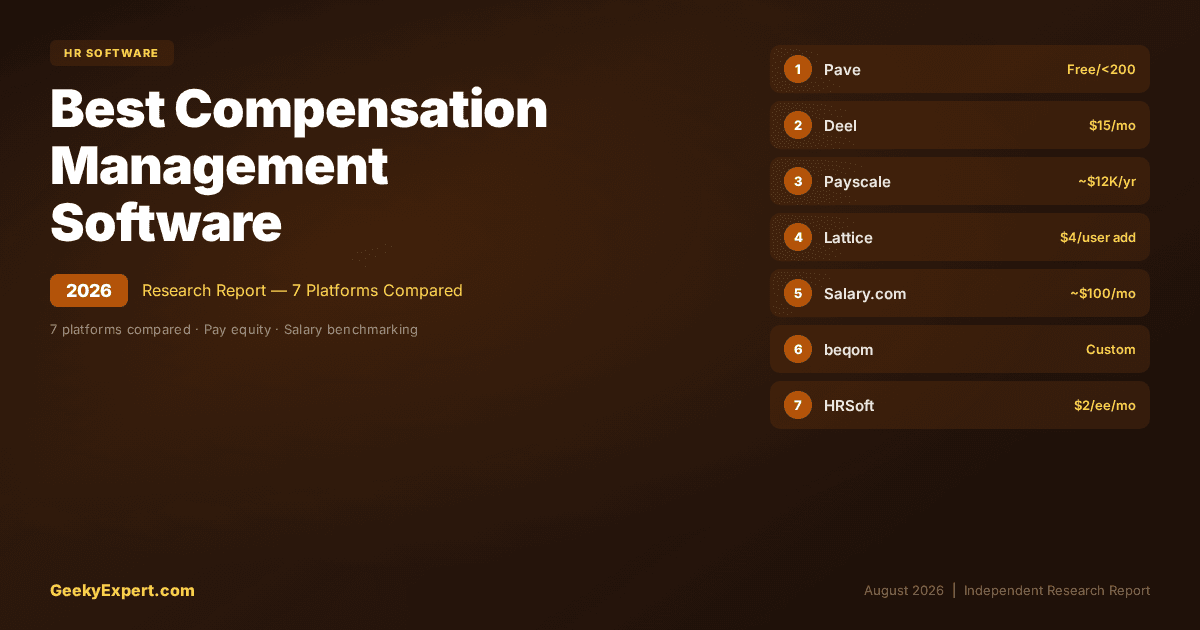
The best compensation management software in 2026 is Pave -- it provides real-time compensation benchmarking with data from 8,000+ companies, a free tier for companies under 200 employees, and the strongest total rewards communication tools in the market. Deel leads for global compensation across 150+ countries. Payscale offers the largest salary database with 200M+ data points.
Best for your situation
- ▸Real-time benchmarking: Pave -- free/<200 ee
- ▸Global comp (150+ countries): Deel -- $15/mo
- ▸Largest salary database: Payscale -- ~$12K/yr
- ▸Comp + performance link: Lattice -- $4/user/mo add-on
VERIFIED PLATFORM & PRICING DATA (2026)
| Platform | Entry Price | Strength | Rating / Note |
|---|---|---|---|
| Pave | Free (<200 ee) / $10K--50K+ enterprise | Real-time benchmarking from 8,000+ companies | G2 4.6+; best free tier |
| Deel | $15/mo (compensation module) | Global compensation across 150+ countries | G2 4.8; global leader |
| Payscale | ~$12K/yr | Largest salary database with 200M+ data points | G2 4.4+; data depth |
| Lattice | $4/user/mo add-on | Compensation tied to performance reviews | G2 4.7; perf + comp |
| Salary.com | ~$100/mo (CompAnalyst) | AI job matching + comprehensive job pricing | G2 4.5+; job pricing |
| beqom | Custom (enterprise) | Complex enterprise comp (sales, exec, equity) | G2 4.3+; enterprise |
| HRSoft | $2/ee/mo | Merit cycle automation + budget management | G2 4.4+; merit cycles |
The Pay Transparency Imperative
THE PAY TRANSPARENCY LANDSCAPE (2026)
Why This Market Is Accelerating
| Driver | Impact |
|---|---|
| Pay transparency laws (15+ US states, EU) | Mandatory salary ranges in job postings |
| Pay equity litigation | $2--5M average cost per case |
| Remote/global hiring | Multi-currency, multi-jurisdiction pay bands |
| Talent retention pressure | Employees now compare total comp in real time |
What to Optimise For
Choosing the right compensation platform depends on identifying your primary challenge -- the one thing you most need the tool to solve. The three most common challenges map to different platforms and approaches.
THREE OPTIMISATION TARGETS FOR COMPENSATION PLATFORMS
| Challenge | Platform | Approach | Best When |
|---|---|---|---|
| Real-Time Benchmarking | Pave | Live comp data from 8,000+ companies with total rewards comms | You need current market data and candidate-facing total comp statements |
| Global Compensation | Deel | Multi-country comp with local compliance, benefits, and currency support | You hire across borders and need jurisdiction-aware pay bands |
| Pay Equity + Compliance | Payscale | 200M+ data points, pay equity analytics, and compliance-ready reporting | You need defensible pay data and audit-ready equity analysis |
Featured HR Tech & Employee Experience
Pave -- Best Real-Time Compensation Benchmarking (Free Tier Available)

Pave is the best compensation management software in 2026 for organisations that need real-time salary benchmarking and total rewards communication. Unlike legacy survey-based tools that deliver data months after collection, Pave integrates directly with HRIS and cap table systems across 8,000+ companies to provide live compensation data. The free tier for companies under 200 employees is unmatched in the market, making it accessible to startups and scaling companies that historically could not afford enterprise compensation tools. Enterprise plans range from $10K to $50K+ per year.
PAVE AT A GLANCE
| Attribute | Detail |
|---|---|
| Entry price | Free (<200 employees) / $10K--50K+ enterprise |
| G2 Rating | 4.6+ |
| Differentiator | Real-time benchmarking from 8,000+ companies |
| Data source | Live HRIS + cap table integrations |
| Deployment | 2--4 weeks |
Honest Limitation
Pave's data skews toward technology and venture-backed companies -- organisations in traditional industries (manufacturing, healthcare, government) may find less relevant benchmarking data. The free tier has feature limitations compared to enterprise plans, and companies that outgrow 200 employees face a significant price jump. Pay equity analytics are present but not as deep as Payscale's dedicated equity tools. Merit cycle management features are newer and less mature than HRSoft or beqom.
Best For
Technology companies, startups, and scaling organisations (50--5,000 employees) that need real-time compensation benchmarking, strong total rewards communication tools, and want to start with a free tier before committing to enterprise pricing.
Deel -- Best for Global Compensation Across 150+ Countries

Deel is the best compensation management software for organisations with a distributed global workforce. Its compensation module, starting at $15/month, sits on top of Deel's global employment infrastructure spanning 150+ countries, giving compensation teams the ability to set, benchmark, and manage pay across jurisdictions with local compliance built in. For organisations already using Deel for contractor or EOR payments, the compensation module adds strategic planning on top of operational execution.
DEEL AT A GLANCE
| Attribute | Detail |
|---|---|
| Entry price | $15/mo (compensation module) |
| G2 Rating | 4.8 |
| Differentiator | Global compensation across 150+ countries |
| Compliance | Local employment law built in per jurisdiction |
| Deployment | 1--3 weeks (existing Deel users) / 4--6 weeks (new) |
Honest Limitation
Domestic-only companies gain minimal value from Deel's global infrastructure and will overpay for benchmarking that Pave or Payscale delivers at a lower effective cost. The compensation module is newer than Deel's core EOR and payroll products -- pay equity analytics and advanced merit cycle features are less mature than dedicated tools like Payscale or HRSoft. Benchmarking data in some smaller markets may be thinner than Payscale's 200M+ data point database.
Best For
Organisations with a globally distributed workforce (hiring in 5+ countries) that want compensation planning, benchmarking, and execution in a single platform, especially those already using Deel for EOR, contractor payments, or global payroll.
Payscale -- Best for Pay Equity Analytics and Salary Data Depth

PAYSCALE AT A GLANCE
| Attribute | Detail |
|---|---|
| Entry price | ~$12K/year |
| G2 Rating | 4.4+ |
| Database | 200M+ compensation data points |
| Pay equity | Multivariate regression + remediation modelling |
| Deployment | 6--10 weeks |
Honest Limitation
Payscale's data, while vast, is partially survey-based and partially crowdsourced, meaning some data points lag real-time market movements. The platform interface is functional but less modern than Pave or Lattice -- expect a steeper learning curve for new compensation analysts. At approximately $12K/year, it is too expensive for startups that Pave serves with its free tier. Merit cycle management features exist but are less streamlined than HRSoft's dedicated workflows.
Best For
Mid-market to enterprise organisations (200--10,000+ employees) across any industry that need the deepest salary data for job pricing, compliance-ready pay equity analytics for regulatory defence, and a compensation platform that extends beyond the tech sector.
Lattice -- Best for Tying Compensation to Performance Reviews

LATTICE AT A GLANCE
| Attribute | Detail |
|---|---|
| Entry price | $4/user/month (add-on) |
| G2 Rating | 4.7 |
| Prerequisite | Requires Lattice performance platform |
| Differentiator | Compensation tied to performance data |
| Deployment | 2--4 weeks (existing Lattice users) |
Honest Limitation
The compensation module requires the Lattice performance platform -- it is not a standalone product. Organisations not on Lattice face the total cost of the performance suite plus the compensation add-on. Benchmarking data relies on third-party integrations rather than Pave's or Payscale's proprietary databases. Pay equity analytics are present but lighter than Payscale's dedicated regression-based tools. Lattice is sunsetting its HRIS module by mid-2026, which may affect organisations that adopted Lattice as a broader HR platform.
Best For
Mid-market organisations (100--5,000 employees) already using or evaluating Lattice for performance management who want compensation decisions directly informed by performance, engagement, and goal data without managing separate systems.
Salary.com (CompAnalyst) -- Best for Comprehensive Job Pricing with AI

Salary.com's CompAnalyst is the best compensation management software for organisations that need comprehensive job pricing with AI-powered job matching. Starting at approximately $100/month, CompAnalyst combines Salary.com's decades of compensation survey data with AI that automatically matches internal job descriptions to market benchmarks, eliminating the manual job-matching process that consumes weeks of compensation analyst time. The platform is strongest for organisations with complex job architectures that need precise market positioning for hundreds or thousands of unique roles.
SALARY.COM (COMPANALYST) AT A GLANCE
| Attribute | Detail |
|---|---|
| Entry price | ~$100/month |
| G2 Rating | 4.5+ |
| Differentiator | AI-powered job matching + comprehensive job pricing |
| Data | Survey + employer-reported + public data blend |
| Deployment | 4--8 weeks |
Honest Limitation
The platform's interface and user experience feel more traditional than Pave or Lattice -- compensation analysts familiar with legacy survey tools will adapt quickly, but modern UI expectations may not be met. Data freshness lags behind Pave's real-time integrations, as much of the data is survey-based with annual or semi-annual refresh cycles. The platform is primarily focused on job pricing and benchmarking -- merit cycle management and total rewards communication features are less developed than specialised tools. Global data coverage is present but thinner outside North America compared to Deel.
Best For
Mid-market to enterprise organisations (200--10,000+ employees) with complex job architectures that need AI-assisted job pricing, comprehensive salary survey integration, and a platform built by a company with decades of compensation data expertise.
beqom -- Best for Complex Enterprise Compensation (Sales, Executive, Equity)

beqom is the best compensation management software for large enterprises with complex compensation structures spanning sales incentives, executive compensation, long-term equity programmes, and multi-country regulatory requirements. Custom enterprise pricing reflects the platform's positioning as the most sophisticated compensation engine on this list, designed for organisations where compensation is a strategic function with board-level visibility and regulatory complexity that simpler tools cannot handle.
BEQOM AT A GLANCE
| Attribute | Detail |
|---|---|
| Pricing | Custom (enterprise) |
| G2 Rating | 4.3+ |
| Differentiator | Sales comp + exec comp + equity in one engine |
| Pay equity | Deep analytics with continuous monitoring |
| Deployment | 12--20 weeks (enterprise) |
Honest Limitation
Enterprise-only positioning means beqom is inaccessible to mid-market companies -- custom pricing, long sales cycles, and 12--20 week implementations put it out of reach for organisations under 2,000 employees. The platform's complexity is its strength and its weakness: teams that only need benchmarking and merit cycles will find it massively over-engineered. The user interface prioritises configurability over simplicity, requiring dedicated administrators. The learning curve is the steepest on this list.
Best For
Large enterprises (2,000--100,000+ employees) with complex compensation structures spanning sales incentives, executive pay with proxy reporting requirements, long-term equity programmes, and multi-country regulatory obligations that need a single unified compensation engine.
HRSoft -- Best for Merit Cycle Automation and Budget Management

HRSoft is the best compensation management software for organisations whose primary pain point is the annual merit cycle -- the budget allocation, manager recommendations, approval workflows, and communication process that consumes weeks of HR and leadership time when managed in spreadsheets. At $2/employee/month, HRSoft is the most affordable per-employee option on this list, making it accessible to mid-market organisations that need dedicated compensation cycle management without the enterprise complexity of beqom or the benchmarking focus of Pave.
HRSOFT AT A GLANCE
| Attribute | Detail |
|---|---|
| Entry price | $2/employee/month |
| G2 Rating | 4.4+ |
| Differentiator | Merit cycle automation + budget control |
| Focus | Compensation planning and cycle execution |
| Deployment | 4--8 weeks |
Honest Limitation
HRSoft's benchmarking data is limited compared to Pave, Payscale, or Salary.com -- it relies on imported survey data rather than proprietary databases. The platform is focused on compensation cycle execution rather than strategic compensation analytics, meaning pay equity features and advanced modelling are lighter than Payscale or beqom. The user interface is functional but not as polished as Pave or Lattice. Smaller market presence and brand recognition compared to other tools on this list.
Best For
Mid-market organisations (200--5,000 employees) whose primary compensation pain point is the annual merit cycle process -- budget management, manager recommendations, approval workflows, and compensation communication -- and who need an affordable, focused tool rather than a full-suite compensation analytics platform.
Frequently Asked Questions
What is compensation management software?
Compensation management software is a platform that helps organisations plan, benchmark, analyse, and communicate employee pay. It replaces spreadsheets and manual salary surveys with real-time market data, pay equity analytics, merit cycle automation, and total rewards statements. Modern platforms like Pave provide real-time benchmarking data from 8,000+ companies, while tools like Payscale offer 200M+ salary data points for job pricing.
These tools are distinct from payroll software (which processes payments) -- compensation management decides what to pay and ensures those decisions are market-competitive, equitable, and compliant with pay transparency laws.
How much does compensation management software cost in 2026?
Costs range widely depending on scope and company size. Pave offers a free tier for companies under 200 employees (enterprise plans $10K--50K+/year). Deel's compensation module starts at $15/month. HRSoft charges $2/employee/month, making it the most affordable per-employee paid option. Salary.com's CompAnalyst starts at approximately $100/month. Payscale runs approximately $12K/year. Lattice adds compensation as a $4/user/month add-on to its performance platform.
beqom uses custom enterprise pricing for complex implementations. Factor in implementation time (2--4 weeks for Pave, 12--20 weeks for beqom) and internal effort to build job architecture and calibrate pay data.
Why is pay transparency important and how does software help?
Pay transparency laws are now active in 15+ US states (including California, New York, Colorado, Washington, and Illinois) and across the EU, requiring salary ranges in job postings and equal pay reporting. Pay equity litigation averages $2--5 million per case, making proactive compliance far less expensive than reactive defence.
Compensation software helps by providing defensible market data for setting salary ranges, running pay equity audits that identify gaps before regulators or litigants do, generating compliance-ready reports for regulatory submissions, and creating total rewards statements that communicate the full value of compensation to employees and candidates. Platforms like Payscale and beqom offer the deepest pay equity analytics with multivariate regression modelling.
What's the difference between compensation management and payroll software?
Payroll software processes payments -- it calculates wages, handles tax withholding, manages deductions, and deposits money into bank accounts. Compensation management software decides what to pay -- it benchmarks salaries against market data, plans merit increases, analyses pay equity, manages bonus and equity programmes, and communicates total rewards. Payroll is execution; compensation management is strategy.
Most organisations need both, and the best compensation tools (especially Deel and Lattice) integrate with payroll systems to ensure compensation decisions flow into payment execution. For payroll-specific recommendations, see our report on the best payroll software for small business.
How do compensation tools handle pay equity analysis?
Modern compensation tools run statistical analyses -- typically multivariate regression -- across employee populations to identify unexplained pay gaps based on gender, race, ethnicity, age, and other protected characteristics. The analysis controls for legitimate pay factors (role, level, experience, location, performance, tenure) to isolate true disparities from explainable differences.
Payscale and beqom offer the deepest pay equity analytics, including remediation scenario modelling that estimates the cost of closing identified gaps (typically 1--3% of payroll for organisations with meaningful disparities). The best tools provide ongoing monitoring rather than one-time audits, flagging new gaps as they emerge from hiring and promotion decisions. Compliance-ready reports can be generated for regulatory submissions in jurisdictions requiring pay equity reporting.
About Geeky Expert
Geeky Expert is a leading provider of research and insights, dedicated to helping businesses make informed decisions through comprehensive analysis.