
Best Third-Party Risk Management (TPRM) Software (2026)
What is the best third-party risk management software in 2026?
The best third-party risk management (TPRM) software in 2026 is Prevalent (by Mitratech) for enterprise-grade full-lifecycle vendor risk management -- combining AI-powered assessments, the largest Global Risk Exchange, and integrated GRC/ESG capabilities. SecurityScorecard leads for continuous external monitoring, OneTrust for privacy-integrated TPRM, and UpGuard for the best value with transparent pricing.
Best for your situation
- ▸Enterprise full-lifecycle TPRM: Prevalent (Mitratech)
- ▸Continuous security ratings: SecurityScorecard
- ▸Privacy-integrated TPRM: OneTrust
- ▸Best value + transparent pricing: UpGuard
- ▸Compliance-first automation: Vanta
- ▸Supply chain intelligence: BitSight
- ▸Cyber risk + questionnaire speed: Panorays
PRICING & DEPLOYMENT COMPARISON (2026)
| Platform | Starting Price | Pricing Model | Best For |
|---|---|---|---|
| Prevalent (Mitratech) | Custom (est. $50K–$150K+/yr) | Per-vendor + modules | Enterprise full-lifecycle TPRM |
| SecurityScorecard | Free / $15K+/yr (paid) | Per-vendor portfolio | Continuous security ratings |
| OneTrust | From $10K/yr | Per-module + users | Privacy-integrated TPRM + GRC |
| UpGuard | Free / $1,599/mo (Starter) | Tiered (vendor count) | Best value + attack surface |
| Vanta | ~$11K/yr (VRM add-on) | Add-on to compliance plan | Compliance-first automation |
| BitSight | Custom (est. $30K–$100K+/yr) | Tiered packages | Supply chain intelligence |
| Panorays | $30K–$60K/yr (typical) | Per-vendor + modules | Cyber risk + questionnaire speed |
TPRM MARKET DATA (2026)
| Metric | Figure | Source |
|---|---|---|
| TPRM market size (2026) | $10.6 billion | Mordor Intelligence, 2026 |
| Projected market size (2031) | $20.7 billion | Mordor Intelligence, 2026 |
| TPRM market CAGR (2026–2031) | 14.3% | Mordor Intelligence, 2026 |
| Breaches involving third parties (2026) | 48% of all breaches | Verizon DBIR, 2026 |
| YoY increase in third-party breaches | 60% | Verizon DBIR, 2026 |
| Average cost of a data breach (2025) | $4.88 million | IBM Cost of a Data Breach, 2025 |
| Orgs with formal TPRM programs | ~54% | Gartner, 2026 |
WHY THIRD-PARTY RISK IS THE FASTEST-GROWING ATTACK VECTOR
Manual Vendor Management AI-Powered TPRM +---------------------------+ +---------------------------+ | Spreadsheets + emails | | Automated assessments | | Annual questionnaires | vs. | Continuous monitoring | | Point-in-time snapshots | | Real-time risk scoring | | "Hope nothing changed" | | AI-driven remediation | +---------------------------+ +---------------------------+ The Problem in 2026: - 48% of breaches now involve third-party compromise (Verizon DBIR) - Average enterprise manages 5,800+ third-party vendors - Third-party breach involvement grew 60% year-over-year - Regulatory penalties for vendor oversight failures increasing - Supply chain attacks growing more sophisticated (SolarWinds, MOVEit legacy) TPRM answers: "What is the real-time security posture and compliance status of every vendor, supplier, and partner in my ecosystem -- continuously, not annually?"
DECISION FRAMEWORK: WHICH TPRM PLATFORM FITS YOU?
ENTERPRISE FULL-LIFECYCLE TPRM (onboarding → offboarding) → Prevalent (Mitratech) -- Alfred AI, Global Risk Exchange, Forrester Leader → Best for: Mature risk programs with 500+ vendors, GRC integration needs CONTINUOUS SECURITY RATINGS + outside-in monitoring → SecurityScorecard -- 12M+ orgs rated, daily updates, free tier → Best for: CISOs wanting objective, data-driven vendor risk scores PRIVACY + TPRM + GRC in a unified suite → OneTrust -- privacy, AI governance, ESG, and TPRM in one platform → Best for: DPOs and compliance teams managing privacy + vendor risk together BEST VALUE with transparent pricing → UpGuard -- starts at $1,599/mo, free tier, attack surface monitoring → Best for: Mid-market teams wanting immediate visibility without enterprise pricing COMPLIANCE-FIRST with automated evidence → Vanta -- agentic AI assessments, SOC 2/ISO/HIPAA-integrated VRM → Best for: Fast-growing SaaS companies already using Vanta for compliance SUPPLY CHAIN INTELLIGENCE at scale → BitSight -- largest mapped supply chain dataset, breach correlation → Best for: Enterprises managing complex multi-tier supply chains RAPID QUESTIONNAIRE AUTOMATION → Panorays -- Smart Match autofill, Nth-party discovery → Best for: Teams drowning in vendor questionnaires needing AI acceleration
Why Third-Party Risk Management Matters in 2026
Featured Cybersecurity & Identity
Prevalent (Mitratech) -- Best Overall Third-Party Risk Management Platform
Prevalent, now part of Mitratech following a strategic combination, is the best overall third-party risk management platform in 2026 for enterprises that need full-lifecycle vendor risk management from onboarding through assessment, continuous monitoring, and offboarding. Recognized as a Leader in The Forrester Wave: Third-Party Risk Management Platforms, Q1 2026, Prevalent differentiates with its AI-powered Alfred™ assistant for automated evidence evaluation and questionnaire processing, the largest Global Risk Exchange providing access to 18,000+ pre-completed vendor assessments and 370,000+ vendor profiles, and deeply integrated GRC, ESG, and InfoSec capabilities that extend TPRM beyond cybersecurity into operational, financial, and sustainability risk. The Mitratech combination has strengthened Prevalent's position by adding contract lifecycle management, legal operations, and compliance workflow capabilities to the core TPRM platform, creating a unified vendor governance solution.
PREVALENT (MITRATECH) VERIFIED CAPABILITIES
| Attribute | Detail |
|---|---|
| AI assistant | Alfred™ -- automated evidence review, questionnaire processing, risk trend analysis |
| Risk Exchange | 18,000+ attested assessments, 370,000+ vendor profiles |
| Analyst recognition | Forrester Wave Leader, Q1 2026 |
| Risk domains | Cybersecurity, privacy, operational, financial, ESG, geopolitical |
| Pricing | Custom (typically $50K–$150K+/yr for mid-to-large enterprise) |
| Deployment | Cloud-hosted SaaS |
| Best fit | Mature risk programs managing 500+ vendors with GRC integration needs |
Honest Limitation
Prevalent is an enterprise platform with enterprise pricing -- the typical $50K to $150K+ annual cost and implementation complexity make it impractical for mid-market organizations managing fewer than 200 vendors. The platform is feature-rich, which means a steep learning curve and significant configuration effort to tailor workflows, scoring models, and dashboards to organizational requirements. Smaller teams may find the depth overwhelming when a simpler tool would suffice. External security ratings are not as granular as dedicated ratings platforms like SecurityScorecard or BitSight -- organizations that prioritize continuous outside-in monitoring may need to supplement Prevalent with a dedicated ratings feed. The Mitratech combination is still integrating product lines, and some workflows between the legacy Prevalent and Mitratech platforms may not yet be fully seamless. Pricing is entirely custom with no public transparency, making budget planning difficult without a sales engagement.
Best For
SecurityScorecard -- Best for Continuous Security Ratings
SecurityScorecard is the best third-party risk management platform for continuous security ratings and outside-in vendor monitoring in 2026. As the most widely adopted security ratings platform globally, SecurityScorecard monitors the security posture of over 12 million organizations worldwide, providing objective, data-driven risk scores that update daily based on externally observable security signals. Unlike questionnaire-based TPRM tools that rely on vendor self-reporting, SecurityScorecard generates ratings independently by analyzing DNS health, patching cadence, open ports, SSL certificate hygiene, malware infections, dark web exposure, email security configurations, and hundreds of other signals -- giving CISOs an unbiased view of vendor risk that does not depend on vendor cooperation. The platform offers a free tier for basic self-monitoring, making it accessible to organizations of all sizes, while enterprise plans scale to comprehensive portfolio management with supply chain intelligence.
SECURITYSCORECARD VERIFIED CAPABILITIES
| Attribute | Detail |
|---|---|
| Organizations monitored | 12 million+ globally |
| Rating update frequency | Daily (continuous scanning) |
| Signal categories | Network security, DNS health, patching, endpoint, IP reputation, application security, cubit score, hacker chatter, info leak, social engineering |
| Pricing tiers | Free / Business ($15K+/yr) / Enterprise ($100K+/yr) |
| Key differentiator | Automatic Vendor Detection + Supply Chain Risk Intelligence |
| Best fit | CISOs wanting objective, continuous outside-in vendor risk monitoring |
Honest Limitation
Security ratings are based on externally observable signals, which means they cannot assess internal controls, access management policies, employee security training, or incident response capabilities -- all of which require questionnaire-based assessment. A vendor with a high security rating may still have poor internal security practices that external scanning cannot detect. The rating methodology can produce false positives (flagging shared hosting IP addresses, CDN artifacts, or legacy domains no longer in active use) that require manual investigation to validate. Enterprise pricing can exceed $100,000 per year for large vendor portfolios, which is comparable to full-lifecycle TPRM platforms that offer broader functionality. The platform's assessment and workflow capabilities, while improved, are not as deep as Prevalent's full-lifecycle management. Free tier is limited to basic self-monitoring and does not include vendor portfolio management.
Best For
OneTrust -- Best for Privacy-Integrated Third-Party Risk Management
OneTrust is the best third-party risk management platform for organizations that need privacy, AI governance, ESG, and vendor risk management unified in a single trust platform. While most TPRM tools focus primarily on cybersecurity risk, OneTrust's differentiation is its ability to manage vendor risk across privacy, data protection, ethical AI, and environmental sustainability alongside traditional security assessments -- all within a platform that also handles consent management, data subject requests, and privacy impact assessments. This makes OneTrust uniquely valuable for Data Protection Officers (DPOs) and compliance teams that must manage vendor relationships through both a security lens and a privacy/regulatory lens simultaneously. OneTrust's AI-powered data collection can fast-track third-party risk assessments by up to 70%, and its user-configurable workflows support critical event-triggered automation that adapts assessment cadence to real-world risk changes.
ONETRUST VERIFIED CAPABILITIES
| Attribute | Detail |
|---|---|
| Platform scope | Privacy + TPRM + GRC + AI Governance + ESG + Consent |
| AI assessment acceleration | Up to 70% faster assessments with AI-powered data collection |
| TPRM lifecycle | Onboarding, assessment, monitoring, mitigation, reporting, offboarding |
| Privacy frameworks | GDPR, CCPA/CPRA, LGPD, POPIA, PIPL (200+ global regulations) |
| Pricing | From $10K/yr (TPRM module); scales with modules + users + vendors |
| Best fit | DPOs and compliance teams managing privacy + vendor risk together |
Honest Limitation
OneTrust's breadth is both its strength and its weakness -- the platform covers privacy, TPRM, GRC, AI governance, ESG, and consent management, which means the TPRM module may not be as deep as dedicated TPRM platforms like Prevalent in areas such as assessment exchange networks, vendor-facing portals, and remediation workflow sophistication. The modular pricing structure means costs can escalate significantly as organizations add modules, users, and vendor capacity -- a full-suite deployment can easily exceed $100,000 per year. Minimum annual deal sizes of $10,000 (effective Q2 2026) and typical 5-10% annual escalation clauses built into contracts add to total cost of ownership. Implementation complexity is high for organizations deploying multiple modules simultaneously. The platform's TPRM continuous monitoring capabilities, while solid, are not as granular as dedicated security ratings platforms like SecurityScorecard or BitSight.
Best For
UpGuard -- Best Value with Transparent Pricing
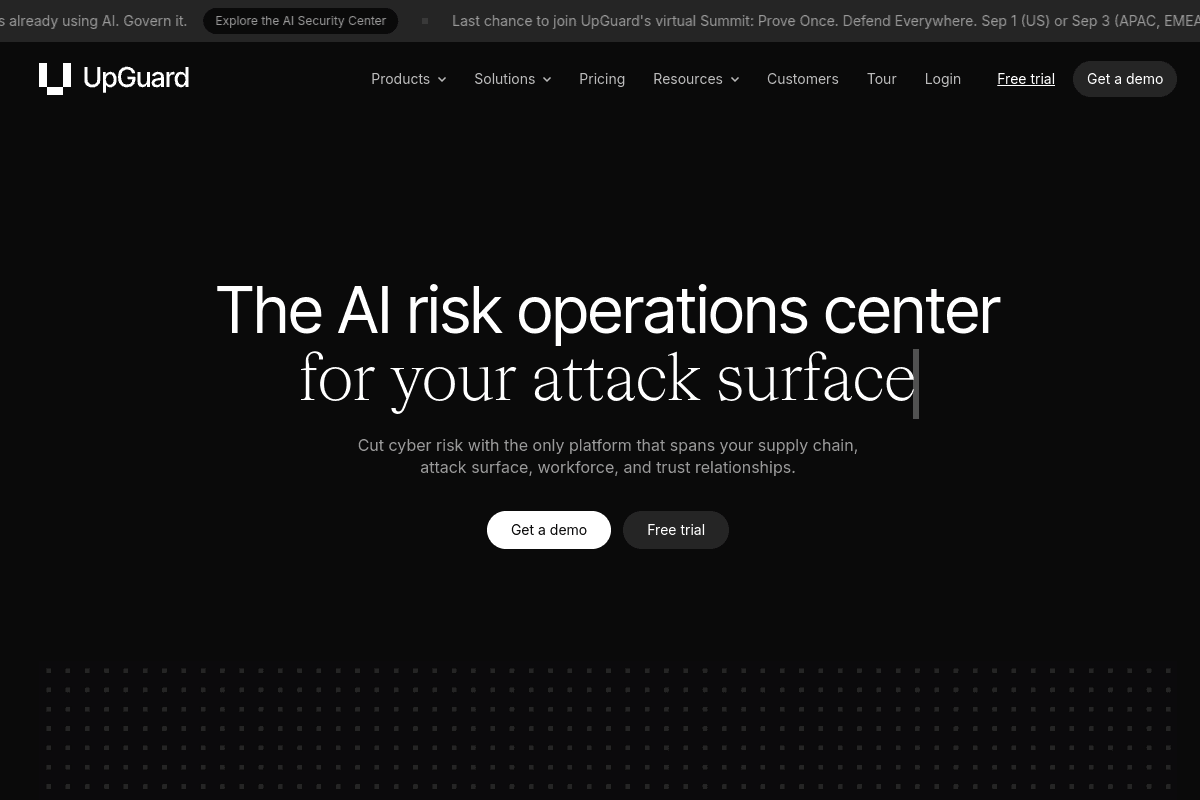
UpGuard is the best third-party risk management platform for mid-market organizations that want transparent pricing, immediate time-to-value, and a strong combination of vendor risk assessment and attack surface monitoring in 2026. Unlike enterprise TPRM platforms that require sales conversations to learn pricing, UpGuard publishes its plans openly: a free version with 3 users and limited monitoring, a Starter plan at $1,599 per month billed annually, and a Professional plan at $3,333 per month billed annually. This transparency, combined with AI-powered vendor evidence analysis, daily scanning, credential leak detection, and dark web monitoring, makes UpGuard the most accessible entry point for organizations building their first formal TPRM program. The platform uniquely combines third-party risk management with attack surface management, providing both outside-in vendor monitoring and visibility into your own organization's external exposure in a single tool.
UPGUARD VERIFIED CAPABILITIES
| Attribute | Detail |
|---|---|
| Pricing transparency | Free / Starter: $1,599/mo / Professional: $3,333/mo |
| Platform scope | Third-party risk + attack surface management |
| AI capabilities | AI-powered evidence analysis, control mapping, risk identification, report generation |
| Monitoring frequency | Daily scanning |
| Vendor capacity (Standard) | 50 vendors (Standard $1,750/mo); higher tiers: unlimited |
| Best fit | Mid-market teams wanting value + visibility without enterprise pricing |
Honest Limitation
The Starter plan's vendor capacity (approximately 50 vendors on the Standard tier) may be insufficient for organizations with larger vendor portfolios, requiring an upgrade to higher-priced tiers for unlimited vendor monitoring. UpGuard's assessment workflow capabilities, while functional, are not as sophisticated as Prevalent's full-lifecycle management with Global Risk Exchange access and AI-powered Alfred assistant. The platform's compliance framework coverage, though broad, does not match OneTrust's depth in privacy-specific regulations (GDPR data mapping, DPIA integration, consent management). The risk intelligence feed, while effective for daily monitoring, does not provide the same depth of supply chain mapping and breach correlation that SecurityScorecard or BitSight offer at the enterprise level. Role-based access controls and advanced audit logging are limited to higher-tier plans, which may be a concern for regulated organizations. GRC integration capabilities are narrower than enterprise platforms.
Best For
Vanta -- Best Compliance-First TPRM with Agentic AI
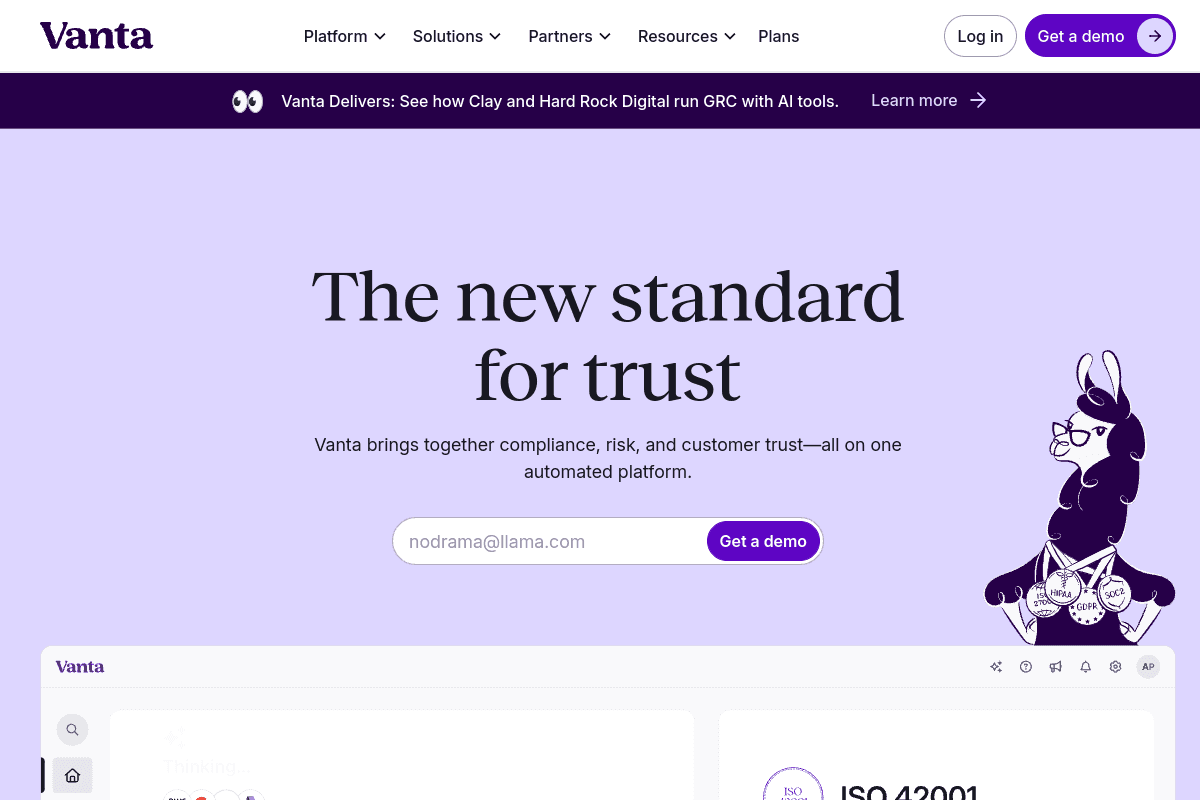
Vanta is the best third-party risk management platform for compliance-first organizations in 2026, particularly fast-growing SaaS companies that already use Vanta for SOC 2, ISO 27001, or HIPAA compliance automation. As the self-described "#1 agentic trust platform," Vanta has evolved from a compliance automation tool into a unified trust management platform that includes vendor risk management (VRM/TPRM) as an integrated module. What makes Vanta uniquely compelling is the tight integration between compliance evidence and vendor risk: when Vanta automates your SOC 2 evidence collection, it simultaneously surfaces vendor-related compliance gaps, links vendor risk findings to specific control requirements, and ensures that vendor management is not a separate workstream but an embedded part of your compliance posture. In March 2026, Vanta launched Agentic TPRM Assessment with AI agents that automate questionnaire creation, evidence gathering, and vendor risk evaluation with minimal human intervention.
VANTA VERIFIED CAPABILITIES
| Attribute | Detail |
|---|---|
| Platform positioning | #1 agentic trust platform -- compliance + VRM unified |
| AI capabilities | Agentic TPRM Assessment (March 2026), AI Agent Governance (August 2026 LA) |
| VRM module pricing | ~$11K/yr (add-on to compliance plans) |
| Compliance frameworks | SOC 2, ISO 27001, HIPAA, PCI DSS, GDPR, SOX ITGC, NIST, custom |
| Vendor onboarding | Okta SSO import, bulk upload, automated discovery |
| Best fit | SaaS companies already using Vanta for compliance automation |
Honest Limitation
Vanta's VRM module is an add-on to its compliance platform, not a standalone TPRM product -- organizations that do not use Vanta for compliance will not benefit from the integration advantages that justify its ranking position. The VRM module's depth is less than dedicated TPRM platforms like Prevalent in areas such as full-lifecycle offboarding workflows, GRC integration breadth, and ESG risk assessment. The Essential plan ($7,500/year) does not include TPRM features, meaning organizations need at least the Foundational plan ($15,000/year) plus the VRM add-on (~$11,000/year) for a total minimum commitment of approximately $26,000 per year. Continuous monitoring and advanced TPRM features (API access, reporting, automated evidence gathering) are listed as separate add-ons, which can increase total cost. The platform is strongest for SaaS and technology companies; organizations in heavily regulated industries (financial services, healthcare) with complex vendor governance requirements may find the TPRM module insufficient for their needs. AI Agent Governance entered limited availability in August 2026 and may not be generally available for all customers.
Best For
BitSight -- Best for Supply Chain Intelligence
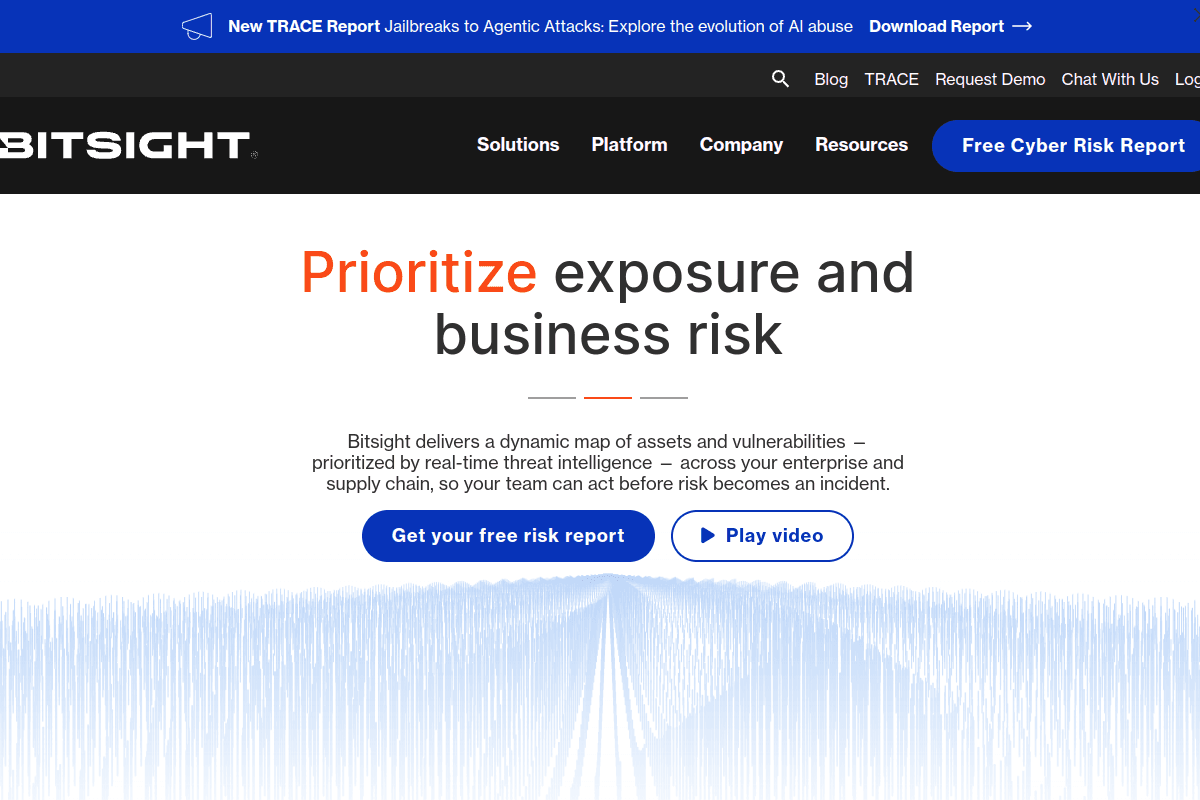
BitSight is the best third-party risk management platform for supply chain intelligence and multi-tier vendor risk visibility in 2026. What distinguishes BitSight from other security ratings platforms is the depth of its supply chain dataset -- BitSight has built the largest independently mapped vendor network in the industry, which enables organizations to see not just their direct third-party vendors but also fourth-party, fifth-party, and Nth-party dependencies that create hidden concentration risk and cascading failure points. BitSight's security ratings are backed by independently validated breach correlation data, meaning the platform can demonstrate a statistically significant relationship between low BitSight ratings and actual breach outcomes -- a claim that moves security ratings from subjective scoring to evidence-based risk quantification. The platform has expanded its AI capabilities significantly in 2026, with Framework Intelligence that automatically maps vendor evidence to compliance frameworks and Dark Web Intelligence that monitors underground marketplaces for vendor-related threat indicators.
BITSIGHT VERIFIED CAPABILITIES
| Attribute | Detail |
|---|---|
| Key differentiator | Largest independently mapped supply chain dataset |
| Breach correlation | Independently validated (statistical correlation between ratings and breaches) |
| AI features (2026) | Framework Intelligence, Dark Web Intelligence, AI questionnaire automation |
| Pricing tiers | Essentials / Advanced / Premier (custom; est. $30K–$100K+/yr) |
| Vendor onboarding | Instant onboarding via mapped vendor network |
| Best fit | Enterprises managing complex multi-tier supply chains |
Honest Limitation
BitSight's pricing is entirely custom and typically ranges from $30,000 to $100,000+ per year, making it inaccessible for smaller organizations. Like all outside-in ratings platforms, BitSight cannot assess internal security controls, access management policies, or incident response capabilities -- it measures externally observable posture only. The assessment and workflow management capabilities, while improving with AI automation, are not as deep as dedicated full-lifecycle TPRM platforms like Prevalent or ProcessUnity. The Essentials tier is designed for organizations beginning their TPRM program and may lack features that maturing programs require, forcing upgrades to higher-cost tiers. Volume-based pricing means costs scale with the number of vendors monitored, which can become expensive for organizations with large vendor portfolios. Privacy-specific assessment capabilities are less developed than OneTrust's unified privacy and risk platform.
Best For
Panorays -- Best for Questionnaire Automation and Nth-Party Discovery
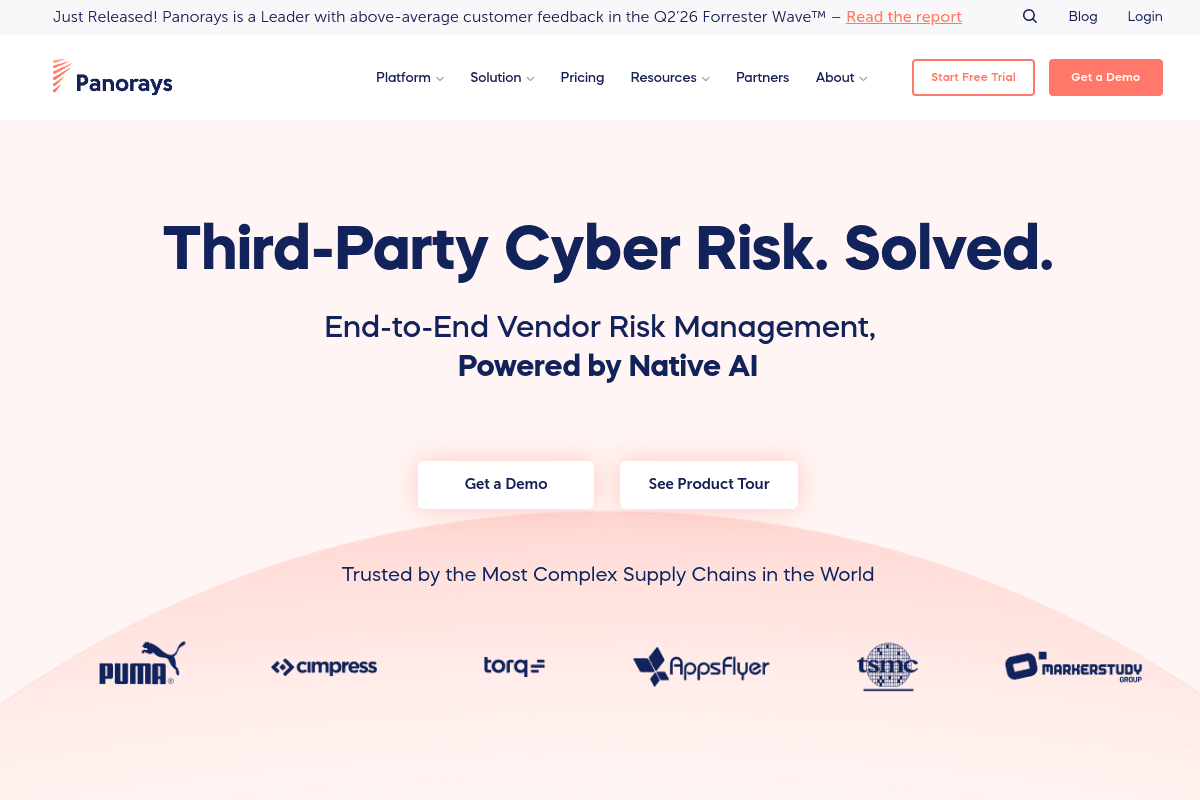
Panorays is the best third-party risk management platform for organizations drowning in vendor questionnaires that need AI-powered automation to accelerate assessment cycles in 2026. Panorays' core differentiator is Smart Match, a Gemini-powered AI engine that analyzes uploaded vendor compliance documentation (SOC 2 reports, ISO 27001 certificates, penetration test results, and other attestations) and automatically generates referenced answer suggestions for security questionnaires. This means instead of manually reading through a 200-page SOC 2 report to answer each questionnaire question, Smart Match extracts the relevant evidence, maps it to the specific question, and provides an auto-populated answer with a direct reference to the source document. Panorays also excels in Nth-party discovery, mapping fourth-party and beyond dependencies to provide a complete view of supply chain risk that extends past direct vendor relationships.
PANORAYS VERIFIED CAPABILITIES
| Attribute | Detail |
|---|---|
| AI engine | Smart Match -- Gemini-powered questionnaire autofill with source references |
| Nth-party discovery | 4th-party and beyond dependency mapping (Premium+ tiers) |
| Pricing tiers | Basic / Premium / Enterprise / Strategic ($30K–$60K/yr typical) |
| Assessment approach | Attack surface assessment + customized questionnaires + continuous monitoring |
| Threat intelligence | Prioritized breach alerts, expanded cyber news sources (Strategic tier) |
| Best fit | Teams processing high volumes of vendor questionnaires needing AI acceleration |
Honest Limitation
Smart Match's questionnaire autofill quality depends heavily on the quality and comprehensiveness of uploaded vendor documentation -- if a vendor provides a sparse SOC 2 report or incomplete attestation, the AI-generated answers will be correspondingly thin. The Basic tier is limited to attack surface assessments and customized questionnaires, without continuous monitoring or Nth-party discovery, which may not provide sufficient capability for maturing TPRM programs. The Enterprise and Strategic tiers (which include the most valuable features like customized risk ratings, executive reporting, and advanced threat intelligence) push the total cost toward $50,000 to $60,000 per year, approaching enterprise platform pricing without the same depth of lifecycle management. The platform's workflow automation and remediation tracking capabilities are not as sophisticated as Prevalent's or ProcessUnity's configurable risk response playbooks. Panorays' integration ecosystem is narrower than SecurityScorecard or BitSight, with fewer native connectors to GRC platforms, SIEM tools, and procurement systems. Gartner Peer Insights recognition is still building compared to more established vendors in the market.
Best For
Frequently Asked Questions
What is third-party risk management (TPRM) software?
Third-party risk management (TPRM) software is a platform that helps organizations identify, assess, monitor, and mitigate risks posed by external vendors, suppliers, partners, and service providers. TPRM tools replace manual, spreadsheet-based vendor risk processes with structured workflows, standardized assessments, continuous monitoring, and real-time risk scoring dashboards.
Modern TPRM platforms use AI to automate evidence review, autofill questionnaires, predict risk trends, and provide continuous external security ratings -- transforming vendor risk from an annual checkbox exercise into a continuous, data-driven discipline.
The TPRM market reached $10.6 billion in 2026, driven by the alarming finding from Verizon's 2026 DBIR that 48% of data breaches now involve third-party compromise, a 60% year-over-year increase that has made vendor risk management a board-level priority for enterprises globally.
How much does TPRM software cost?
TPRM software pricing varies widely based on vendor portfolio size, modules, and deployment scale. Enterprise full-lifecycle platforms like Prevalent typically range from $50,000 to $150,000+ per year, while BitSight and SecurityScorecard enterprise plans can exceed $100,000 annually for large vendor portfolios.
Mid-market solutions offer more accessible entry points: UpGuard starts at $1,599 per month billed annually with a free tier available, Vanta charges approximately $11,000 per year for its VRM add-on (on top of compliance plan costs), and OneTrust's TPRM module starts from $10,000 per year. Panorays contracts typically fall in the $30,000 to $60,000 per year range based on vendor count and tier selection. SecurityScorecard offers a free plan for basic self-monitoring.
Beyond software costs, organizations should budget 0.25 to 1.0 FTE of internal administration for platform configuration, vendor communication, assessment review, and remediation tracking. Multi-year commitments (2-3 years) commonly yield 15-25% discounts from enterprise vendors.
What is the difference between TPRM and VRM?
TPRM (Third-Party Risk Management) and VRM (Vendor Risk Management) are often used interchangeably, but TPRM is the broader discipline. VRM focuses specifically on managing risks from technology vendors and SaaS providers, typically emphasizing cybersecurity posture, data handling practices, and contractual compliance.
TPRM encompasses all third-party relationships including vendors, suppliers, contractors, partners, distributors, and any external entity with access to your systems, data, or operations. TPRM covers a wider spectrum of risk domains: cybersecurity, privacy, financial stability, operational resilience, ESG (environmental, social, governance), geopolitical risk, regulatory compliance, and reputational risk.
In practice, most modern platforms marketed as VRM tools have evolved into full TPRM suites covering the broader risk spectrum. Vanta still uses the VRM terminology for its module, while Prevalent, OneTrust, and others have adopted the TPRM label to reflect the broader scope of risk domains they address.
What are security ratings and how do they work in TPRM?
Security ratings are objective, data-driven scores that assess an organization's cybersecurity posture based on externally observable signals, similar to a credit score but for security. Platforms like SecurityScorecard (monitoring 12 million+ organizations) and BitSight analyze publicly available data including DNS health, patching cadence, open ports, SSL certificate hygiene, malware infections, dark web exposure, and email security configurations to generate a risk score that updates daily.
In TPRM, security ratings provide an outside-in view of vendor risk that does not require vendor participation or cooperation -- the ratings are generated independently from external scanning data. Security ratings complement questionnaire-based assessments by providing continuous, objective monitoring between periodic reviews.
They are particularly valuable for initial vendor screening (quickly assessing hundreds of potential vendors before engaging them), continuous monitoring of critical vendors between annual assessments, benchmarking vendor security posture against industry peers, and executive reporting that translates technical risk into quantifiable metrics. BitSight has independently validated the correlation between its ratings and actual breach outcomes, adding statistical rigor to risk quantification.
How should I choose a TPRM platform for my organization?
Choose based on five criteria: (1) Vendor portfolio size -- mid-market organizations managing 50 to 200 vendors may find UpGuard or Vanta sufficient, while enterprises managing 500+ vendors need platforms like Prevalent, SecurityScorecard, or BitSight with enterprise-scale workflow automation and risk exchange networks.
(2) Primary risk focus -- if continuous outside-in security ratings drive the decision, SecurityScorecard or BitSight lead; if privacy and regulatory compliance integration matter most, OneTrust is strongest; if full-lifecycle management from onboarding to offboarding is the priority, Prevalent leads.
(3) Existing tech stack -- Vanta integrates best if you already use it for SOC 2 or ISO 27001 compliance; OneTrust fits organizations already using its privacy or GRC modules; SecurityScorecard and BitSight integrate with most SIEM and GRC platforms. (4) Budget -- UpGuard and Vanta offer the most accessible entry points for mid-market budgets; enterprise platforms like Prevalent and BitSight typically require $50,000+ annual commitments.
(5) Assessment volume -- if your team processes hundreds of vendor questionnaires annually, Panorays Smart Match autofill or Prevalent Alfred AI will deliver the highest ROI through automation. Start with a proof of concept involving 10-20 vendors before committing to a full deployment.
About Geeky Expert
Geeky Expert is a leading provider of research and insights, dedicated to helping businesses make informed decisions through comprehensive analysis.